
Micron Warns AI Memory Wall Is Widening as Compute Outpaces DRAM Bandwidth
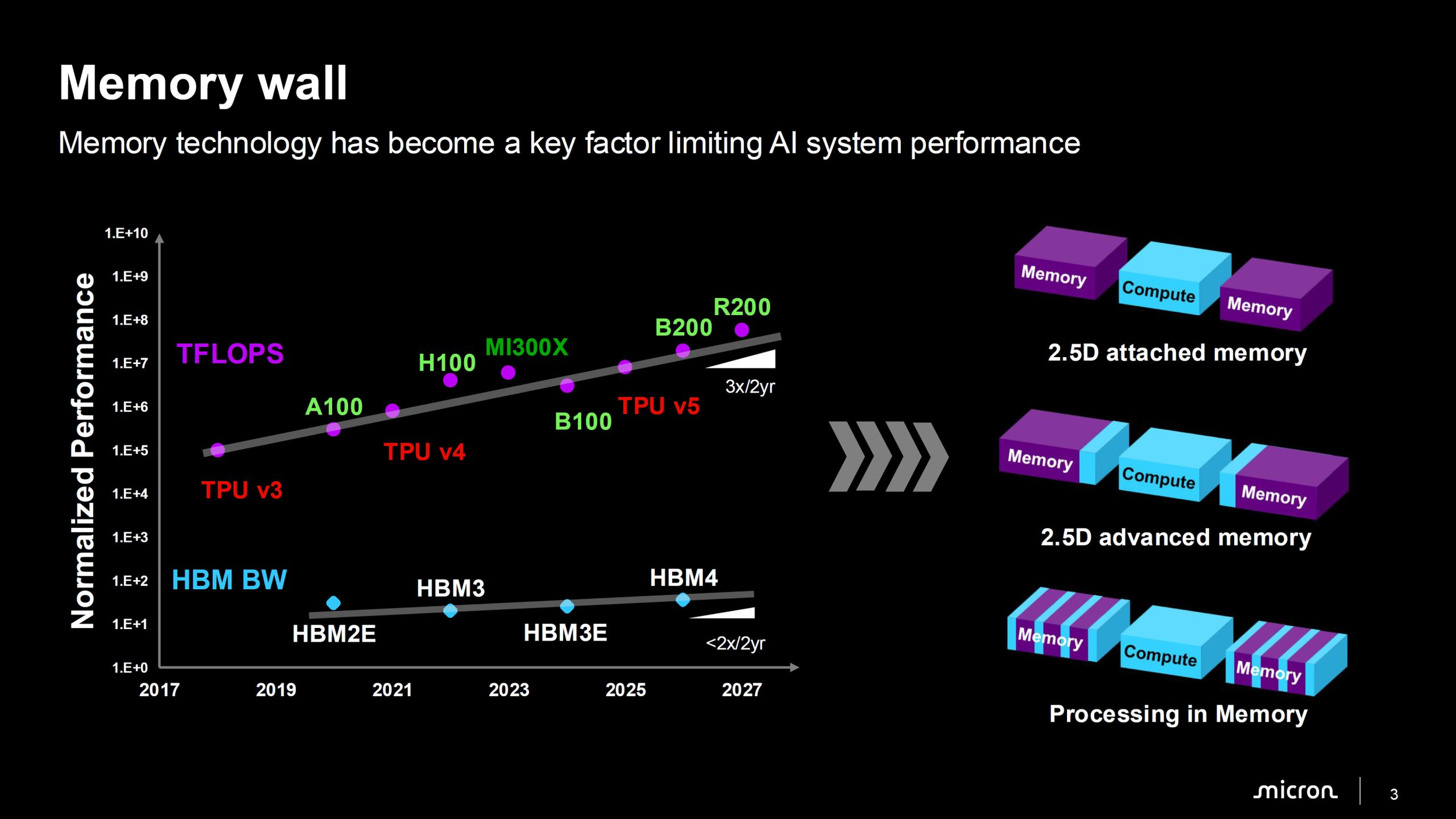
Micron is warning that the AI industry is running directly into a worsening memory wall as processor performance advances considerably faster than the memory systems required to keep those processors supplied with data. Research highlighted around the issue shows that peak server compute performance has historically increased by roughly 3x every 2 years, while DRAM bandwidth has improved by only around 1.6x and interconnect bandwidth by approximately 1.4x during the same period. The result is an expanding gap where increasingly powerful GPUs and AI accelerators can spend substantial amounts of time waiting for data rather than performing calculations.
Micron Executive Vice President and Chief Business Officer Sumit Sadana recently emphasized how serious this bottleneck has become, saying some processors can remain idle for roughly 50% of their operating time because data is not arriving from DRAM quickly enough. As AI moves toward reasoning, agentic workloads and much longer context windows, both memory capacity and bandwidth are becoming fundamental system performance constraints rather than secondary specifications. Micron says agentic AI can require between 5x and 30x more tokens than a comparable chat interaction, further increasing the amount of data that must continuously move through the memory hierarchy.
"The processor is sitting idle for 50% of the time because it is waiting for data from the DRAM."
— Quote by: Sumit Sadana, Micron.
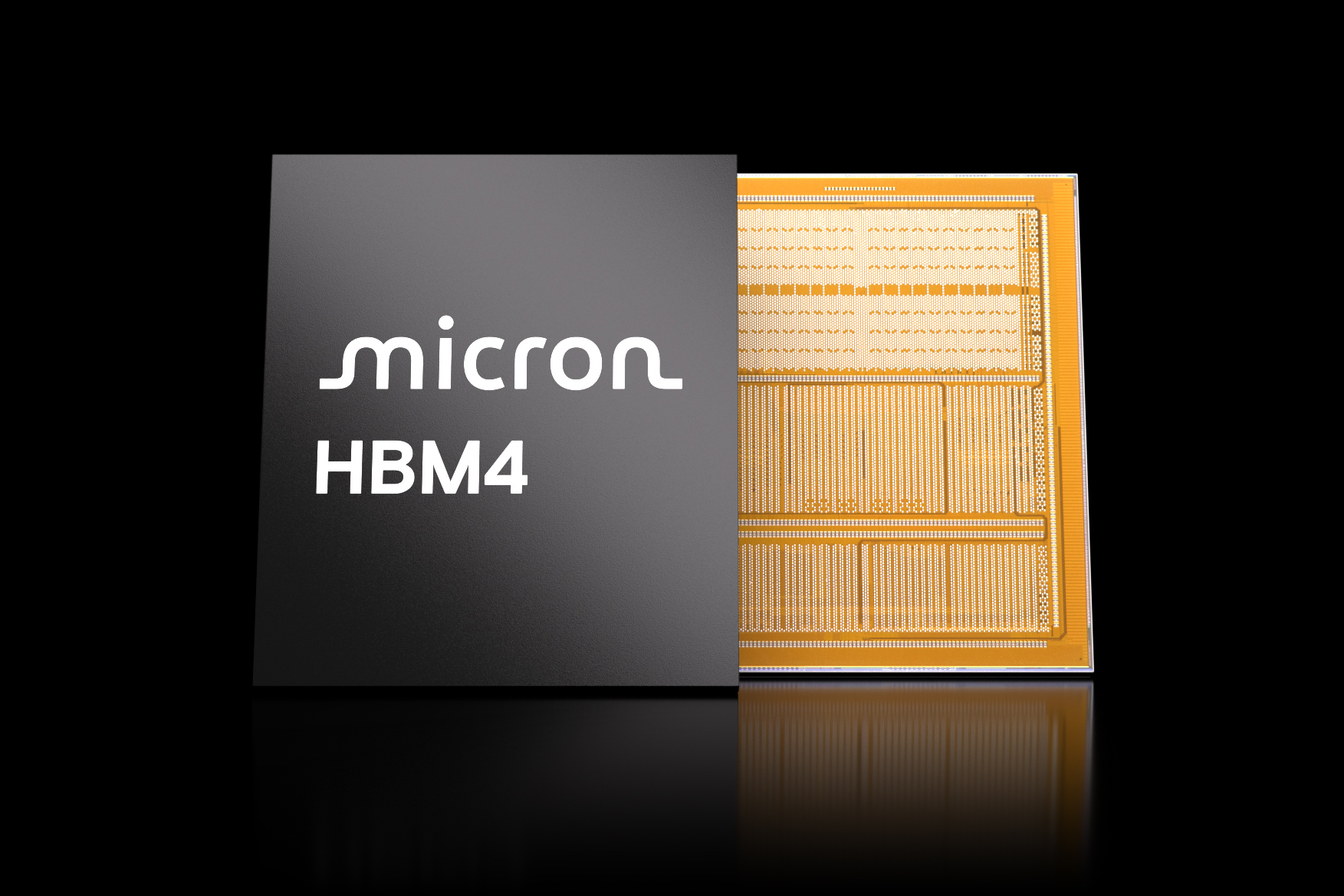
High Bandwidth Memory is one of the industry's primary answers to this problem, but even HBM must evolve rapidly to prevent compute performance from pulling further ahead. Micron HBM4 delivers more than 2.8 TB/s of bandwidth per stack through a 2,048 bit interface operating above 11 Gbps per pin. That represents approximately 2.3x the bandwidth of Micron HBM3E while improving power efficiency by more than 20%. Micron began high volume HBM4 shipments during Q1 2026 for NVIDIA Vera Rubin and has also sampled 48 GB 16 high HBM4 products as customers demand increasingly larger memory pools.
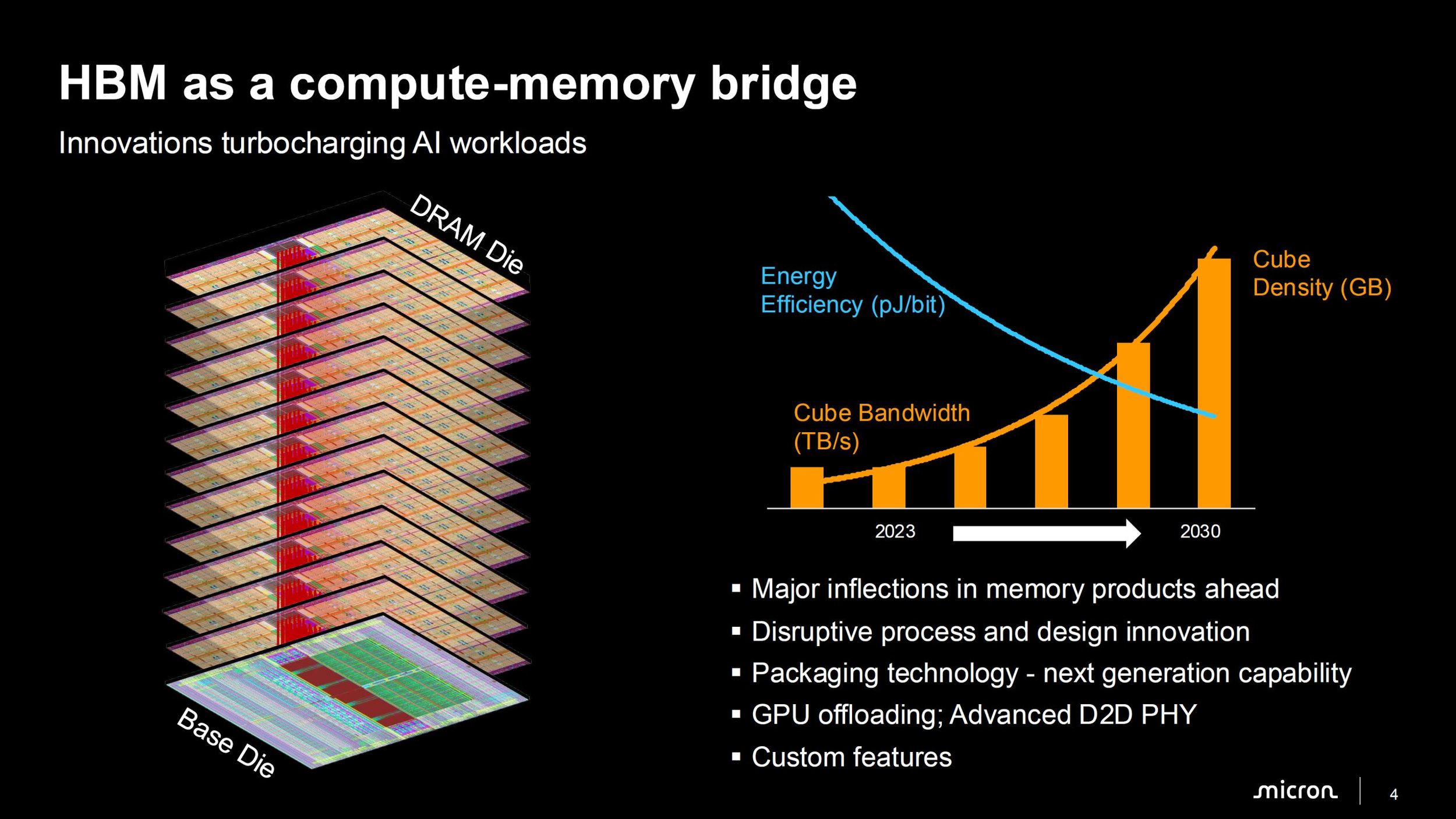
HBM4E will push this strategy further in 2027. Micron plans to manufacture the next generation memory using its 1 gamma DRAM process and will work with TSMC on base logic dies for both standard and customized HBM4E products. Custom logic gives accelerator companies greater flexibility to optimize how memory communicates with their processors, making HBM increasingly integrated into the architecture of the accelerator itself rather than functioning as a standardized component placed beside it. Advanced packaging is also becoming critical as higher stack density, wider interfaces and faster signaling increase power density and thermal challenges.
The problem is not limited to HBM performance. Producing HBM also consumes significantly more DRAM manufacturing capacity than conventional memory. Micron says producing 100 bits of HBM3E effectively requires sacrificing around 300 bits of potential DDR output, creating a roughly 3 to 1 production trade ratio. By HBM4E, the company expects that ratio to move closer to 4 to 1. That means every major expansion in AI accelerator memory can tighten the supply available for traditional server DRAM, desktop DDR5 and other products.
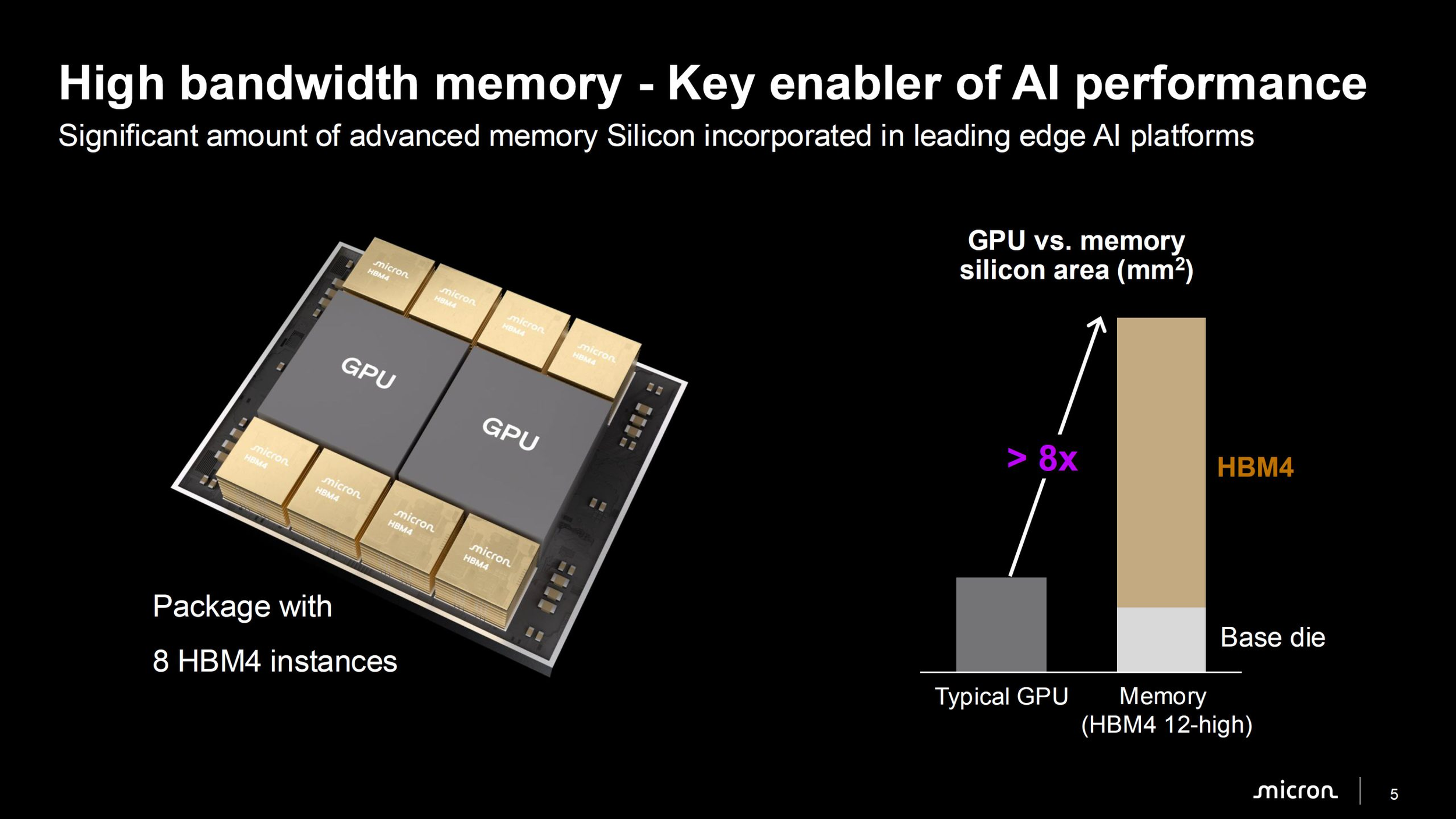
This increasingly connects the memory wall with the wider global memory shortage. NVIDIA Vera Rubin systems can contain enormous quantities of DRAM and HBM4, while NVIDIA and SK hynix have already formed a multi year partnership around next generation AI memory. Memory manufacturers are also seeing customers lock future capacity through long term agreements as AI companies increasingly view access to DRAM as strategic infrastructure rather than a commodity purchased shortly before deployment.
The pressure may continue for years. SK hynix has warned that 2027 could become one of the industry's most severe memory shortage periods, while Micron says customer demand signals continue rising and that 2027 could now be tighter than 2026. New fabs will eventually increase capacity, but constructing, equipping and qualifying advanced memory factories takes years, leaving the industry with a difficult problem where digital AI demand can expand much faster than physical semiconductor production.
The next major AI performance battle may not be decided by who builds the largest GPU. It may be decided by who can keep that GPU fed with data. Adding more compute delivers diminishing value when expensive accelerator silicon spends significant time waiting for memory, which is why HBM4, HBM4E, custom base dies and advanced packaging are becoming central parts of accelerator architecture. The complication is that solving the AI memory wall also consumes more DRAM manufacturing capacity, potentially making conventional DDR5 and server memory even harder to supply. Memory is no longer sitting behind the processor as a supporting component. It is becoming one of the primary limits defining how quickly AI performance can scale.
Could memory bandwidth become more important than raw GPU compute for the next generation of AI accelerators?
