
SK hynix CEO Warns 2027 Could Bring Memory’s Worst Supply Shortage Ever
SK hynix Chief Executive Kwak Noh jung has warned that the global memory industry could experience its worst supply shortage in history during 2027, with customer demand potentially remaining above the company’s production capacity beyond 2030.
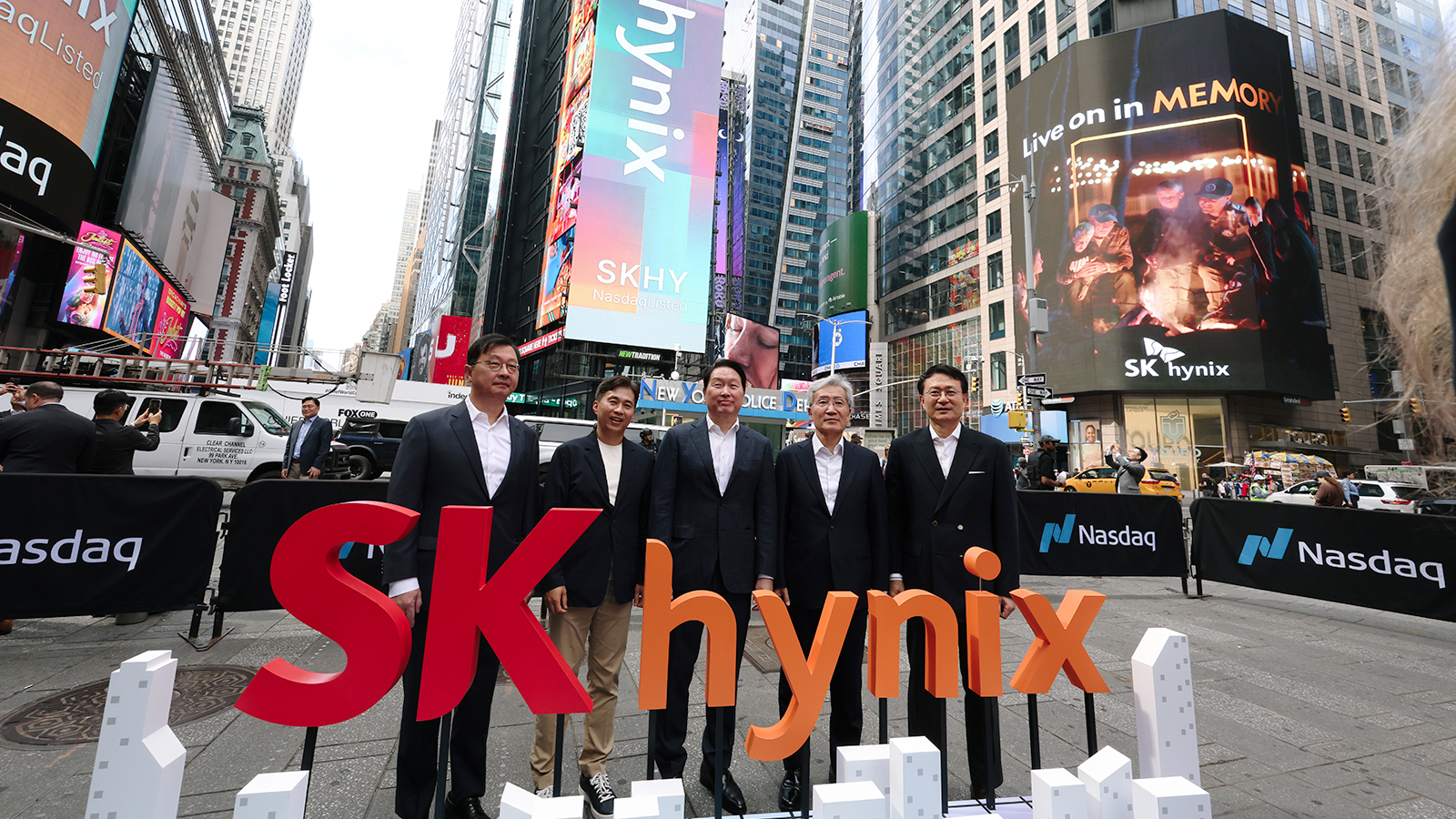
Kwak delivered the warning during an interview with Reuters as SK hynix celebrated the Nasdaq trading debut of its American Depositary Receipts on July 10, 2026. The listing was accompanied by a major promotional campaign across Times Square and represented an important expansion of the South Korean memory manufacturer’s presence in global capital markets.
"We forecast that next year will be the worst year in the industry’s history from the supply perspective.
— Kwak Noh jung, SK hynix Chief Executive"
Kwak said customer demand continues to grow while manufacturing capacity remains limited. Despite aggressive investments in new factories and production infrastructure, SK hynix expects demand to remain higher than its available supply capacity beyond 2030.
"Our customer demand continues to go up, while our capacity has limitations. We still forecast that customer demand will remain higher than our supply capacity even beyond 2030. But we are doing our best to solve the problem.
— Quote by: Kwak Noh jung, SK hynix Chief Executive"
The forecast shows how dramatically artificial intelligence infrastructure is reshaping the global memory market. Data centers require enormous quantities of High Bandwidth Memory, server DRAM, enterprise storage, and increasingly LPDDR memory for next generation accelerator and processor platforms.
SK hynix has become one of the most important suppliers within this ecosystem because of its leadership in HBM. The company provides advanced memory for artificial intelligence accelerators and has formed a multiyear technology partnership with NVIDIA covering HBM4, future HBM generations, LPDDR, NAND Flash, and broader artificial intelligence infrastructure development.
This demand has helped SK hynix achieve record financial performance, but it has also intensified competition for the company’s limited wafer capacity, manufacturing equipment, advanced packaging resources, and engineering talent.
The problem is not limited to HBM. Artificial intelligence servers also require large quantities of conventional DRAM and NAND Flash, while cloud companies are signing multiyear supply agreements to secure memory before new data center projects begin operating.
These agreements give major customers stronger supply visibility but can leave smaller manufacturers, memory module companies, system integrators, and consumer electronics brands competing for the remaining production allocation.
SK hynix has reportedly been adjusting its production strategy to capture demand across both premium and mainstream memory, SK hynix may shift additional attention toward DDR5 as conventional DRAM shortages push margins higher. However, additional DDR5 production does not guarantee immediate relief for consumers because server, mobile, and enterprise customers may receive priority.
The current shortage is also affecting more than desktop memory kits. Higher DRAM and NAND costs are increasing production expenses across PCs, smartphones, gaming consoles, graphics cards, workstations, servers, and solid state drives.
The budget smartphone market has become particularly vulnerable because memory can represent a substantial percentage of the total manufacturing cost of lower priced devices. Omdia data reported by Tom’s Hardware indicates that DRAM and NAND can account for as much as 64% of the component cost in certain entry level smartphones, forcing manufacturers to raise prices, reduce specifications, or retreat from lower price categories.
PC builders are facing a similar challenge. Memory brands must compete for DRAM components while also managing higher costs for power management integrated circuits, printed circuit boards, controllers, logistics, and validation. Manufacturers with smaller supply allocations may be forced to purchase components through more expensive channels to continue filling customer orders.
Samsung, SK hynix, and Micron are facing a United States antitrust lawsuit accusing them of restricting conventional DRAM supply while prioritizing more profitable memory categories. The allegations remain unproven, and tight supply can also be explained by genuine artificial intelligence demand, limited manufacturing capacity, and the long construction timelines required for semiconductor factories.
Building a new memory factory is not a rapid solution. Manufacturers must secure land, utilities, clean room infrastructure, production equipment, process technology, qualified personnel, and customer validation before the facility can contribute commercially meaningful output.
SK hynix is participating in a broader South Korean semiconductor investment program alongside Samsung Electronics, while also evaluating potential future production locations in the United States, Japan, and Southeast Asia. Kwak said access to land, infrastructure, water, electricity, and skilled workers would influence any future location decisions.
These investments are essential, but they may not arrive quickly enough to prevent the projected 2027 shortage. New capacity can also generate different types of memory depending on market priorities, meaning a large investment does not automatically translate into more DDR5 modules or affordable consumer products.
HBM production is particularly demanding because it requires multiple DRAM dies to be manufactured, stacked, interconnected, tested, and packaged. Increasing HBM output can therefore consume more resources than producing conventional memory, while advanced artificial intelligence processors may require several HBM stacks per accelerator.
At the same time, the industry cannot simply abandon HBM in favor of consumer DRAM. NVIDIA, AMD, cloud providers, and artificial intelligence companies are planning increasingly powerful accelerator platforms that require more memory capacity and bandwidth with every generation.
This creates a difficult allocation decision. Memory manufacturers can prioritize the highest value products and long term contracts, but doing so may tighten the supply of mainstream DRAM, mobile memory, and NAND Flash. Increasing commodity production could improve availability, but it may reduce the capacity available for strategically important artificial intelligence customers.
Chinese memory manufacturers could gain additional opportunities from this imbalance. CXMT continues expanding its DRAM capabilities, while YMTC is increasing its position in NAND Flash. As Samsung, SK hynix, and Micron direct significant resources toward HBM and high value enterprise products, Chinese suppliers may capture more domestic and international demand for conventional memory.
China’s DRAM expansion could help moderate DDR5 prices from 2027 onward. However, production volume alone will not guarantee immediate competition. New suppliers must maintain stable yields, product consistency, platform compatibility, validation support, and long term reliability before major manufacturers adopt their components at scale.
SK hynix’s warning also extends the expected duration of the shortage beyond several earlier market forecasts. Silicon Motion Chief Executive Chia Chang Gou previously warned that DRAM and NAND shortages could continue into 2028 because artificial intelligence inference is increasing demand for both working memory and storage.
Kwak’s forecast suggests the memory industry is no longer facing a conventional cyclical shortage that will be resolved after several quarters. Instead, it may be entering a structural period where artificial intelligence demand expands faster than manufacturers can add capacity.
That environment could keep memory prices elevated while giving Samsung, SK hynix, and Micron strong profitability. However, it also creates significant risks for downstream companies that cannot secure enough DRAM or NAND to manufacture products at competitive prices.
The warning came as SK hynix celebrated a significant corporate milestone. The company highlighted how it overcame severe financial difficulties approximately 25 years ago, joined SK Group in 2012, and became an early leader in HBM development before the technology became central to modern artificial intelligence infrastructure.
Today, SK hynix supplies HBM, DRAM, and NAND technologies used across artificial intelligence servers, mobile devices, computers, and enterprise storage. Its transformation into a critical artificial intelligence supplier has strengthened the company financially, but Kwak’s comments show that commercial success has created a new operational challenge: customers are requesting memory faster than the company can build the capacity required to supply it.
SK hynix’s warning should be taken seriously, but it does not mean every memory product will remain equally unavailable through 2030. Supply conditions will vary across HBM, DDR5, DDR4, LPDDR, enterprise NAND, and consumer storage depending on production decisions, contract commitments, and demand from individual markets.
The most important part of Kwak’s statement is that the company expects demand to exceed its own capacity beyond 2030. That is a much stronger warning than saying prices will remain elevated for several quarters. It suggests SK hynix believes artificial intelligence infrastructure will continue absorbing memory faster than new factories can supply it.
For consumers, 2027 could become particularly difficult if manufacturers continue prioritizing HBM, server DRAM, high capacity modules, and mobile memory for major contract customers. Additional wafer capacity may be produced, but ordinary desktop kits, gaming laptops, entry level smartphones, and affordable solid state drives may remain lower priorities.
There is also a possibility that demand forecasts prove too aggressive. Semiconductor industries have experienced major periods of overinvestment before, and factories being built for an expected shortage can eventually produce excess capacity if artificial intelligence spending slows. Concerns about possible oversupply beginning around 2027 or 2028 contributed to market volatility following SK hynix’s Nasdaq debut, showing that investors do not universally accept a permanent shortage scenario.
For now, the market is moving in the opposite direction. Large technology companies are securing supply years in advance, memory manufacturers are expanding slowly, and artificial intelligence platforms require increasingly larger amounts of HBM, DRAM, and NAND.
The result is a memory market where the largest customers gain priority, manufacturers generate record profits, and consumers carry a growing portion of the cost. Unless new capacity arrives faster than expected or artificial intelligence investment slows materially, 2027 may become the most challenging year yet for memory availability and pricing.
Do you think memory shortages will remain severe beyond 2030, or will aggressive factory expansion eventually create another period of oversupply?
