
Samsung, SK hynix and Micron Face New US Lawsuit Over Alleged DRAM Supply Restrictions
Samsung Electronics, SK hynix, and Micron Technology are facing a proposed class action lawsuit in the United States that accuses the 3 memory manufacturers of coordinating DRAM supply restrictions to increase prices during the current global memory shortage. The complaint arrives as artificial intelligence infrastructure demand continues absorbing manufacturing capacity, leaving PC builders, system integrators, electronics companies, and consumers facing rapidly rising memory costs.
The 118 page complaint was filed on June 25, 2026, in the United States District Court for the Northern District of California under case number 5:26 cv 06345. The defendants include Samsung Electronics, Samsung Semiconductor, SK hynix, SK hynix America, and Micron Technology. The case is currently assigned to District Judge Noel Wise, with an initial case management conference scheduled for September 29, 2026.
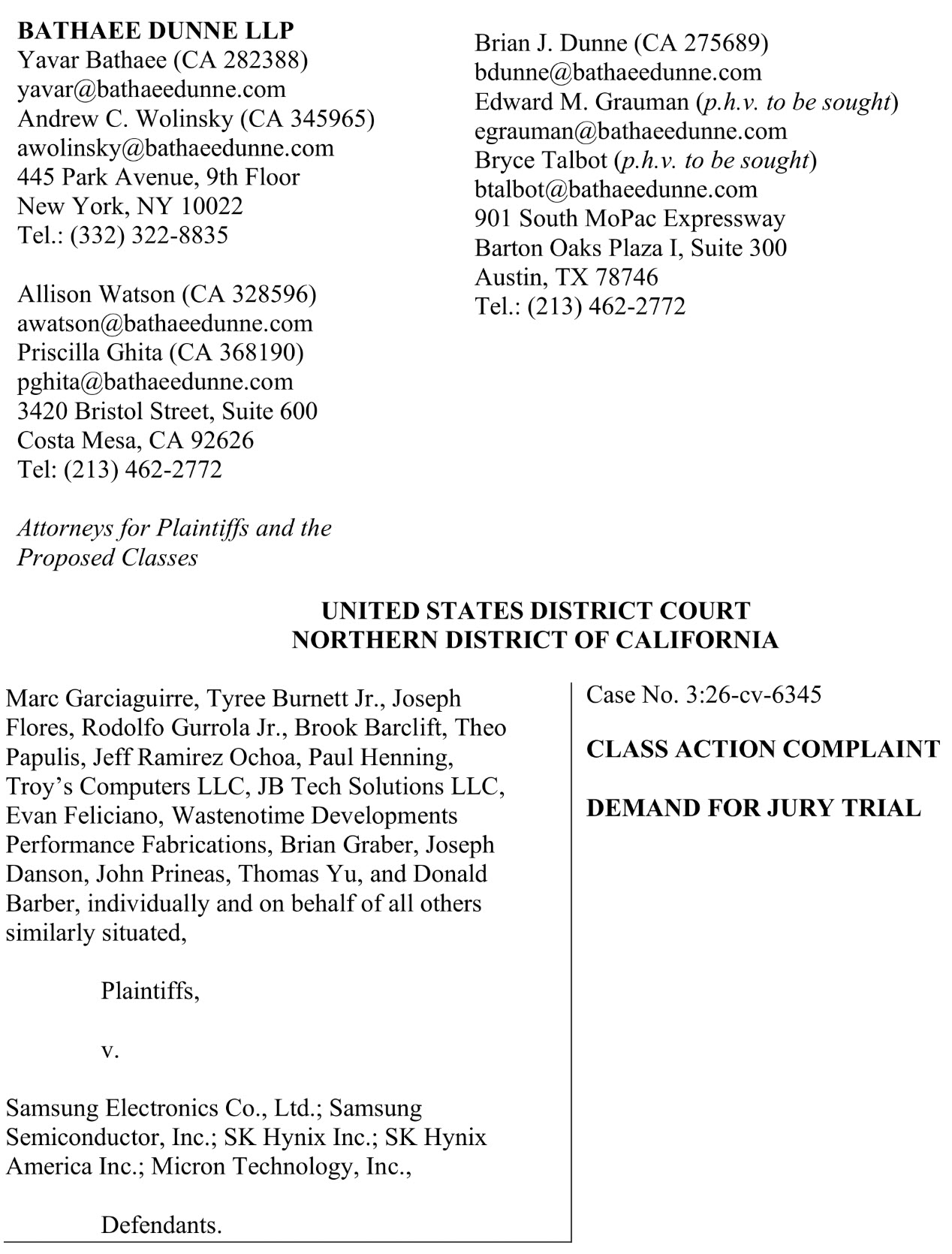
The plaintiffs include 14 individual buyers and 3 businesses, including Troy’s Computers, My Florida PC, and WNTD Fab. They are seeking class status and financial compensation for customers they claim paid artificially inflated prices for DRAM and products containing memory. The lawsuit alleges violations of United States antitrust law, but the complaint remains at an early stage and none of its claims have been proven in court.
According to the complaint, Samsung, SK hynix, and Micron restricted the growth of conventional DRAM supply while directing greater production capacity toward more profitable products such as High Bandwidth Memory and server memory. The plaintiffs argue that these decisions allowed the companies to benefit from shortages and maintain higher prices across consumer and enterprise markets.
Current market data confirms that supply is extremely tight, but it does not independently prove coordination between the manufacturers. TrendForce expects conventional DRAM contract prices to increase between 58% and 63% during Q2 2026 as suppliers prioritize server applications and HBM. It also reports that PC manufacturers and memory module companies with limited supply allocations are being forced to purchase components at higher prices.
Demand from AI infrastructure is placing genuine pressure on global production. High capacity server modules and HBM consume substantial wafer capacity, while hyperscalers are signing multiyear agreements to secure supply in advance. New fabrication facilities and production lines require years of construction, equipment installation, qualification, yield improvement, and customer validation before they can provide meaningful volume.
This distinction will be central to the case. The plaintiffs must provide evidence that the manufacturers reached an unlawful agreement rather than independently responding to the same demand, profitability, and production conditions. Similar business decisions among companies operating inside a concentrated market do not automatically establish an antitrust conspiracy.
Samsung, SK hynix, and Micron previously defeated another DRAM antitrust case involving allegations that they coordinated production reductions beginning in 2016. In 2022, the United States Court of Appeals for the Ninth Circuit upheld the dismissal of that lawsuit, ruling that the plaintiffs had demonstrated parallel conduct but had not provided enough additional facts to make a conspiracy more plausible than independent business decisions.
The companies also have a genuine history of DRAM price fixing enforcement, although it involved a different period and cannot be treated as evidence that the new allegations are true. In 2005, Samsung agreed to plead guilty and pay a 300 million USD criminal fine for participating in a conspiracy affecting DRAM sold between 1999 and 2002. Hynix paid a 185 million USD fine, while Infineon and Elpida also entered guilty pleas in the wider Department of Justice investigation.
The current shortage is already affecting far more than gaming PCs. Rising memory and storage costs have contributed to higher prices for computers, consoles, smartphones, workstations, and data center systems. China’s growing DRAM production could help ease DDR5 pricing during 2027, although stable yields and validated production capacity will be required before that expansion can significantly rebalance the market.
Intel CEO Lip Bu Tan considers memory the largest immediate AI supply chain shortage. His warning supports the argument that the shortage has a real industrial cause, but it does not prevent a court from examining whether suppliers independently or collectively made decisions that unnecessarily intensified the pressure.
Samsung, SK hynix, and Micron have not publicly responded to the new complaint at the time of publication. The case will likely depend on whether the plaintiffs can uncover communications, agreements, or other evidence showing coordination beyond the companies following similar strategies in response to the AI memory boom.
The lawsuit arrives at a moment when consumers have understandable reasons to be frustrated. Memory costs are rising rapidly, conventional products are receiving lower production priority, and the 3 largest manufacturers control most of the global DRAM market. That combination deserves regulatory and legal scrutiny.
However, high prices and similar production strategies are not enough by themselves to prove an illegal agreement. HBM and server DRAM are absorbing capacity because customers are willing to pay significantly more for them, while constructing new supply takes years. The plaintiffs will need evidence that the companies coordinated their actions rather than simply responding to the same powerful market incentives.
The most important result may be greater transparency. Whether the lawsuit succeeds or fails, consumers and smaller manufacturers deserve a clearer explanation of how capacity is allocated, how long the shortage may continue, and whether strategic supply agreements are permanently pushing conventional memory behind the needs of the largest AI customers.
Do you believe the current DRAM shortage is primarily the result of legitimate AI demand, or should regulators investigate whether the largest manufacturers are restricting consumer supply too aggressively?
