
Jim Keller Targets Major Intel or Qualcomm Deal as Tenstorrent Challenges Cerebras

Tenstorrent chief executive officer Jim Keller says the company is pursuing a major technology agreement with Intel or Qualcomm while preparing its Blackhole Galaxy systems to challenge NVIDIA, Cerebras, and other established AI infrastructure providers. Keller confirmed that he has met with the chief executives of both semiconductor companies, although he declined to comment directly on reports that Tenstorrent could become an acquisition target.
Speaking with EE Times, Keller said the discussions have focused on Tenstorrent’s RISC V processor technology and wider hardware intellectual property. He also revealed that a major hyperscaler is evaluating the company’s AI technology for a smaller chip, showing that Tenstorrent is attempting to expand beyond complete server sales through licensing and custom silicon partnerships.
"I’m hoping to get a big deal out of one of those guys."
— Jim Keller
The statement should not be interpreted as confirmation that an Intel or Qualcomm agreement has been completed. Keller confirmed meetings and his desire to secure a significant deal, but did not identify which company is closest to an agreement or whether the discussions involve licensing, joint development, distribution, investment, or a complete acquisition. A Reuters report previously said Qualcomm was discussing a possible Tenstorrent purchase valued between 8 billion and 10 billion dollars, although neither company confirmed those negotiations.
Keller also responded aggressively to the recent Cerebras initial public offering, describing the public listing and resulting valuation as helpful for Tenstorrent. Cerebras raised approximately 6.4 billion dollars in gross proceeds after completing the largest semiconductor initial public offering on record, giving the company substantial capital to expand its inference infrastructure and cloud services.
"We’re going to beat them on everything. Challenge accepted!"
— Jim Keller
His comments followed Cerebras publishing strong performance for the Kimi K2.6 model, a 1 trillion parameter open weight system. Cerebras reported that Artificial Analysis measured its CS 3 infrastructure at 981 output tokens per second, making it the fastest result measured by the organization for a model of that size.
Keller believes large deployments of Tenstorrent Galaxy Blackhole servers can exceed that result at a fraction of the hardware cost. However, Tenstorrent has not yet released a direct Kimi K2.6 comparison using the same model, precision, workload, user count, and service conditions. Until such testing is available, the promise remains a competitive claim rather than an independently verified victory over Cerebras.
Tenstorrent has already demonstrated up to 350 tokens per second per user on DeepSeek R1 671B using 16 Galaxy servers containing 512 Blackhole chips. The workload is different from Cerebras’ Kimi K2.6 result, so comparing the headline numbers alone would not provide an accurate measure of which platform is faster or more economical.
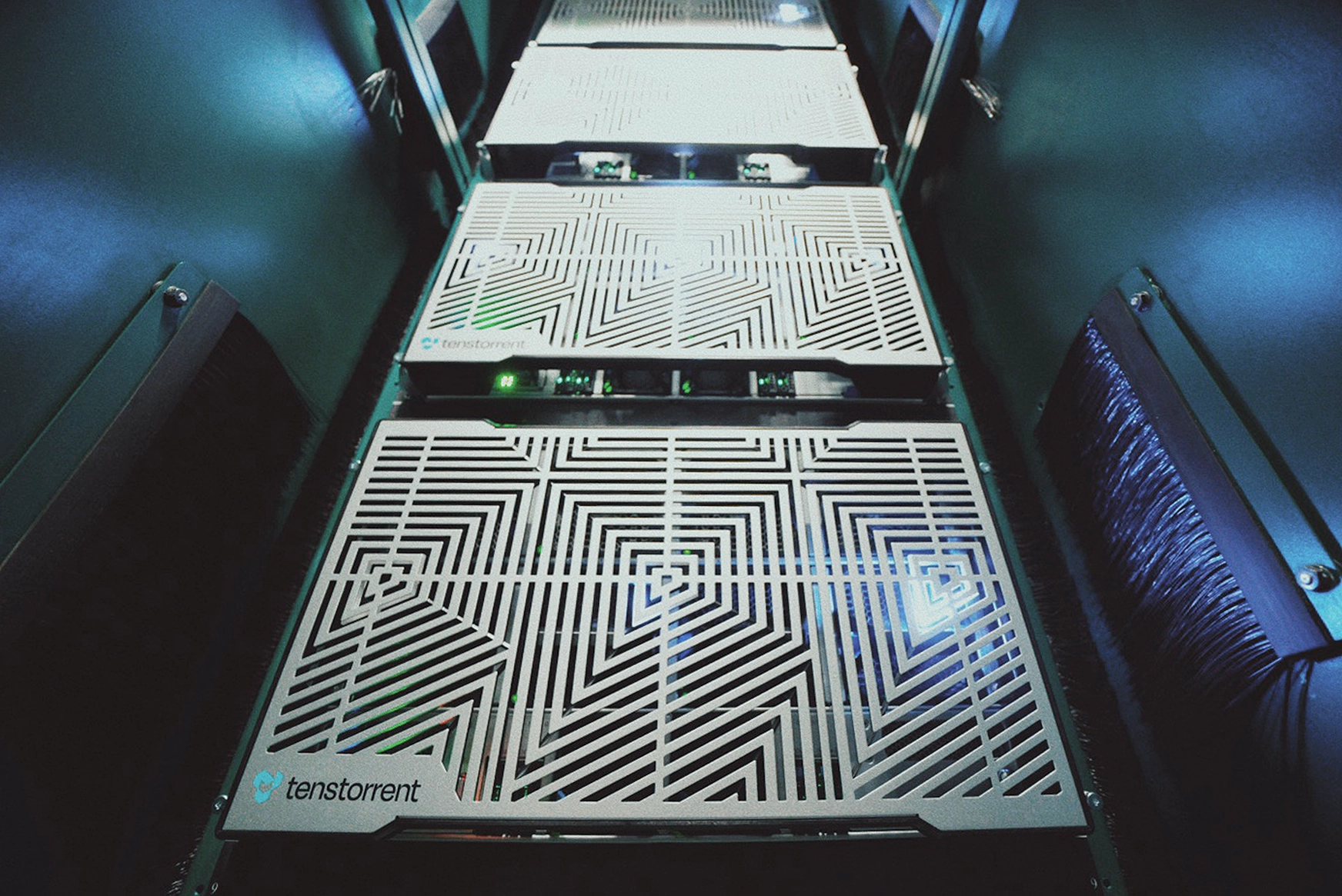
The official Tenstorrent Galaxy Blackhole system starts at 110,000$ and contains 32 Blackhole processors, 1 TB of GDDR6 memory with 16 TB per second of bandwidth, 6.2 GB of local SRAM, and up to 56 ports supporting 800G Ethernet connections. Tenstorrent’s strategy is based on connecting large numbers of relatively affordable processors through standard Ethernet while keeping compute, memory, and networking inside one scalable architecture.
Keller argues that this design gives Tenstorrent an advantage when handling the key value cache required during large language model inference. Blackhole processors can keep data close to the compute hardware through local SRAM and DRAM, then stream additional information when the model cannot fit entirely inside the faster local memory. Keller contrasted this with architectures that depend more heavily on specialized systems or additional hardware for extremely fast decode.
Commercial orders are beginning to test whether that architectural promise translates into market demand. Keller said Tenstorrent received an order for a 96 Galaxy cluster containing 3,072 Blackhole chips from a customer outside the United States. The company is currently producing 1,000 Galaxy servers, with at least half already sold, while approximately 10 customers have systems installed and have moved beyond the proof of concept stage.
Keller also claimed that some customers facing long NVIDIA delivery times have replaced planned 100 million dollar purchases with approximately 20 million dollars of Tenstorrent equipment. This does not necessarily mean both configurations offer identical performance, software compatibility, or capacity, but it demonstrates the price and availability argument Tenstorrent is using to attract customers unable or unwilling to depend entirely on NVIDIA.
Tenstorrent’s near real time AI video generation demonstration, where 4 Blackhole Galaxy servers generated a 5 second 720p video in 2.4 seconds using an optimized model. The result showed that the architecture could compete across workloads beyond language generation, although broader independent testing remains necessary.
Tenstorrent is also preparing for a possible public offering of its own. Keller said investors are enthusiastic about the idea, while the company expands its supply chain, international operations, and customer deployments. No filing, valuation, or schedule has been announced, and Keller suggested that a strategic agreement or joint market approach may be more likely than selling the company outright.
Jim Keller’s confidence is unsurprising, but the next step must be evidence. Beating Cerebras on a different model or comparing Tenstorrent pricing with an unspecified NVIDIA order does not provide the controlled data required to establish a clear winner.
Tenstorrent still has a compelling position. Its combination of RISC V processor intellectual property, open software, local memory, standard Ethernet scaling, and lower entry pricing gives Intel, Qualcomm, hyperscalers, and sovereign AI customers several reasons to consider a partnership.
A major agreement would not necessarily mean an acquisition. Licensing Tenstorrent’s RISC V cores or AI technology could be more valuable to the company over the long term because it would preserve independence while placing its designs inside a much larger number of products.
The Galaxy order numbers also suggest that Tenstorrent is moving beyond technical demonstrations. The company now needs to prove software maturity, reliable deployment, and competitive economics across the same models and service conditions used by NVIDIA and Cerebras. Bold statements create attention, but repeatable customer results will decide whether Tenstorrent becomes a true platform competitor.
Would Tenstorrent benefit more from remaining independent and licensing its technology, or should Intel or Qualcomm attempt a complete acquisition?
