
TSMC Could Double CoWoS Capacity by 2028 as AI Packaging Demand Spills to Rivals

TSMC could double its CoWoS advanced packaging capacity to approximately 260,000 12 inch wafer equivalents per month by the end of 2028 as demand for NVIDIA, AMD and custom AI accelerators continues to overwhelm available packaging supply.
Industry estimates cited by Taiwanese media suggest TSMC is on track to reach more than 130,000 CoWoS wafers per month by the end of 2026 before continuing an aggressive expansion through 2027 and 2028. A previous DIGITIMES supply chain report placed the official 2027 expansion target at around 200,000 wafers per month, while equipment suppliers believed actual capacity could potentially reach between 240,000 and 260,000 by the end of 2027 if demand continues accelerating.
The expansion is being driven by one of the largest bottlenecks in the AI hardware supply chain. CoWoS allows large GPU and accelerator dies to operate alongside multiple HBM stacks through extremely dense interconnects, making advanced packaging essential for modern AI processors. TSMC officially describes CoWoS as a core platform for combining multiple SoCs with high bandwidth memory, with demand increasing sharply following the generative AI expansion that began in 2022. TSMC continues increasing both package size and manufacturing capacity to support that demand.
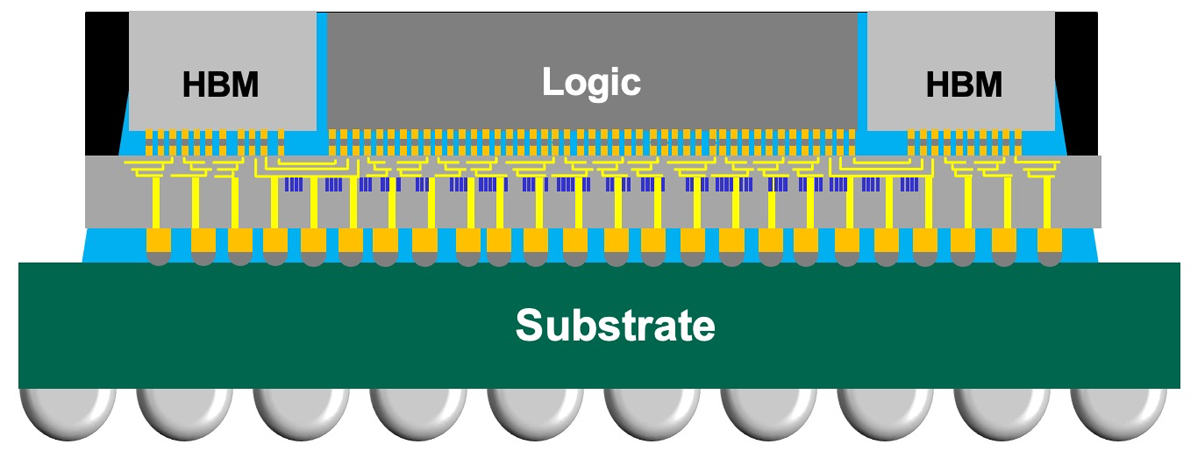
TSMC has already pushed its 5.5 reticle CoWoS generation into production, with recent manufacturing results showing yields above 98%. The roadmap becomes considerably more ambitious in 2028, when TSMC plans to introduce a 14 reticle CoWoS package capable of integrating approximately 10 large compute dies and 20 HBM stacks. Versions exceeding 14 reticles are planned for 2029.
Even that rapid expansion may not completely satisfy demand. NVIDIA, AMD, Broadcom and major cloud providers are simultaneously increasing orders for GPU and custom XPU products. Recent supply chain estimates suggest AMD alone could dramatically increase its CoWoS requirements during 2027, putting additional pressure on capacity already heavily consumed by NVIDIA.
That shortage is creating opportunities outside TSMC. Intel is expanding its EMIB T advanced packaging technology, with analyst estimates suggesting capacity equivalent to approximately 15,000 to 20,000 12 inch CoWoS wafers per month in 2027 and 40,000 to 45,000 by 2028. Other providers including ASE and Amkor are also expanding advanced packaging production as customers increasingly look for alternatives when TSMC capacity cannot accommodate every program.
The spillover is already becoming visible in the wider supply chain. Intel may be gaining AI packaging business as TSMC demand spills into Malaysia, highlighting how packaging availability rather than leading edge wafer production alone is becoming one of the deciding factors behind AI accelerator shipments.
TSMC is also preparing to expand advanced packaging outside Taiwan. The company confirmed that its enlarged Arizona investment includes advanced packaging facilities alongside additional leading edge logic fabs, while simultaneously building 13 leading edge and advanced packaging facilities across Taiwan over the coming years.
AI chip production is no longer limited simply by how many advanced GPU dies TSMC can manufacture. Packaging those dies together with increasingly large quantities of HBM has become an equally important constraint.
Doubling CoWoS capacity from around 130,000 wafers per month to approximately 260,000 would be an enormous expansion, yet demand from NVIDIA, AMD and custom AI silicon could grow quickly enough to absorb much of it.
That creates an interesting opportunity for Intel, ASE and Amkor. They do not need to replace TSMC as the dominant advanced packaging supplier. They only need AI demand to remain larger than the capacity TSMC can provide.
Will doubling CoWoS capacity be enough to ease the AI chip shortage by 2028, or will demand continue growing faster than TSMC can expand?
