
Intel Could Be Gaining AI Packaging Business as TSMC CoWoS Demand Spills Into Malaysia
Intel may be starting to capture more advanced packaging business as overwhelming AI demand pushes beyond TSMC's available CoWoS capacity. New export data highlighted by Economic Daily shows approximately 1.3 billion dollars worth of HBM being shipped to Malaysia, while the value of HBM shipments heading to Taiwan has fallen below 3 billion dollars. Industry analysis cited by the report points toward Intel's Malaysian advanced packaging operations as a likely destination for at least part of this volume, suggesting customers may increasingly be using Intel capacity when TSMC's own backend facilities cannot absorb every AI order.
The data does not prove that Intel has taken a specific percentage of advanced packaging market share from TSMC, and neither company has announced a corresponding customer transfer. However, the movement of large HBM volumes into Malaysia is significant because assembling modern AI accelerators requires the memory stacks to ultimately be integrated with compute silicon through sophisticated packaging infrastructure. Economic Daily reports that Intel's facilities and its EMIB and Foveros technologies are being linked with this increased Malaysian traffic.
TSMC itself has already acknowledged how difficult the capacity situation has become. During its July 2026 earnings call, Chairman and CEO C.C. Wei said the gap between demand and available capacity remained extremely large while the company continued accelerating new facilities. TSMC increased its 2026 capital expenditure plan to between 60 billion and 64 billion dollars, with approximately 10% to 20% allocated to advanced packaging, testing, mask production, and related infrastructure.
The pressure does not indicate weakness in TSMC's technology. Its latest 5.5 reticle CoWoS platform has already entered volume production, while TSMC recently confirmed yields above 98% for multiple AI customer products, with some reaching 99%. TSMC is also preparing a 14 reticle CoWoS platform for 2028 capable of integrating approximately 10 large compute dies and 20 HBM stacks inside a single package.
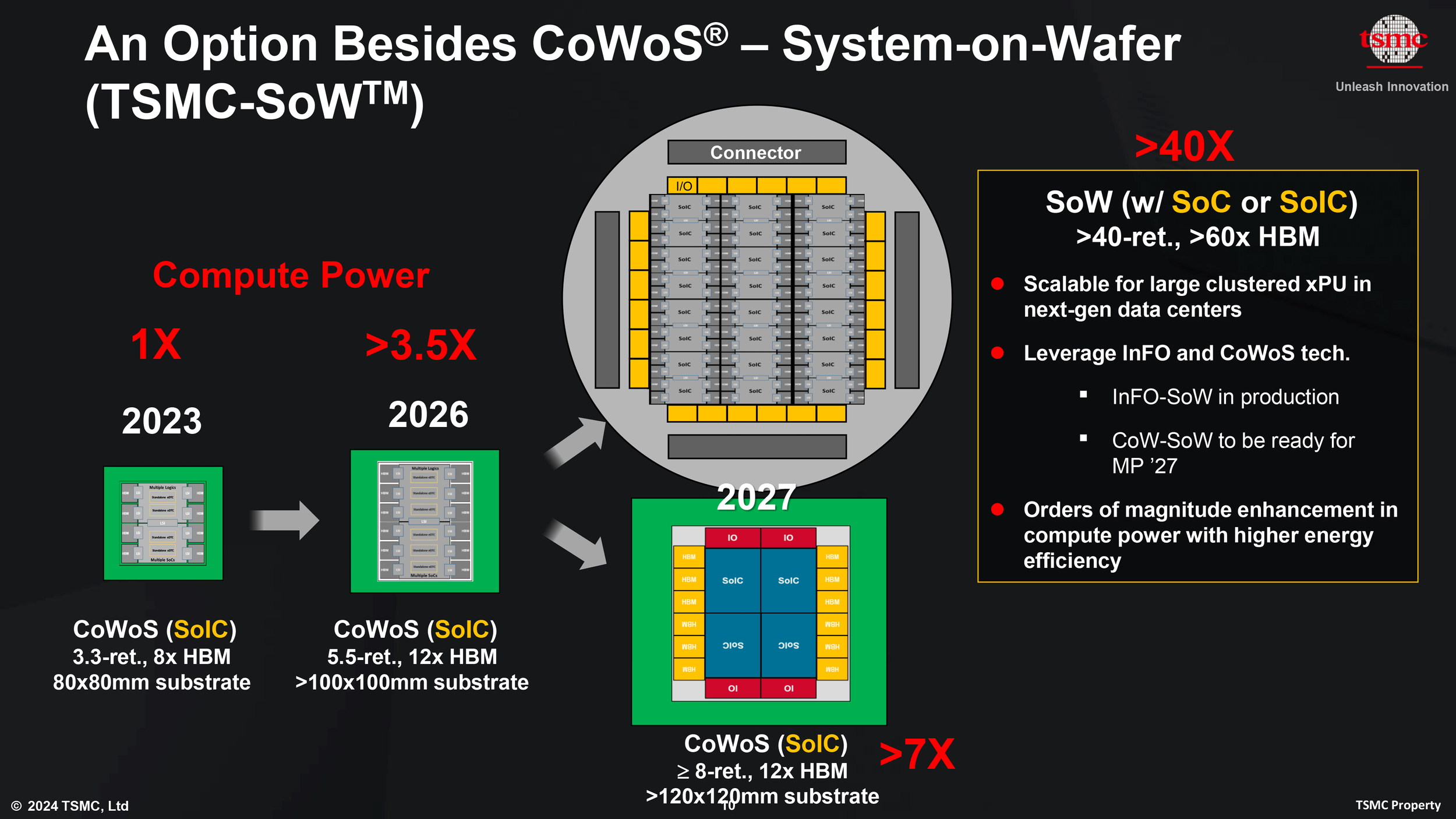
The issue is therefore scale rather than demand disappearing. Foxconn recently warned that the availability of CoWoS capacity could become one of the main factors determining how quickly next generation AI server shipments grow, with market expectations pointing toward another substantial expansion in 2027. NVIDIA, AMD, Broadcom, and custom AI accelerator developers are all demanding increasingly large packages with more compute silicon and more HBM, keeping pressure on a part of semiconductor manufacturing that historically received far less investment than leading edge wafer fabrication.
Intel has been preparing specifically for that opportunity. Its EMIB advanced packaging expansion includes additional equipment and manufacturing capacity across multiple locations as the company attempts to establish packaging as a major external Foundry business. Intel has also expanded its packaging footprint through Malaysia and partnerships with external assembly providers, creating additional capacity that could become increasingly valuable when customers cannot secure enough CoWoS production.
Technically, Intel is approaching the problem differently. Intel Foundry uses small silicon bridges embedded within the package substrate rather than relying exclusively on a large silicon interposer underneath the entire compute complex. Intel argues this allows high density connections to be placed only where required while improving silicon utilization and reducing some of the manufacturing complexity associated with extremely large interposers.
Its latest EMIB T technology adds through silicon vias for improved power delivery and is already capable of die complexes around 6 times the reticle size. Intel says this will expand beyond 8 reticles during 2026 and exceed 12 reticles by 2028, with future packages supporting at least 16 HBM4 or HBM5 stacks and 30 or more EMIB T bridges. That gives Intel a legitimate technical roadmap for the extremely large accelerator packages expected during the next phase of AI infrastructure growth.
TSMC and Intel therefore do not necessarily need to compete for every stage of the same processor. Economic Daily reports that TSMC is open to additional companies helping absorb constrained backend production, while the company can continue manufacturing the leading edge compute dies. In such a model, Intel could gain valuable packaging revenue without immediately taking the frontend wafer manufacturing business away from TSMC.
That distinction is particularly important when interpreting the latest export data. A larger flow of HBM into Malaysia could represent capacity diversification rather than customers abandoning CoWoS. TSMC remains aggressively expanding its own packaging facilities, including future production in Arizona, while Intel is positioning EMIB as another scalable path for customers trying to secure enough advanced packaging capacity during an unprecedented AI infrastructure buildout.
Intel does not need to defeat CoWoS to turn advanced packaging into a meaningful Foundry business. It only needs AI demand to remain larger than the amount of premium packaging capacity TSMC can provide.
That appears to be exactly what is happening. TSMC has excellent yields and an aggressive roadmap, yet customers still need more capacity. Intel already owns proven packaging technologies, manufacturing infrastructure, and a roadmap designed around enormous chiplet systems containing large quantities of HBM.
The 1.3 billion dollars in HBM flowing toward Malaysia is therefore an important signal, but it should not yet be described as proof of a dramatic market share shift. The stronger conclusion is that Intel may finally be benefiting commercially from the packaging investments it has been making for years. If those volumes turn into repeat external customer programs, advanced packaging could become one of Intel Foundry's strongest opportunities to reenter the AI supply chain.
Could Intel's EMIB technology become a serious second source for AI packaging, or will TSMC continue dominating as CoWoS capacity expands?
