
SK hynix and Sandisk Unveil HBF Standard With Up to 3 TB/s Bandwidth
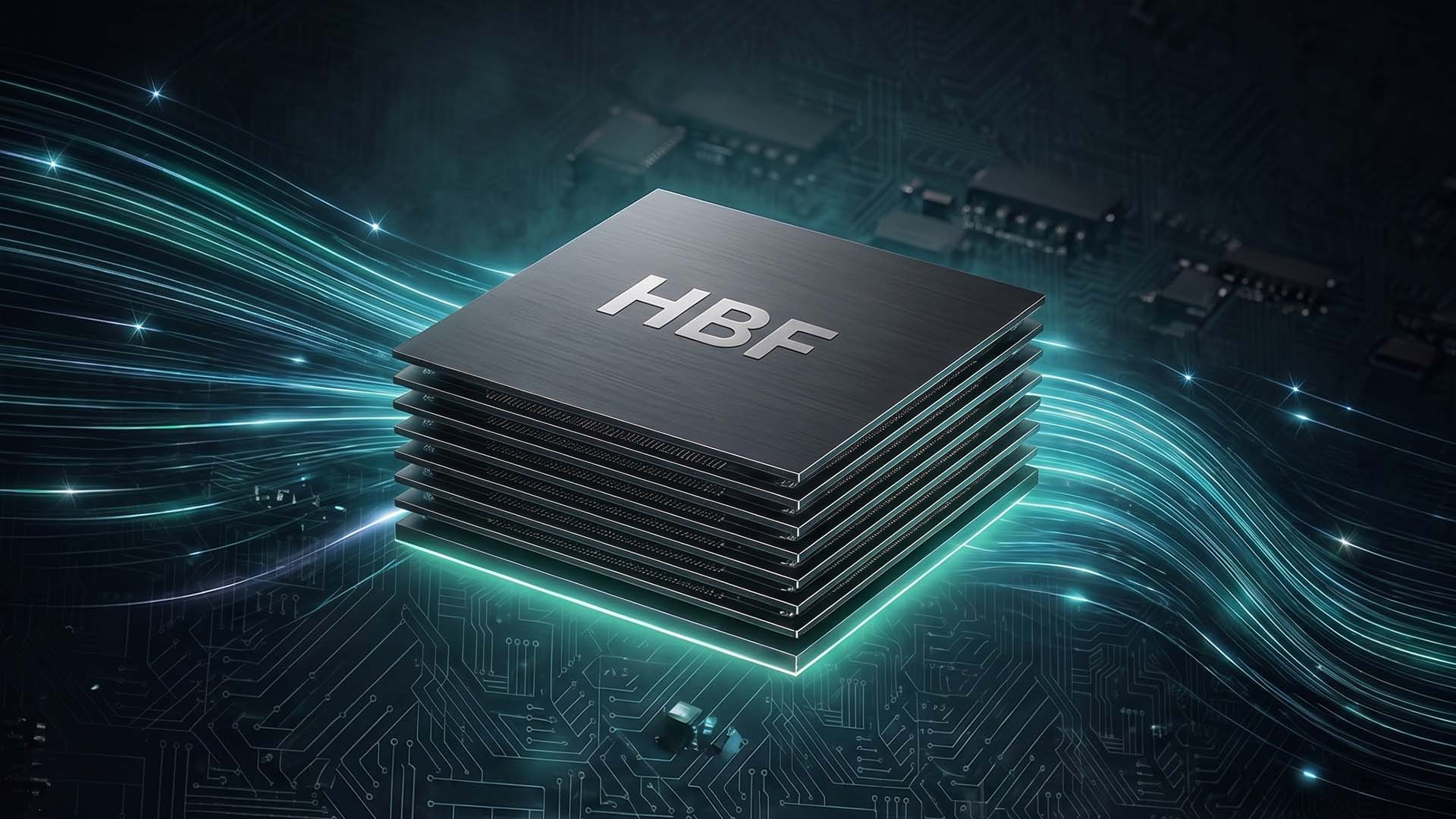
SK hynix and Sandisk have released the first specifications for High Bandwidth Flash, establishing a new open memory standard designed to reduce storage and memory bottlenecks in AI inference systems. HBF combines stacked NAND flash capacity with significantly higher bandwidth than conventional enterprise solid state drives, creating an additional memory layer between HBM and long term storage.
The official SK hynix announcement was published during FMS 2026, held from August 4 to August 6 at the Santa Clara Convention Center in California. The specification was disclosed through the Open Compute Project, allowing semiconductor companies, processor developers and cloud providers to build compatible products rather than relying on a proprietary implementation.
HBF uses vertically stacked NAND dies in configurations containing 8 or 16 layers. The first specification supports capacities of up to 512 GB, while 3 performance grades provide bandwidth ranging from approximately 0.4 TB/s to 3.0 TB/s. UCIe connectivity will allow HBF components to communicate with different CPUs, GPUs and AI accelerators through an established chiplet interface.
The technology is not intended to replace HBM. Instead, HBM would continue handling the most latency sensitive data required immediately by an accelerator, while HBF could store larger model parameters, key value cache data and other information that must remain close to the processor but does not require full HBM performance.
This tiered approach could become increasingly important as AI models grow beyond the practical capacity and cost limits of HBM. A model containing 500 billion parameters could require hundreds of gigabytes of memory depending on its numerical format, making it expensive to keep the complete model inside HBM. HBF could provide a larger and more power efficient intermediate layer before data must be retrieved from an enterprise solid state drive.
Google and Tenstorrent are already participating in the HBF consortium. SK hynix and Sandisk began their standardization partnership in August 2025 and launched the formal consortium in February 2026, reaching the first published specification approximately 6 months later. Commercial demand for the technology is expected to increase closer to 2030 as AI inference infrastructure adopts more complex memory hierarchies.
SK hynix also introduced its tenth generation 375 layer 4D NAND at FMS 2026. The company claims the new NAND delivers 2.5 times greater performance per watt than its previous generation and plans to begin mass producing high performance enterprise solid state drives based on the technology in early 2027.
"Through HBF, SK hynix will expand the boundaries between memory and storage and contribute to building new architectures that enhance overall system efficiency."
— Quote by: Kim Chun sung, SK hynix Executive Vice President and Head of Solution Development.
HBF reflects a broader change in AI hardware design. Improving GPU compute alone is no longer enough when increasingly large models are constrained by memory capacity, bandwidth, power consumption and data movement.
The standard could give accelerator designers a more practical method of keeping large models physically close to the processor without paying the full cost of equivalent HBM capacity. Sandisk is also exploring this direction through an architecture that places AI compute directly above NAND, reinforcing the industry’s movement toward tightly integrated memory, storage and processing packages.
The most important detail is that HBF is being developed as an open standard. Adoption by processor companies, cloud platforms and packaging partners will determine whether it becomes a genuine third layer in AI memory systems or remains a specialized solution used by a limited number of accelerators.
Could HBF become as important to AI inference as HBM has become to AI training?
