
Coherent’s Texas Expansion Powers NVIDIA’s Optical AI Data Center Push
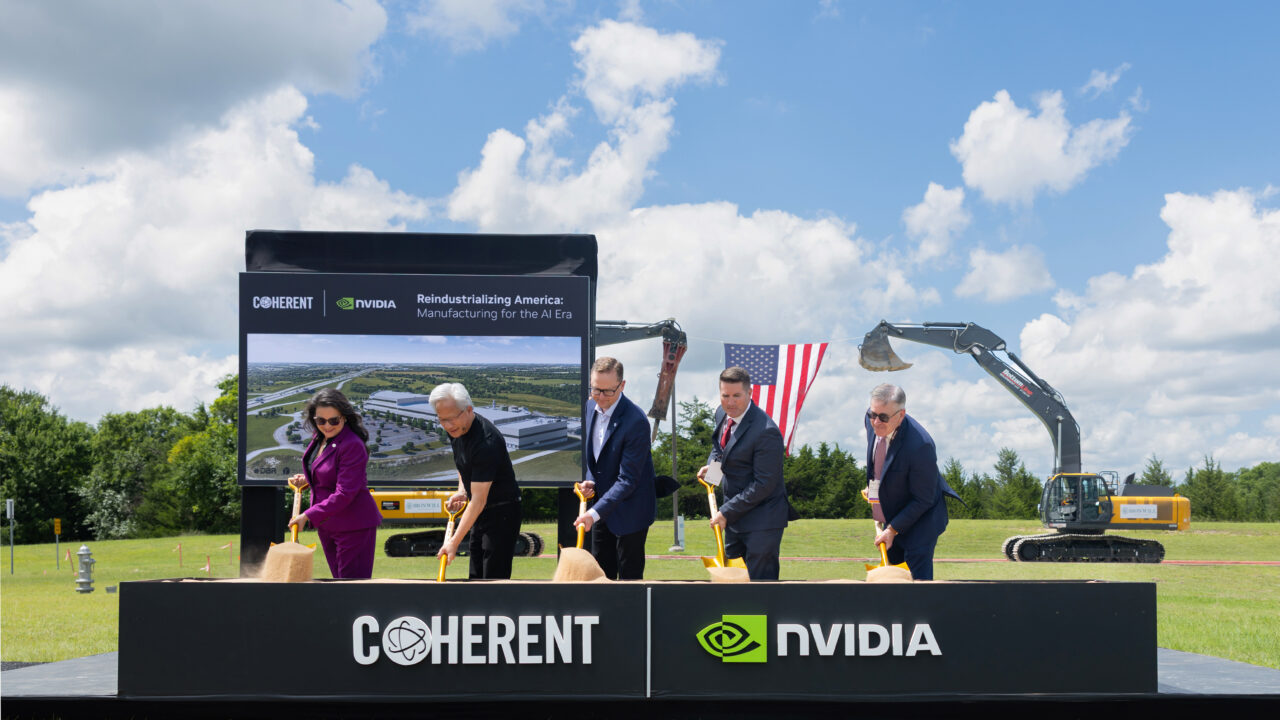
Coherent has broken ground on the expansion of its Sherman, Texas facility, and the move is much bigger than a normal manufacturing update. The project is designed to scale production of 6 inch indium phosphide wafers, lasers, optical components, and compound semiconductor technologies that help connect NVIDIA’s next generation AI systems. NVIDIA detailed the expansion through its official Coherent Texas AI optical blog, positioning Coherent as a key partner in the shift from copper heavy data center networking toward optical fabrics built for massive AI clusters.
The expansion is also backed by public and private support. Coherent announced that it signed a letter of intent for up to 50 million$ in direct funding under the CHIPS and Science Act from the United States Department of Commerce to expand its Sherman indium phosphide manufacturing facility. That proposed funding builds on around 20 million$ in previous support from the Texas Semiconductor Innovation Fund and the Sherman Economic Development Corporation, while NVIDIA’s earlier strategic partnership with Coherent includes a 2 billion$ investment, a multibillion dollar purchase commitment, and future access rights for advanced laser and optical networking products.
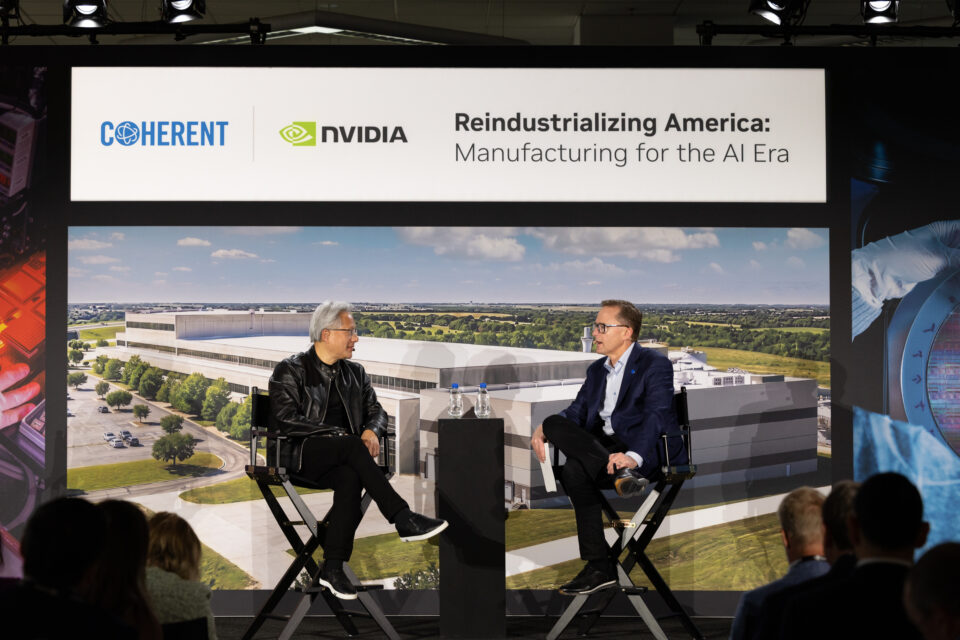
The technical reason this matters is simple: AI data centers are running into the limits of electrical networking. As GPU clusters scale from individual servers to rack scale and multi rack systems, copper links face higher signal loss, higher power draw, and harder thermal management. NVIDIA uses the example of systems with 576 GPUs across 8 racks, similar to the direction of Vera Rubin Ultra NVL576 class infrastructure, where the network must behave like one connected machine instead of a collection of separate servers. Moving data through optical links can reduce the penalty of distance and make large AI factories more power efficient at scale.
Coherent’s Sherman facility focuses on indium phosphide, also known as InP, a compound semiconductor material used to build high performance optical networking devices. These photonic components are critical because they turn electrical data into light and carry that data across the AI system at very high speed. NVIDIA’s official video on Coherent’s Texas expansion reinforces the same point: the AI infrastructure race is not only about GPUs anymore. It is about memory, networking, power delivery, optics, and domestic supply chains working together.
Coherent says the Sherman expansion will double manufacturing production space and quadruple wafer production capacity, with the completed project expected to create more than 1,000 jobs, including more than 550 direct advanced manufacturing, engineering, and technical roles. That gives the project a supply chain importance beyond NVIDIA alone. As demand rises for optical interconnects in AI data centers, telecommunications, and high speed networking, domestic InP capacity becomes a strategic asset for the United States semiconductor ecosystem.
NVIDIA’s co packaged optics roadmap explains why this supply chain is becoming urgent. In a technical breakdown on scaling AI factories with co packaged optics, NVIDIA says its Spectrum X Photonics and Quantum X Photonics platforms integrate optical engines closer to the switch ASIC to reduce electrical loss, cut power use, improve reliability, and support larger AI fabrics. NVIDIA claims these systems can deliver up to 3.5x better power efficiency and 10x higher resiliency compared with previous architectures, with Spectrum X Photonics scaling up to 409.6 Tb/s bandwidth and 512 ports at 800 Gb/s.
This connects directly with the Vera Rubin generation, and the networking layer is becoming just as important as the GPUs themselves. A 576 GPU system cannot reach its full value if data movement becomes the bottleneck. The more NVIDIA scales rack level and data center level platforms, the more optical networking becomes a core part of performance, not a secondary infrastructure detail.
The same pressure is visible across NVIDIA’s broader AI factory strategy, where the key point was that reducing networking power can free more of an AI data center’s energy budget for GPUs. That is the new equation for hyperscale AI: every watt saved in networking, cooling, and power conversion can become more compute capacity for training, inference, and agentic workloads.
The Coherent expansion also sits beside other infrastructure changes, including the move toward higher voltage power systems, showing that the industry is redesigning every layer of the data center stack. Optics solve part of the data movement challenge, while higher voltage power systems target the growing electricity problem. Together, they show how AI hardware is now forcing a complete rebuild of data center architecture.
For Coherent, the Sherman expansion strengthens its position as one of NVIDIA’s most important optical suppliers. For NVIDIA, it secures a deeper domestic manufacturing path for the optical components needed to scale AI factories. For the wider industry, it signals that silicon photonics and co packaged optics are no longer future concepts waiting in research labs. They are becoming part of the production roadmap for the next wave of AI infrastructure.
"Connecting millions of GPUs into one thinking machine requires optical technology built for scale, speed, and energy efficiency."
— Jensen Huang.
The biggest takeaway is that NVIDIA’s AI lead is increasingly tied to the suppliers behind the rack. GPUs remain the headline, but the real competitive advantage is moving into the full stack: optics, power, cooling, memory, switches, packaging, and manufacturing capacity. Coherent’s Texas expansion is one of those behind the scenes moves that could shape how fast the next AI factory generation can scale.
Do you think optical networking will become the most important bottleneck solver for future AI data centers, or will power delivery remain the bigger challenge?
