
NVIDIA’s First Co Packaged Optics Switch Lands At Lambda And Frees More Power For GPUs
Lambda has unboxed one of NVIDIA’s first Quantum X InfiniBand Photonics switches, showing how co packaged optics can cut networking power and free more of an AI factory’s power budget for GPUs.
Lambda has taken an early look at NVIDIA’s Quantum X InfiniBand Photonics Q3450 LD switch, one of the first co packaged optics samples designed for GB300 NVL72 scale AI clusters. In its technical unboxing, Lambda explains that networking is no longer a background system in modern AI factories. At 800G scale, the back end fabric can become a major part of power use, reliability planning, and token throughput.
NVIDIA’s own Silicon Photonics page positions co packaged optics as a core technology for million GPU AI factories. Instead of relying on traditional pluggable optical transceivers, CPO moves optical conversion closer to the switch ASIC, reducing electrical distance, power loss, latency, and failure points.
📣 Get a first look at the NVIDIA Photonics co-packaged optics switch with @LambdaAPI.
— NVIDIA AI Infrastructure (@NVIDIAAIInfra) June 10, 2026
At NVIDIA GB300 NVL72 scale, the network doesn't just move data between GPUs — it determines how fast your cluster thinks. Co-packaged optics cut switch power, reduce failure points, and… pic.twitter.com/yF5b6HLTuB
The practical result is a major power saving. Lambda says a standard switch consumes around 7.0 kW, while NVIDIA’s Photonics CPO switch consumes 3.95 kW. That saves 3.05 kW per switch, which can be redirected toward additional compute in power constrained data centers.
| GB300 NVL72 Cluster Size | CPO Switches | Network Power Freed | Power Equivalent Extra GPUs |
|---|---|---|---|
| 576 GPUs | 12 | 37 kW | 26 GPUs |
| 4,608 GPUs | 100 | 305 kW | 217 GPUs |
| 10,368 GPUs | 216 | 658 kW | 470 GPUs |
| 41,472 GPUs | 1,440 | 4,392 kW | 3,137 GPUs |
Lambda also points to reliability as a major reason for moving to CPO. A 128,000 GPU data center using traditional pluggable transceivers may require around 655,000 discrete transceiver modules across the switching fabric. Each one is another possible failure point. By removing that component class, CPO can reduce service events and keep more GPUs productive. This follows on Foxconn reportedly moving early CPO racks to NVIDIA ahead of schedule, showing how quickly the supply chain is preparing for optical networking inside future AI infrastructure.
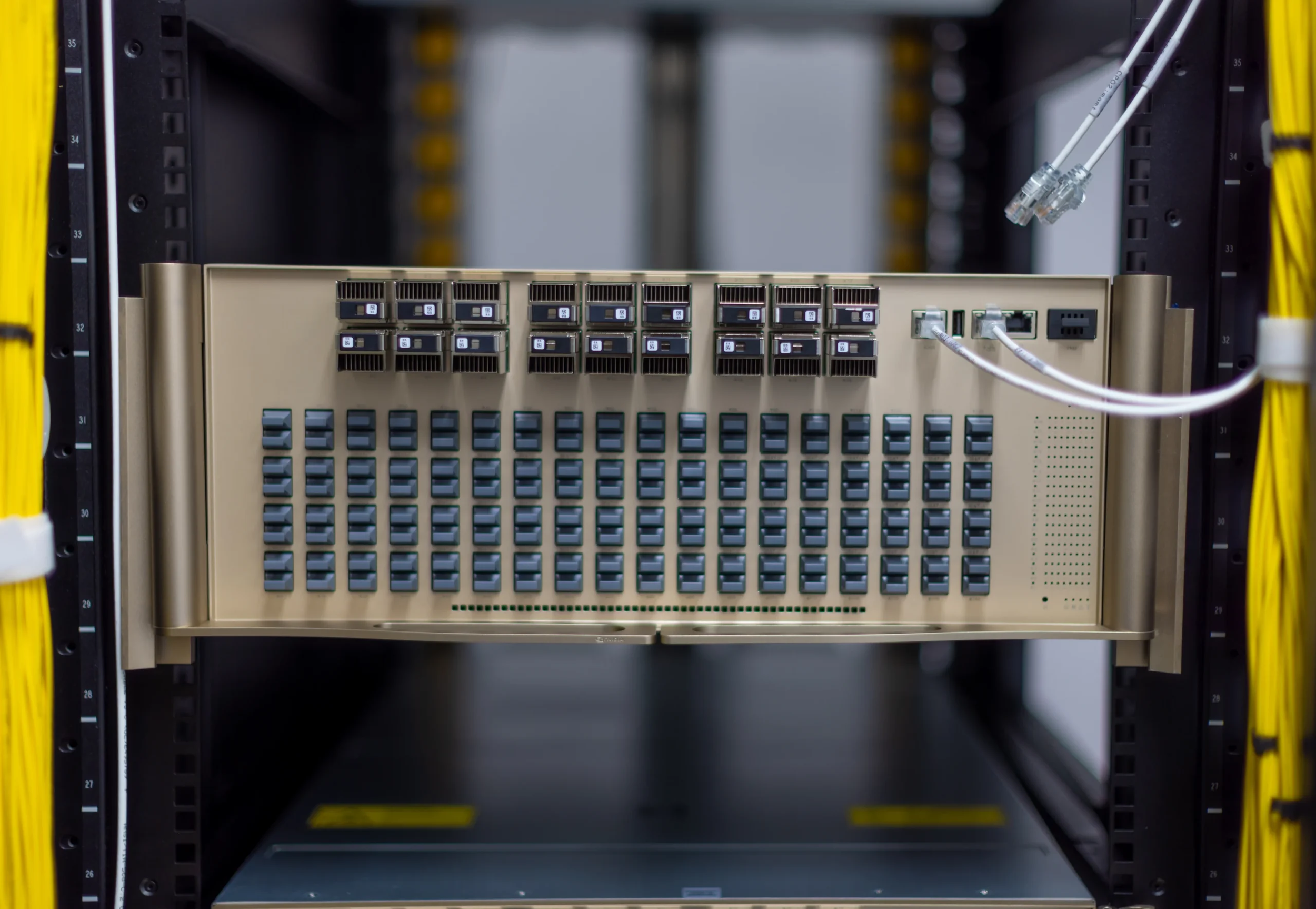
Lambda’s engineering sample uses 18 removable external light source modules feeding 144 MPO ports. Traditional OSFP cages are replaced by fiber array connections that feed directly into the silicon photonics engine.
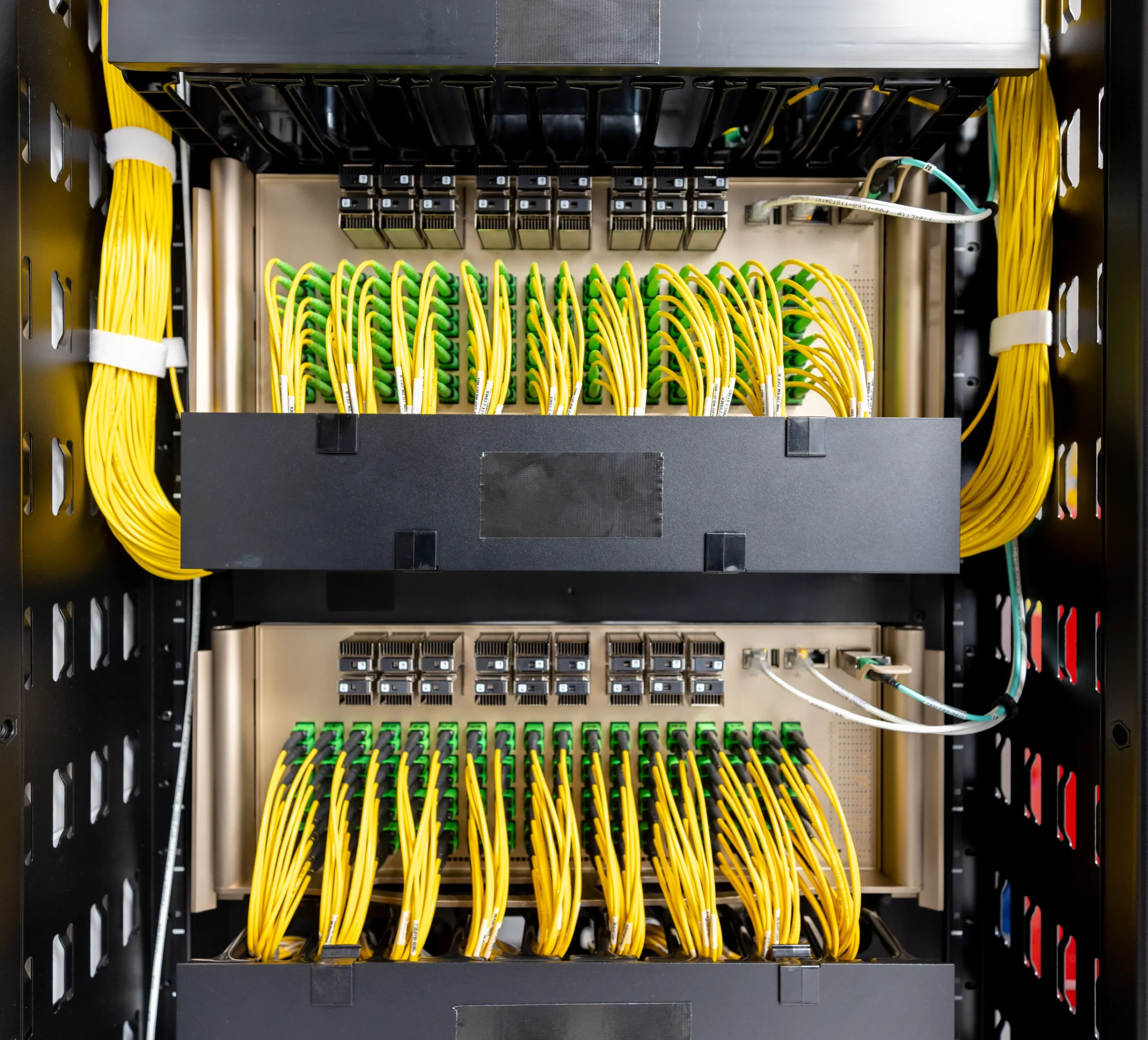
The rear of the unit uses 48V DC busbar power and 4 UDQ4 liquid cooling connections with dual internal loops. That makes the switch feel closely aligned with NVIDIA’s GB300 NVL72 rack infrastructure, where high density power delivery and liquid cooling are already central to the platform.
| Spec | Detail |
|---|---|
| Form factor | 4U |
| ASIC | NVIDIA Quantum X800 |
| Ports | 144 x 800G InfiniBand |
| Optical connectivity | 144 MPO connectors |
| Switching capacity | 115.2 Tb/s non blocking |
| Power input | 48V DC busbar |
| Cooling | Liquid, dual loop |
| Light source | 18 removable external modules, 1 per 8 ports |
SpecDetailForm factor4UASICNVIDIA Quantum X800Ports144 x 800G InfiniBandOptical connectivity144 MPO connectorsSwitching capacity115.2 Tb/s non blockingPower input48V DC busbarCoolingLiquid, dual loopLight source18 removable external modules, 1 per 8 ports
This is one of the clearest examples of why AI infrastructure is no longer only about GPUs. Networking power, latency, reliability, and serviceability are becoming just as important as raw accelerator performance. CPO matters because it attacks several AI factory bottlenecks at once. It lowers switch power, reduces optical failure points, removes parts of the traditional transceiver chain, and gives data centers more room to allocate power toward useful compute.
For Lambda, the value is straightforward. Less power spent on the network means more power available for GPUs. For NVIDIA, this strengthens the full stack AI factory strategy, where the company controls not only the GPU, but also the rack, switch, interconnect, cooling model, and software ecosystem.
The bigger industry signal is clear. As agentic AI workloads create more east west traffic across clusters, optical networking is becoming a requirement, not a luxury. CPO may become one of the defining infrastructure shifts of the Blackwell Ultra and Rubin era.
Do you think co packaged optics will become the next major competitive advantage in AI data centers?
