
SK hynix Samples 48 GB HBM4E At 16 Gbps As AI Memory Race Accelerates
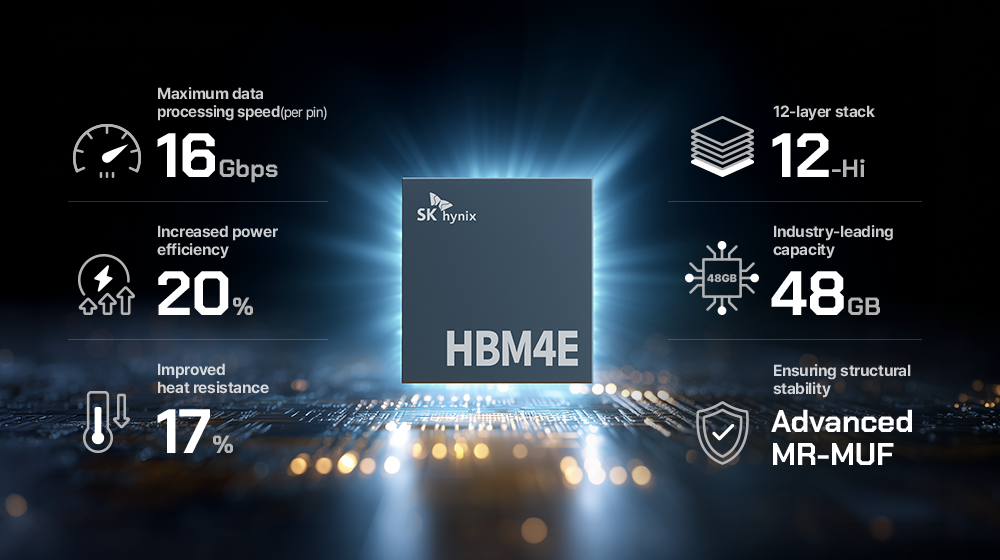
SK hynix has started shipping samples of its next generation HBM4E memory to major customers, putting the company directly into the next phase of the AI memory race as NVIDIA, AMD, cloud providers, and accelerator builders prepare platforms that need more bandwidth, more capacity, and stronger power efficiency than current HBM stacks can deliver. According to the official SK hynix announcement, the new 12 stack HBM4E product reaches 48 GB capacity, offers speeds of up to 16 Gbps per pin, and improves power efficiency by more than 20% compared with previous models.
The timing is important because HBM4E is expected to support the next wave of AI accelerators, including NVIDIA Rubin Ultra and AMD Instinct MI500 class platforms. AMD has already confirmed that its Instinct MI500 Series will use CDNA 6, 2 nm process technology, and HBM4E memory, while reports around NVIDIA’s Rubin Ultra roadmap point to much larger memory configurations as agentic AI workloads demand more capacity and bandwidth per GPU. In this market, memory is no longer a supporting component. It is one of the main limiters of AI system performance.
SK hynix says the 12 stack HBM4E sample was delivered on schedule thanks to its HBM development and mass production experience. "We will work closely with partners for mass production in a timely manner." Quote by: SK hynix. That statement matters because qualification timing is critical in the HBM business. AI chipmakers need memory samples early enough to validate packaging, power behavior, thermal performance, signal integrity, and supply readiness before full platform production begins.
The new HBM4E product uses Advanced MR MUF technology, which helps SK hynix reach 48 GB capacity in a 12 stack structure while maintaining mechanical stability. The company also says heat resistance has improved by 17% compared with HBM4, giving the memory stronger operating stability in high performance computing environments. That thermal gain is especially important because future AI memory stacks are expected to face higher power density, more heat concentration, and tighter integration with large compute packages.
| Spec or feature | SK hynix HBM4E sample |
|---|---|
| Memory type | HBM4E |
| Stack structure | 12 stack |
| Capacity | 48 GB |
| Speed | Up to 16 Gbps per pin |
| Power efficiency | More than 20% better than previous models |
| Thermal improvement | 17% lower heat resistance versus HBM4 |
| Packaging technology | Advanced MR MUF |
| Target market | AI data centers, training, inference, large scale computing |
| Customer stage | Samples shipped to major customers |
| Main purpose | Higher bandwidth, better efficiency, and stronger thermal stability for next generation AI chips |
Samsung has already moved aggressively in the same direction, announcing in late May that it had started shipping 12 stack HBM4E samples with up to 16 Gbps performance, 48 GB capacity, and a 4 nm logic base die through its Samsung Semiconductor announcement. That makes HBM4E one of the clearest battlegrounds between Samsung and SK hynix, while Micron remains another major force in advanced AI memory. The difference now is that customer qualification, packaging readiness, and thermal engineering may matter as much as raw specifications.
The industry pressure is easy to understand. AI models are becoming larger, context windows are expanding, agentic workloads are generating more token traffic, and inference systems need to serve more users at lower cost. That creates a massive appetite for memory bandwidth and capacity. Faster GPUs alone cannot solve the problem if the memory stack cannot feed the compute engines quickly enough. HBM4E exists because the AI industry is hitting a memory wall that requires more than incremental DRAM improvements.
HBM4E also raises the stakes for packaging. A 48 GB 12 stack memory device must operate reliably while sitting close to high power AI accelerators inside advanced packages. This means thermal management, die stacking, interposer design, base die logic, and yield all become part of the final product equation. SK hynix’s 17% heat resistance improvement is not just a technical footnote. It is one of the details that could determine whether these memory stacks can survive real AI data center workloads at scale.
For NVIDIA Rubin Ultra, AMD Instinct MI500, and other future accelerators, HBM4E could become one of the main enablers of higher model throughput and lower cost per token. More bandwidth helps feed compute units. More capacity helps keep larger models and context data closer to the accelerator. Better power efficiency reduces data center operating cost. Better thermals help maintain stability when thousands of stacks are deployed across racks and clusters.
For SK hynix, the opportunity is massive, but so is the pressure. The company already holds a strong position in HBM, especially through its relationship with NVIDIA, but Samsung is clearly moving fast to regain momentum. With Samsung sampling HBM4E and investing in HBM5 thermal concepts such as Heat Path Block, and Micron continuing to push its own HBM roadmap, SK hynix needs to turn early sampling into reliable mass production and customer qualification.
This announcement shows how fast the AI memory roadmap is accelerating. HBM3E helped power the current wave of AI accelerators. HBM4 is moving into the Vera Rubin generation. HBM4E is already being sampled for the next step. HBM5 is appearing on roadmaps and Computex show floors. That pace is unusual for memory, but AI demand has changed the rules. Every major chipmaker wants more bandwidth, more capacity, and more efficient memory as quickly as possible.
The consumer side may feel the impact indirectly. As memory makers prioritize HBM and high margin data center products, conventional DRAM and DDR supply can tighten, which is one reason PC memory pricing has remained under pressure. We previously covered how AMD expects DDR5 memory prices to stay high for another 2 years, and the HBM4E race reinforces why that pressure may continue. AI memory is absorbing enormous engineering focus, wafer capacity, and customer attention.
SK hynix shipping 48 GB HBM4E samples is not only a product milestone. It is a signal that the next AI hardware cycle is already being locked in. The companies that secure the best HBM4E supply, qualify it fastest, and integrate it most efficiently will have a major advantage in the next generation of AI training and inference systems.
Do you think HBM4E will become the biggest advantage for next generation AI chips, or will power and cooling remain the harder bottlenecks to solve?
