
AMD Confirms Zen 6 Olympic Ridge and Medusa Platforms for AM5 and FP10
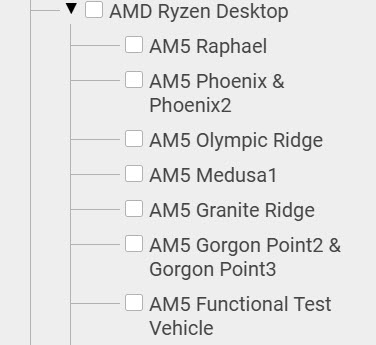
AMD has provided its clearest confirmation yet of how its next generation Ryzen client processors will be distributed across desktop and mobile platforms, with new entries in the company's technical documentation identifying Olympic Ridge, Medusa1 and Medusa2 alongside AM5 and FP10. The documentation links Olympic Ridge directly to AM5, while Medusa1 is associated with both AM5 and FP10 and Medusa2 is listed exclusively for FP10. The discovery provides another major piece of AMD's Zen 6 client roadmap as the company prepares to extend its latest CPU architecture beyond EPYC Venice and into gaming desktops, notebooks and future APUs.
Olympic Ridge is the most important confirmation for desktop PC builders because AMD's documentation associates the family with the existing AM5 socket. The processors are expected to succeed the current Ryzen 9000 Granite Ridge generation and bring Zen 6 into mainstream enthusiast desktops without requiring AMD to abandon its current socket. Previous reporting has suggested configurations reaching as high as 24 cores and 48 threads through new CCDs containing as many as 12 Zen 6 cores each, but AMD has not officially confirmed those core counts, frequencies, cache capacities, TDPs or retail Ryzen branding. Earlier reports have also claimed that Olympic Ridge could replace its basic integrated graphics with an NPU, although those specifications remain unconfirmed.
The platform confirmation is especially significant because AMD officially extended Socket AM5 support through 2029 during Computex 2026. AMD introduced AM5 alongside Zen 4 Ryzen 7000 processors in 2022, continued it through Zen 5 Ryzen 9000 and has now provided direct evidence that its next client generation is also being prepared for the socket. For gamers already using X670, B650, X870 or newer AM5 motherboards, that creates the possibility of another substantial CPU upgrade without replacing the motherboard, although compatibility with individual boards will still depend on firmware support from manufacturers. AMD has not yet provided an official compatibility list for existing AM5 boards.
Medusa1 reveals a more flexible strategy. AMD documentation links the processor family to both FP10 and AM5, suggesting the design is being prepared for mobile products as well as socketed desktop systems. Medusa has repeatedly appeared in software development associated with future Zen 6 APUs, and AMD has already begun preparing Linux support for Medusa1, Medusa2 and Olympic Ridge through Family 1Ah processor identifiers. Medusa1 is mapped to Models 80h through 87h, Olympic Ridge to 88h through 8Fh and Medusa2 to E0h through E3h.
Medusa2 currently appears more tightly focused on mobile systems because AMD's documentation associates it exclusively with FP10. The exact product segmentation remains unknown, but previous reports have positioned the Medusa family across several notebook performance levels. Software development has also exposed a new AMD Low Power CPU core type that could eventually play a role in future mobile processors, although AMD has not officially connected that design directly to Medusa. AMD Low Power core report, the additional core class could allow future notebooks and gaming handhelds to move background workloads onto more efficient CPU resources, but its architecture and final implementation remain unconfirmed.
Graphics could become another major element of Medusa. AMD recently published firmware for its new RDNA 4m GFX 11.7 architecture, with GFX1170, GFX1171 and GFX1172 already appearing through AMD's software stack. RDNA 4m has repeatedly been associated with future Medusa mobile processors, potentially giving AMD another major integrated graphics upgrade for gaming notebooks and handheld systems. AMD has not formally confirmed that Medusa will use RDNA 4m, so the connection remains based on current software development and industry reporting rather than a final product announcement.
The new client roadmap follows AMD's first commercial Zen 6 deployment through EPYC Venice. AMD confirmed in May that Venice had entered production using TSMC's 2 nm process, making it the first high performance computing product AMD says has entered production on the node. The server architecture scales to as many as 256 Zen 6 cores, demonstrating that the underlying CPU generation is already progressing toward commercial deployment even while final desktop and notebook specifications remain undisclosed.
Current industry expectations place the first consumer Zen 6 products around 2027, potentially putting Olympic Ridge against Intel's Nova Lake generation. AMD has not officially announced launch dates for Olympic Ridge, Medusa1 or Medusa2, so reports pointing toward CES 2027 or specific release windows should still be treated as expectations rather than confirmed scheduling. What is now considerably clearer is the platform strategy: AM5 is staying alive for Zen 6, while FP10 becomes an important foundation for AMD's next mobile generation.
The biggest news here is not another rumored Zen 6 core count. It is AM5. AMD promised support through 2029, and Olympic Ridge appearing directly against AM5 gives that commitment much more substance. A user who entered the platform with Ryzen 7000 could potentially move through Zen 4, Zen 5 and Zen 6 while retaining the same motherboard, something that remains one of AMD's strongest advantages in the enthusiast PC market.
Medusa1 may be equally important longer term. A Zen 6 APU that can span both FP10 notebooks and AM5 desktops would give AMD considerable flexibility, especially if RDNA 4m and new Low Power CPU technology eventually become part of the final design. For gamers, the next Ryzen generation is therefore shaping up as more than another IPC and clock speed upgrade. It could become one of AMD's broadest client platform transitions since AM5 originally launched.
Would confirmed Zen 6 support make you keep your current AM5 motherboard for another CPU generation, or are you planning a complete platform upgrade for your next gaming build?
