
AMD Publishes RDNA 4m Firmware as Next Generation APU Launch Moves Closer
AMD has taken another important step toward launching its next generation mobile graphics architecture by publishing the firmware required for its upcoming RDNA 4m hardware. The new binaries have been upstreamed into the Linux Firmware repository, allowing Linux distributions to begin packaging the firmware alongside AMDGPU support before compatible hardware reaches consumers. This is particularly important for launch readiness because the firmware is required for the open source graphics stack to initialize the new GPU hardware correctly, and AMD has historically released some of these files much closer to product availability.
RDNA 4m uses the GFX 11.7 graphics IP rather than the GFX 12.0 architecture used by the desktop Radeon RX 9000 family. That places it technically beyond RDNA 3.5 GFX 11.5 while stopping short of being a conventional implementation of full RDNA 4. AMD's LLVM documentation has nevertheless identified the architecture as RDNA 4m, with the M widely believed to indicate a mobile focused design. Development has already appeared across the AMDGPU kernel driver, LLVM shader compiler, RadeonSI OpenGL driver and RADV Vulkan driver, with GFX1170, GFX1171 and GFX1172 targets indicating that AMD is preparing multiple configurations.
The latest firmware package currently covers GFX 11.7.0 and GFX 11.7.1, while GFX 11.7.2 firmware has not yet been published. AMD has also uploaded firmware for PSP 15.0.0 and PSP 15.0.9 security processors, SDMA 6.1.4 and the VPE 2.0.0 video processing engine, while DCN 4.2 display support is progressing alongside the architecture. Based on the current upstream work, Linux 7.3 together with Mesa 26.2 or 26.3 is expected to form the practical software foundation for RDNA 4m support once compatible processors arrive.
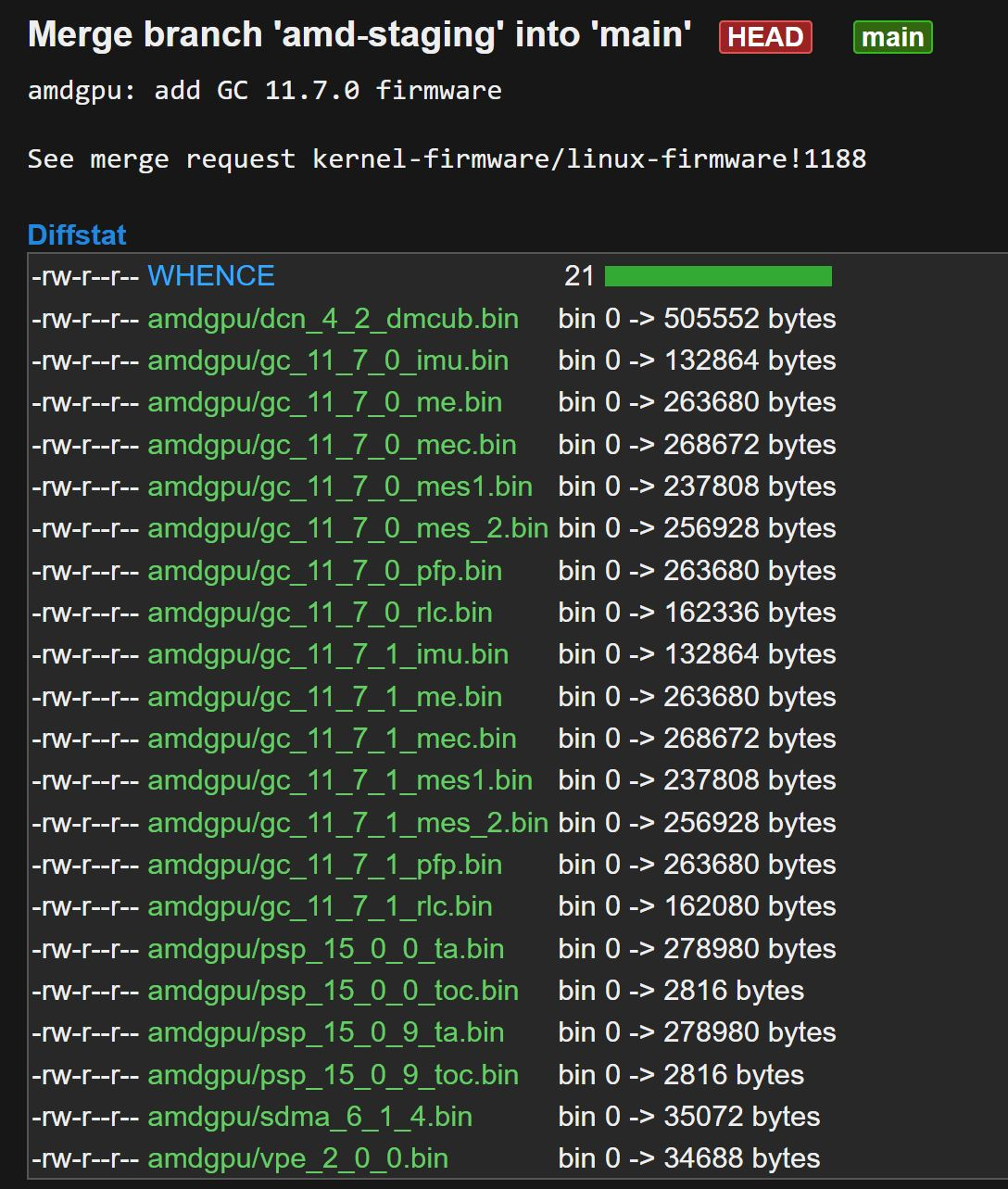
The architecture has repeatedly been associated with AMD's upcoming Zen 6 based Medusa Point mobile processors, although AMD has not officially confirmed the commercial APU family that will use GFX 11.7. That distinction remains important because earlier Linux development has already exposed additional pieces of AMD's future client platform without revealing final product names or configurations. Recent AMD Linux patches also revealed a new Low Power CPU core type, another feature that has been linked through industry reporting to future Medusa mobile designs but has not yet been formally tied to a specific retail processor by AMD.
For gaming laptops and handheld systems, RDNA 4m could be particularly significant if AMD combines the efficiency improvements of its newer mobile designs with selected instruction capabilities approaching RDNA 4. The architecture is expected to introduce several ISA additions beyond RDNA 3.5, while AMD's continued investment in Linux graphics support is also becoming increasingly relevant for handheld gaming platforms and alternative operating systems. AMD has already expanded its software work through developments such as FSR 4.1 support appearing in Proton Experimental for RDNA 3, demonstrating that Linux is becoming a more strategically important part of the Radeon gaming ecosystem.
The firmware release does not confirm a launch date, but it is one of the stronger signs that RDNA 4m hardware is moving from software preparation toward actual product readiness. The most interesting part is that AMD appears to be taking a hybrid architectural approach rather than simply inserting full desktop RDNA 4 graphics into a mobile APU. GFX 11.7 could allow AMD to preserve the efficiency and integration advantages needed for notebooks and handhelds while selectively introducing newer instructions and capabilities. If Medusa Point is ultimately the platform behind RDNA 4m, the real competitive question will be whether AMD can translate those architectural changes into a meaningful gaming efficiency advantage against Intel's increasingly aggressive integrated graphics roadmap.
Could RDNA 4m give AMD another major advantage in gaming laptops and handhelds, or will Intel's next generation integrated graphics close the gap?
