
Watch the AMD Advancing AI 2026 Keynote Replay
AMD has concluded its Advancing AI 2026 keynote, unveiling a major expansion of its data center, artificial intelligence, software, and physical AI portfolio. The presentation was led by AMD Chair and CEO Dr. Lisa Su on July 23 at the Moscone Center in San Francisco, with the complete AMD Advancing AI 2026 keynote now available to watch online.
"The next phase of AI will span frontier models, agents and physical AI, creating new opportunities to bring intelligence everywhere."
— Quote by: Dr. Lisa Su
The central announcement was AMD Helios, the company’s first complete rack scale AI reference design. Each Helios rack combines 72 Instinct MI455X accelerators, 18 6th Gen EPYC Venice processors, Pensando networking, and the ROCm software platform. AMD says the system delivers up to 2.9 EFLOPS of FP4 compute, 1.4 EFLOPS of FP8 performance, 31 TB of HBM4 memory, 260 TB/s of scale up bandwidth, and 43 TB/s of scale out connectivity.
AMD also officially launched its 6th Gen EPYC 9006 processor family based on the Zen 6 architecture. The flagship EPYC 9996 reaches 256 cores and 512 threads, while the platform supports up to 16 memory channels, PCIe 6.0 connectivity, and memory bandwidth reaching 1.6 TB/s. The processors are designed for cloud computing, enterprise infrastructure, high performance computing, and the growing number of CPU workloads supporting autonomous AI agents.
The Instinct MI400 Series was another major focus of the keynote. The flagship MI455X uses AMD’s CDNA 5 architecture and provides 432 GB of HBM4 memory with up to 19.6 TB/s of bandwidth per accelerator. AMD claims that MI455X can deliver as much as 34 times greater token throughput than MI355X in a selected DeepSeek V4 Flash FP4 serving workload, although performance will vary significantly depending on models, software, and system configuration.
Several major customers also detailed plans to adopt AMD infrastructure. OpenAI expects to bring Helios systems online beginning in Q4 2026, while Meta has started validating the platform for future deployments. Anthropic plans to deploy up to 2 GW of MI455X capacity, and Microsoft is preparing new Azure infrastructure combining Instinct accelerators with EPYC Venice processors.
AMD also introduced ROCm.ai, a development platform designed to help coding agents such as Claude, Codex, and Cursor understand AMD hardware and optimize ROCm applications. Beyond data centers, the company expanded into physical AI with new Kria AI system modules, Ryzen AI Embedded X100 processors, and a robotics development platform combining CPU, GPU, NPU, and FPGA processing.
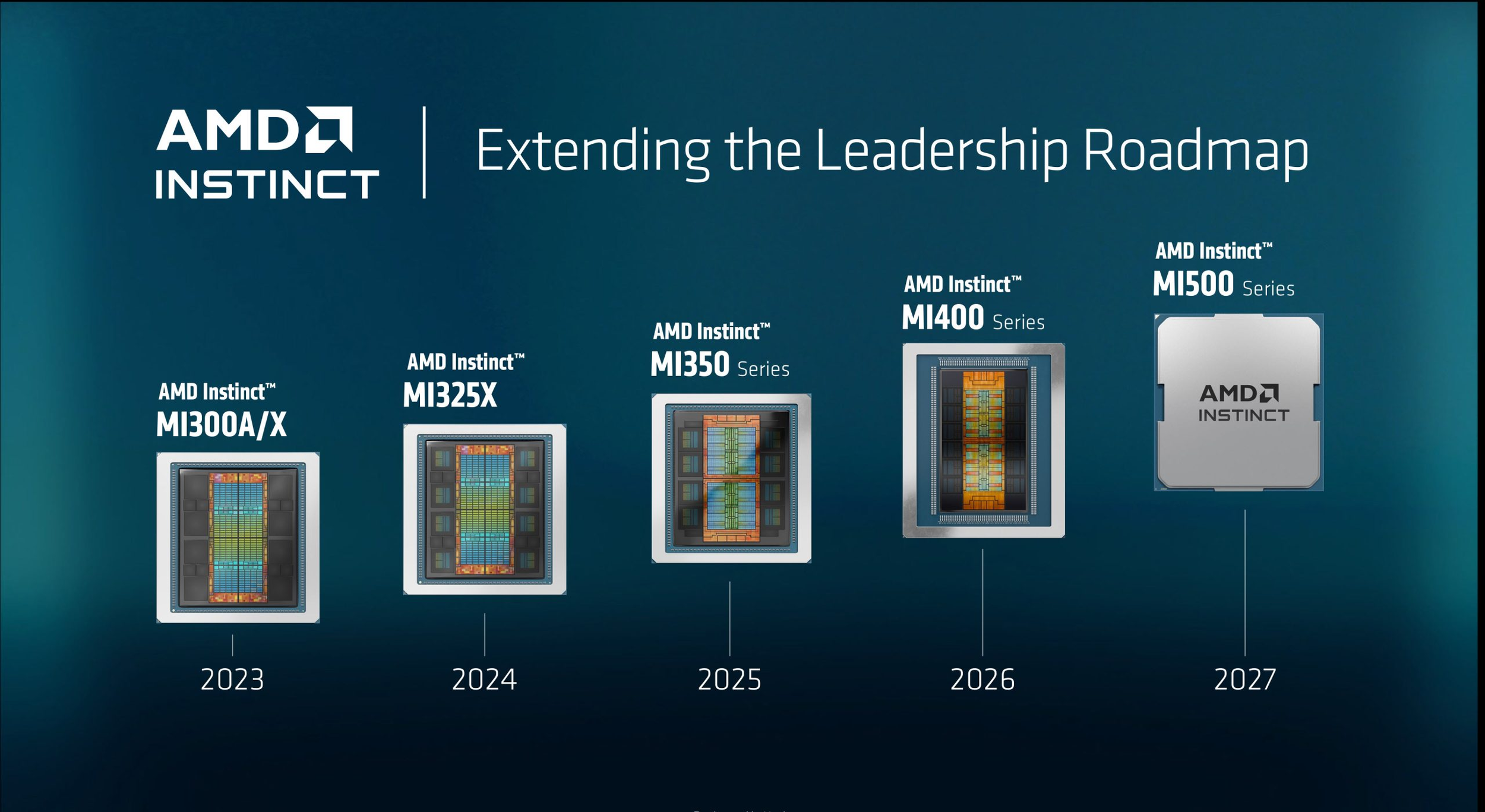
The company also confirmed that Instinct MI500 accelerators are planned for 2027, followed by MI600 in 2028. Future EPYC processors based on Zen 7 are scheduled for 2028, while the Zen 8 based Ravenna generation is planned for 2030. These components will power future Helios 500 and Helios 600 rack scale platforms as AMD moves toward an annual AI infrastructure release cycle.
The Instinct MI450 sampling phase and the production ramp of EPYC Venice on TSMC 2 nm. Advancing AI 2026 now provides the complete architecture surrounding those products and confirms that Helios is moving from a reference roadmap into customer deployment.
Advancing AI 2026 represents AMD’s strongest attempt yet to compete with NVIDIA as a complete infrastructure provider rather than only as a supplier of alternative GPUs. Helios integrates processors, accelerators, networking, memory, software, cooling, and rack design into one coordinated platform while maintaining support for open standards including UALink, Ultra Ethernet, and Open Rack Wide.
The hardware is competitive on paper, particularly in memory capacity, CPU density, and open networking. However, AMD’s ability to convert major deployment commitments into lasting market share will depend heavily on ROCm reliability, developer adoption, production availability, and real world performance when Helios systems enter large scale operation.
Can AMD Helios become a serious alternative to NVIDIA’s rack scale AI platforms, or will CUDA remain the deciding advantage?
