
Shanghai Aishengna Emerges Behind China’s Domestic Immersion DUV Push
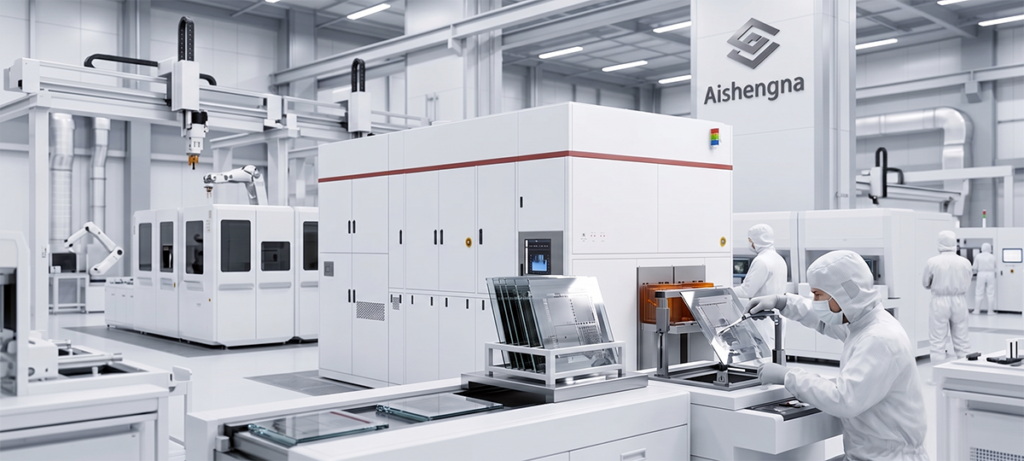
Shanghai Aishengna Electronic Technology Group has been identified as the state backed company leading China’s effort to manufacture domestic immersion deep ultraviolet lithography systems. According to Reuters, the company has begun initial production and plans to manufacture approximately 5 machines during 2026, followed by around 20 systems in 2027.
Aishengna was established in August 2023 with registered capital of CNY 7 billion, approximately $1 billion. Corporate records identify Shanghai Electric Holding and a subsidiary of Shanghai International Trust as its 2 state owned shareholders. The company has no public website and has disclosed little about its operations, which allowed its role in China’s lithography program to remain largely concealed until recently.
The organization reportedly incorporated technical teams from Shanghai Micro Electronics Equipment and Yuliangsheng, a lithography developer connected to Huawei backed semiconductor equipment company SiCarrier. Aishengna and Yuliangsheng also share an address in Shanghai, suggesting that Beijing has consolidated engineering resources from several domestic projects into a coordinated production effort.
Shanghai Aishengna is manufacturing the DUV.
— Zephyr (@zephyr_z9) July 29, 2026
Aishengna's parent company is Shanghai Electric, which is also the parent company of SMEE. SMEE was restructured into 3 in 2024.
AMIES handles back-end litho equipment. SMEE does KrF/i-line. Aishengna (with SMEE patents and their DUV… https://t.co/CVIeFryxBS pic.twitter.com/gB32dNgbTf
Immersion DUV machines place purified water between the projection lens and silicon wafer to increase optical resolution and print smaller circuit patterns. These systems cannot match EUV efficiency at the most advanced manufacturing nodes, but repeated exposures and multiple patterning can extend DUV technology into more complex semiconductor production. The first Chinese systems are reportedly intended for SMIC, Hua Hong Semiconductor, and memory manufacturer CXMT.
The production targets remain considerably smaller than ASML’s commercial output. ASML shipped 131 comparable systems during 2025, while Aishengna’s machines still require extensive testing before their overlay accuracy, throughput, yield, and long term reliability can be evaluated under factory conditions. The announcement nevertheless contributed to a 10% decline in ASML shares across 2 trading days as investors considered the long term risk to its Chinese DUV business.
"Producing a handful of immersion DUV tools is not the same as producing tools that can be used for high volume manufacturing."
— Quote by: JPMorgan analysts
China is pursuing several semiconductor technologies simultaneously rather than depending entirely on its domestic DUV project. Huawei reportedly plans to begin producing glass substrates for artificial intelligence chips in 2027. Glass can improve package flatness, thermal stability, interconnect density, and support for larger chiplet designs, although it complements lithography rather than replacing the need for advanced wafer fabrication equipment. The wider industry is also moving toward glass substrate packaging as artificial intelligence accelerators become larger and more complex.
China has also completed an experimental EUV system in Shenzhen. The prototype can generate extreme ultraviolet light and is undergoing testing, but it has not produced working chips. Government planners reportedly target 2028 for initial chip production, while engineers familiar with the project consider 2030 more realistic. This remains far behind commercial platforms such as ASML High NA EUV, which is already being used for selected Intel 18A production layers.
Aishengna does not represent an immediate commercial replacement for ASML. Building several lithography machines is fundamentally different from operating them reliably across thousands of wafers while maintaining consistent yield, precision, uptime, and production cost.
The strategic impact is still significant. Export restrictions have created a strong commercial and national security incentive for Chinese chipmakers to accept domestic tools that may initially offer lower performance. Aishengna, glass substrates, and the Shenzhen EUV prototype show that China is attacking the semiconductor bottleneck through manufacturing equipment, advanced packaging, and long term lithography research at the same time.
Can China turn its early domestic DUV production into a reliable alternative to ASML, or will manufacturing precision remain the decisive barrier?
