
Qualcomm Snapdragon C Targets 300$ Windows Laptops With 8 CPU Cores and Up to 16 GB Memory
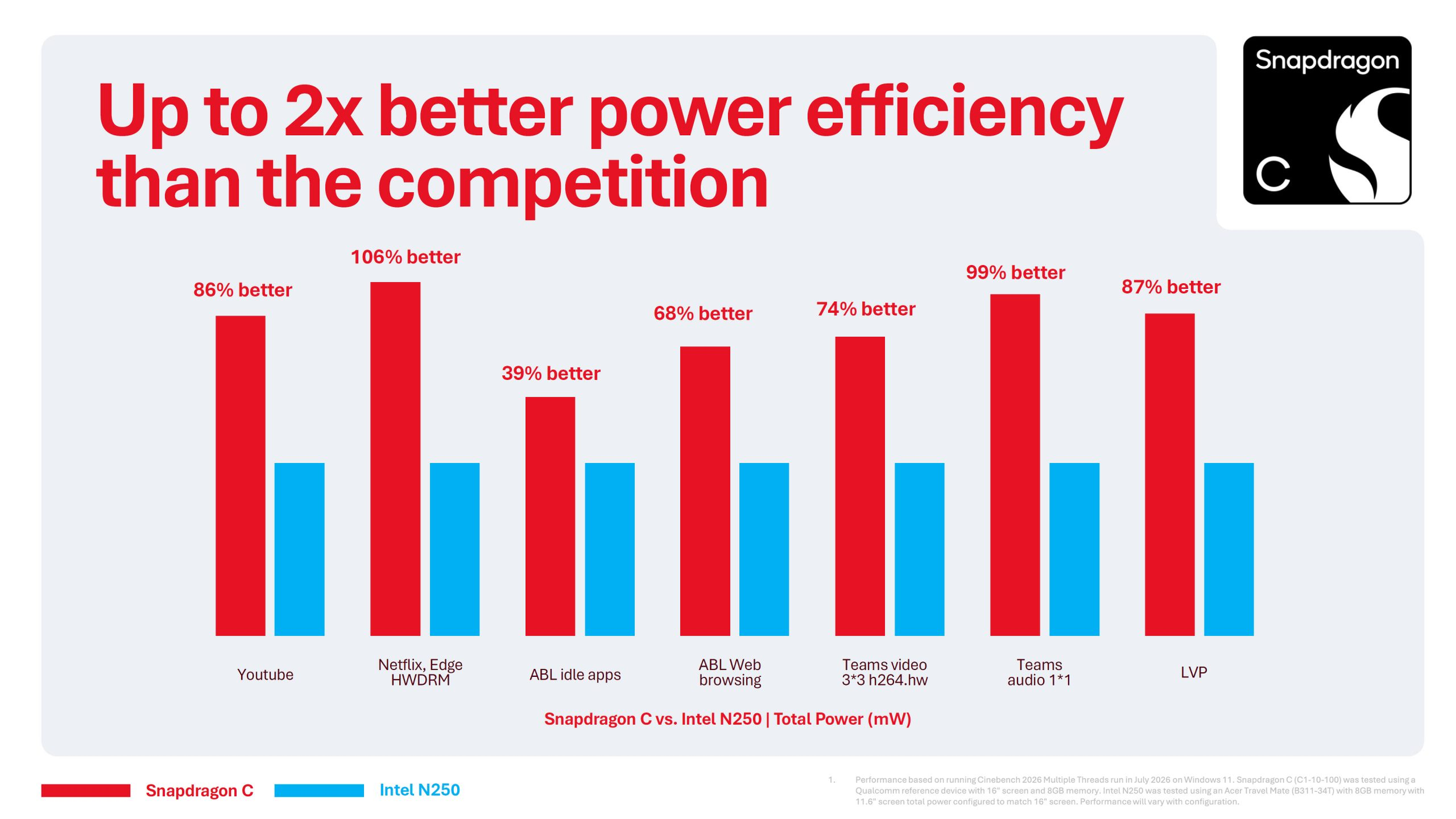
Qualcomm is pushing Windows on Arm into a significantly more affordable segment with the Snapdragon C Platform, an entry level laptop processor designed for systems targeting 300$ and above. First announced in May 2026, Qualcomm has now detailed the platform more extensively through its official Snapdragon C product brief, revealing an 8 core Arm CPU, integrated Adreno graphics, dedicated Hexagon NPU, support for up to 16 GB of memory, and a strong emphasis on battery life, quiet operation, and everyday Windows workloads. Qualcomm says Snapdragon C systems are aimed primarily at students, families, frontline workers, and small businesses rather than the premium AI PC market currently served by Snapdragon X and Snapdragon X2 processors.
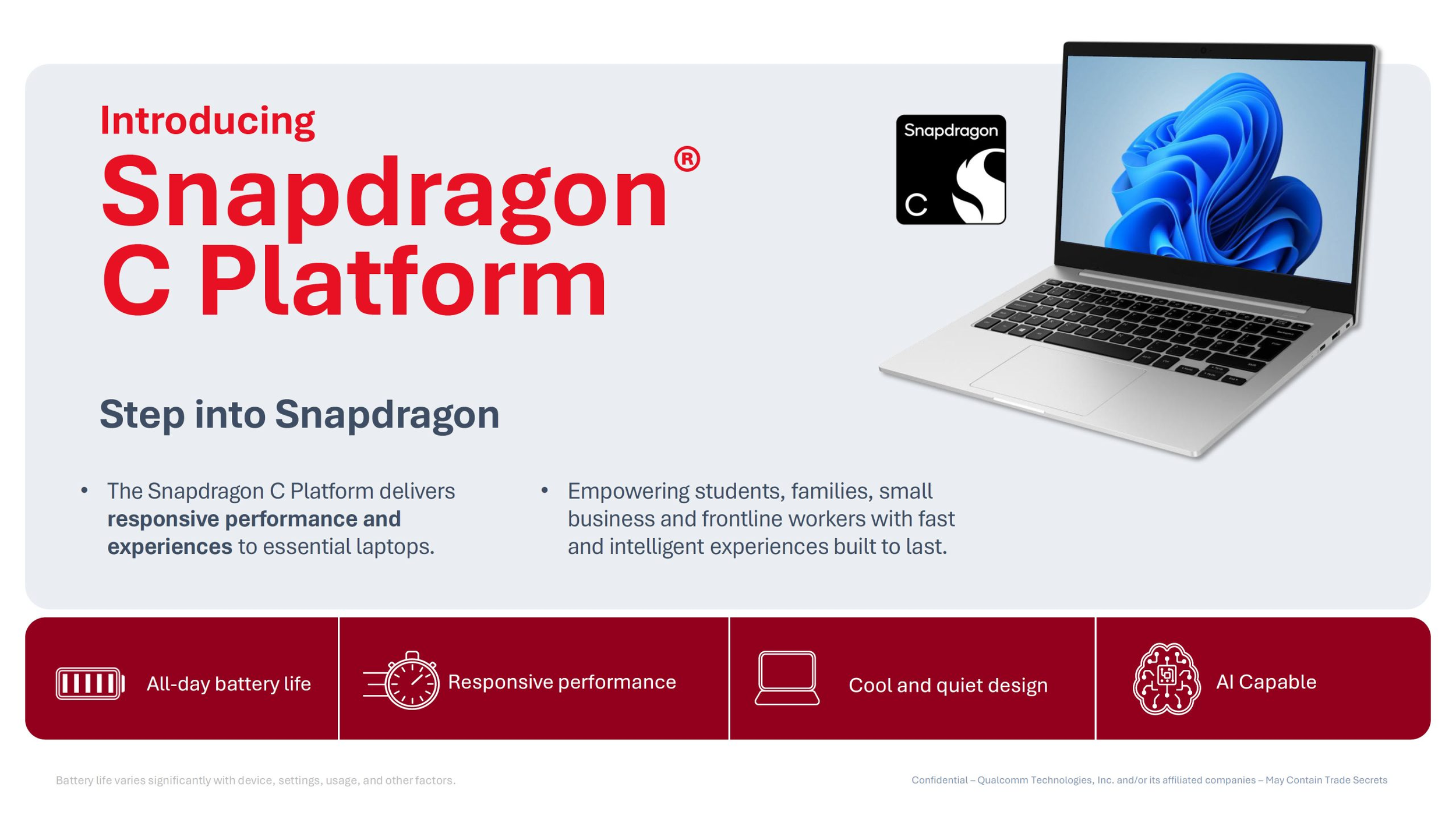
"As costs rise and customer expectations evolve, Snapdragon C brings together value oriented computing, all day battery life, AI capabilities and responsive performance in cool quiet devices for expanded platform choice."
— Quote by: Kedar Kondap, Senior Vice President and General Manager of Compute and Gaming, Qualcomm Technologies
At the center of Snapdragon C is an 8 core Qualcomm Kryo CPU using an Arm64 compatible architecture and manufactured on a 6 nm process. Qualcomm lists a maximum single core frequency of 3.0 GHz, while the processor configuration allows 1 core at 3.0 GHz, 3 cores at up to 2.6 GHz, and another 4 cores at up to 2.0 GHz. Total CPU cache is 2 MB. Unlike the more expensive Snapdragon X family, which uses Qualcomm's newer Oryon CPU architecture, Snapdragon C relies on Kryo as Qualcomm prioritizes efficiency and manufacturing cost for the entry level notebook segment.
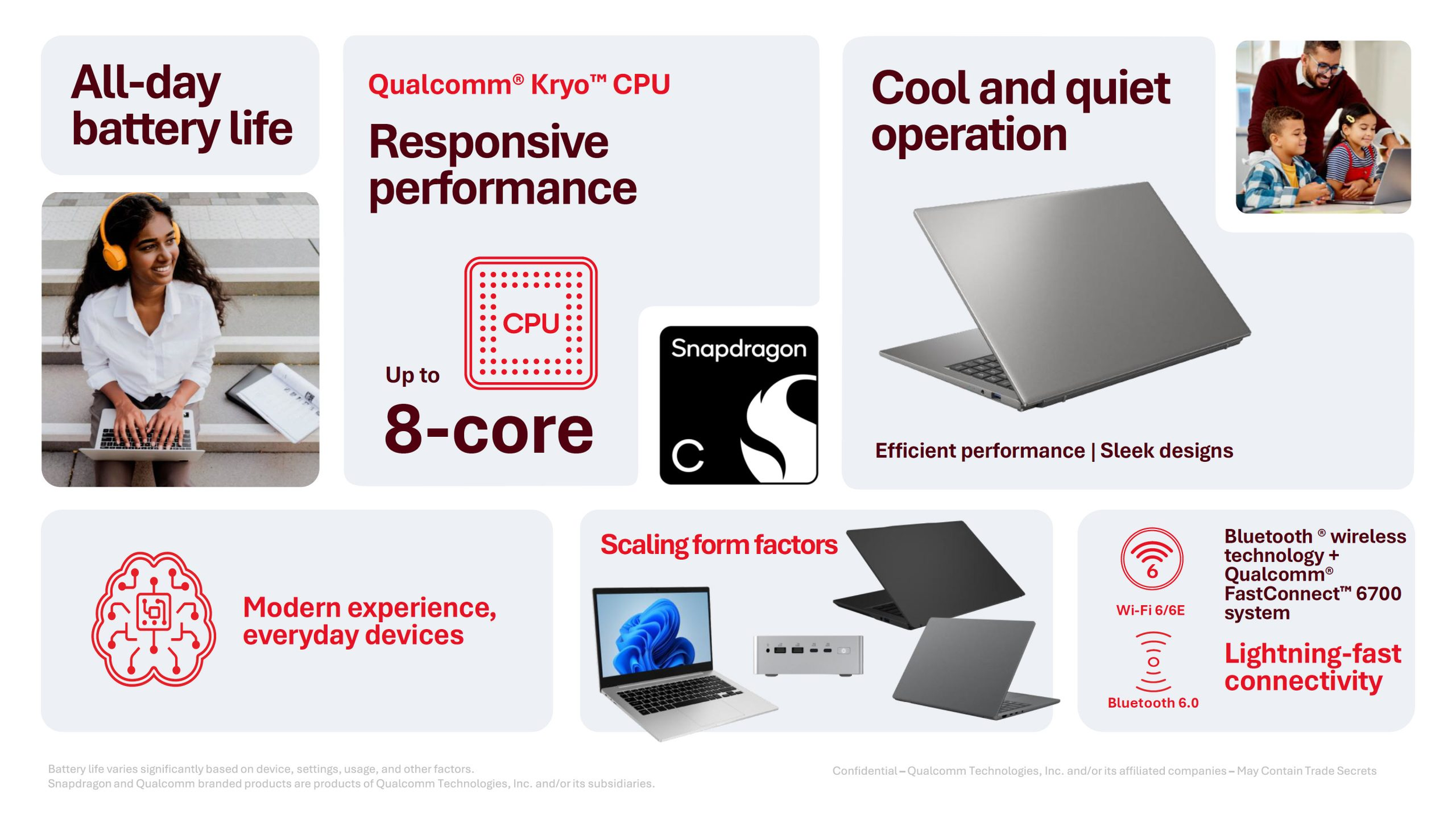
Graphics are handled by an integrated Qualcomm Adreno A643 GPU running at up to 900 MHz with DirectX 12 support. The platform can drive an integrated display at up to FHD Plus and 120 Hz, while an external monitor can reach 4K at 60 Hz through DisplayPort 1.4. Video capabilities include hardware AVC, HEVC, and VP9 decoding at up to 4K 60 FPS, with AVC and HEVC encoding supported at up to 4K 30 FPS. These specifications position Snapdragon C primarily for productivity, browsing, streaming, education, and lightweight entertainment rather than demanding PC gaming or professional graphics workloads.
| Specification | Snapdragon C |
|---|---|
| CPU | Qualcomm Kryo |
| Architecture | Arm64 compatible |
| CPU Cores | 8 |
| Maximum Frequency | 3.0 GHz |
| Process | 6 nm |
| GPU | Adreno A643 |
| GPU Frequency | Up to 900 MHz |
| NPU | Qualcomm Hexagon |
| Maximum Memory | 16 GB |
| Memory | LPDDR5, LPDDR5X, LPDDR4X |
| Maximum Memory Speed | 6400 MT/s |
| Maximum Memory Bandwidth | 25.6 GB/s |
| Internal Display | Up to FHD Plus at 120 Hz |
| External Display | Up to 4K at 60 Hz |
| Wireless | Wi Fi 6 and Wi Fi 6E |
| Bluetooth | Bluetooth 6.0 |
| Storage | PCIe 3.0 NVMe, UFS 2.2 or 3.1 |
Memory support is particularly notable given the aggressive pricing target. Qualcomm allows manufacturers to configure Snapdragon C systems with LPDDR5, LPDDR5X, or LPDDR4X, with capacities reaching 16 GB. LPDDR5 and LPDDR5X configurations support transfer rates up to 6400 MT/s with 25.6 GB/s of bandwidth, while LPDDR4X is limited to 4200 MT/s and 16.8 GB/s. The memory interface is only 32 bit, reinforcing the platform's focus on basic computing rather than graphics intensive workloads, but a 16 GB ceiling gives manufacturers enough capacity to build significantly more practical Windows 11 machines than many low cost notebooks traditionally limited to 4 GB or 8 GB.
Snapdragon C also integrates a dedicated Qualcomm Hexagon NPU for local AI acceleration, although Qualcomm has not disclosed a TOPS rating for this implementation. As a result, the platform is not being positioned alongside Snapdragon X2 as a high performance Copilot Plus PC processor. Instead, Qualcomm describes the NPU as providing modern AI capabilities for everyday laptops. Connectivity includes Qualcomm FastConnect C6700 with Wi Fi 6 and Wi Fi 6E, Bluetooth 6.0, up to 2 USB C and 2 USB A connections depending on the manufacturer, and PCIe 3.0 connectivity for NVMe storage.
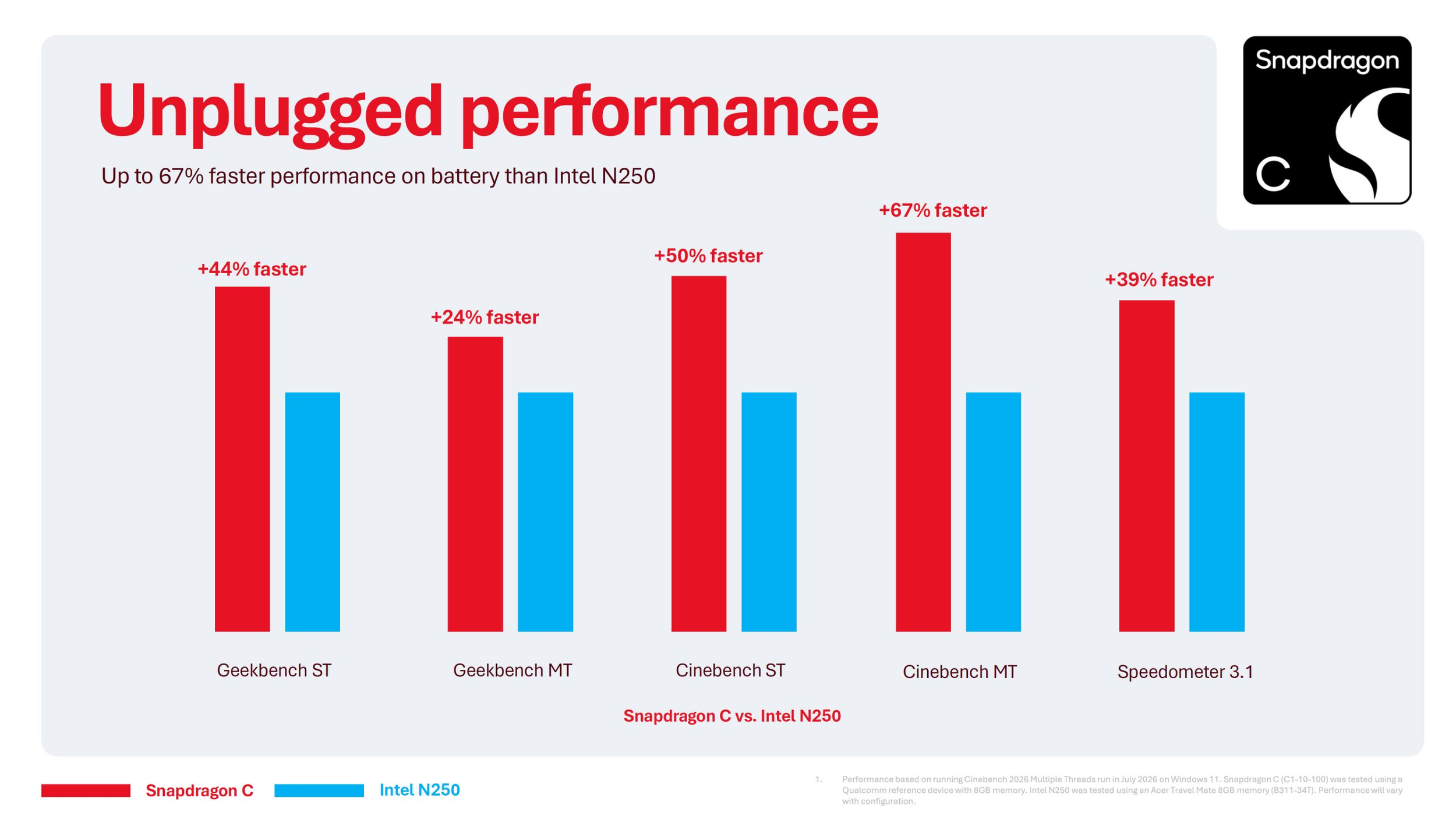

The first manufacturer to confirm a Snapdragon C laptop is Acer, with its Aspire Go 15 using the new processor alongside a 15.6 inch Full HD display, up to 8 GB of memory, up to 512 GB of storage, a 53 Wh battery, Wi Fi 6E, 2 USB C ports, USB A, and HDMI. Acer has not yet announced final pricing or availability for the Aspire Go 15, so Qualcomm's 300$ target should currently be understood as the intended starting segment for Snapdragon C systems rather than a confirmed retail price for Acer's model. Qualcomm has also named HP and Lenovo among the manufacturers preparing Snapdragon C devices, with additional systems expected later in 2026.
Qualcomm's move arrives as Windows on Arm is expanding across increasingly different PC categories. At the premium end, Snapdragon X2 competes for thin and light AI notebooks, while NVIDIA is preparing much more powerful Arm based machines through RTX Spark PCs, combining Blackwell graphics with a Grace based CPU and up to 128 GB of unified memory. Snapdragon C attacks the opposite side of the market by attempting to bring the power efficiency and mobility advantages associated with Arm systems to entry level Windows laptops that traditionally rely on lower cost Intel and AMD processors.
Snapdragon C could be strategically more important for Qualcomm than another premium processor. Snapdragon X proved that Windows on Arm can compete in higher priced notebooks, but volume in the PC market also depends on affordable machines purchased by students, schools, families, businesses, and emerging markets. Reaching the 300$ segment gives Qualcomm an opportunity to establish Arm across a considerably larger installed base.
The specifications are clearly conservative. A 6 nm process, Kryo CPU, 32 bit memory interface, PCIe 3.0 storage, and modest Adreno graphics make Snapdragon C unsuitable for demanding gaming or creator workloads. That is also not its purpose. If manufacturers can genuinely deliver responsive 300$ Windows laptops with 8 cores, 16 GB of memory, quiet operation, and strong battery life, Snapdragon C could place substantial pressure on the traditional entry level x86 notebook market. The bigger challenge remains software compatibility, particularly for older Windows applications, specialized peripherals, and games that still behave better on x86 hardware.
Would you consider a 300$ Snapdragon C laptop with 16 GB of memory and all day battery life, or would you still prefer an Intel or AMD system at this price?
