
NVIDIA and Cisco Unveil USFP Optics With Up to 12.8 Tb/s Capacity
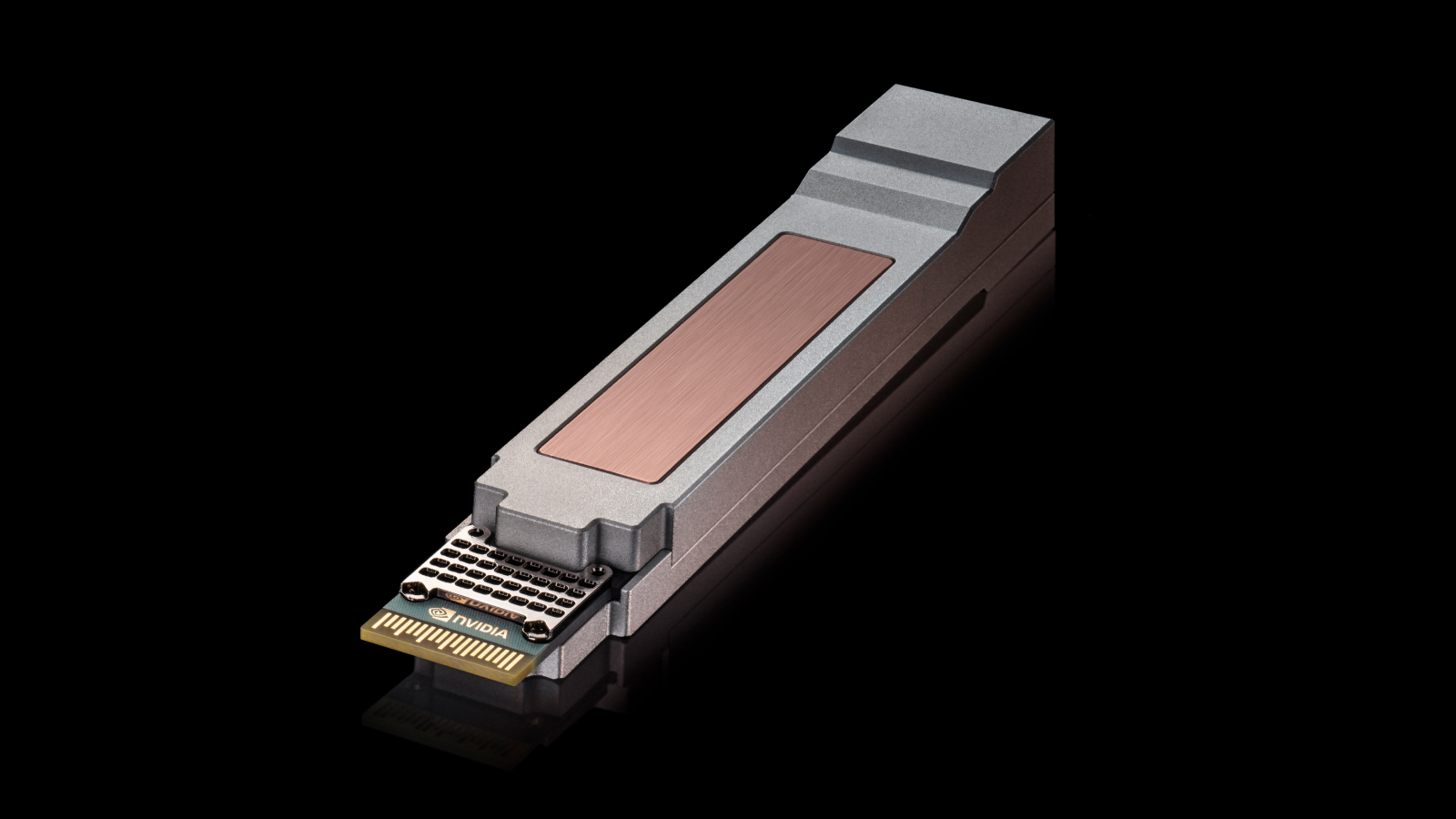
NVIDIA and Cisco are developing a new optical transceiver format for AI networks that targets 400 Gb/s per electrical lane and up to 12.8 Tb/s of overall capacity inside a module comparable in size to today's OSFP optics.
Announced at the 2026 Open Compute Project Global Summit on 2026/10/12, the Ultra Dense Small Form Factor Pluggable, or USFP, is designed to provide 4x the bandwidth density of current 200 Gb/s per lane pluggable optics while retaining the replaceable transceiver model already widely used across data centers.
The first planned USFP transceivers will place 16 full duplex electrical lanes inside an OSFP sized footprint and support both switches and SuperNICs. NVIDIA and Cisco say the connector architecture can later scale to 32 lanes and beyond.
The 12.8 Tb/s figure needs some context. Each electrical lane is designed for 400 Gb/s signaling. With 16 full duplex lanes, the initial design provides 6.4 Tb/s in each direction, producing 12.8 Tb/s of combined bidirectional capacity. It does not mean that a single lane carries 12.8 Tb/s.
| Specification | USFP |
|---|---|
| Electrical Signaling | 400 Gb/s per lane |
| Initial Lane Configuration | 16 full duplex lanes |
| Capacity | Up to 12.8 Tb/s combined bidirectional |
| Future Connector Scaling | 32 lanes and beyond |
| Physical Footprint | Comparable with OSFP |
| Bandwidth Density | 4× versus 200 Gb/s per lane pluggable optics |
| Power Efficiency | Approximately 1.3× higher |
| Supported Module Dissipation | Up to 100 W |
That 4x density gain comes from increasing both the lane count and the bandwidth carried by each lane. This allows switches to connect more 1.6 Tb/s endpoints without immediately adding another networking tier, which can reduce additional switches, optical links, latency, and power consumption as AI clusters grow.
USFP also introduces a new 2 dimensional array connector using a 2 stage insertion mechanism. The high speed contacts engage only after the module is inserted, which NVIDIA and Cisco say can reduce contact wear, improve signal integrity, and provide more predictable insertion force.
The thermal design supports modules dissipating up to 100 W without requiring a separate dedicated cooling circuit inside the transceiver. NVIDIA and Cisco claim USFP also provides approximately 1.3x the power efficiency of existing 200 Gb/s per lane pluggable optics.
Importantly, USFP is still based around removable optical modules. That makes it a different approach from the co packaged optics technology NVIDIA is also developing for future AI networks, where optical engines are integrated much closer to the switch silicon to reduce electrical transmission distances.
Co packaged optics can offer major efficiency advantages at extreme scale, but pluggable modules remain easier to replace and service. USFP attempts to preserve that operational model while substantially increasing the bandwidth available from each front panel connection.
The technology is intended to work across both NVIDIA Spectrum X Ethernet and Cisco Silicon One based networks. TE Connectivity and Amphenol are already collaborating on cages, connectors, and modules, while NVIDIA and Cisco plan to establish USFP as an open industry specification through a future community led multi source project.
The announcement fits into a much broader shift in AI infrastructure. NVIDIA's Vera Rubin platform is dramatically increasing compute and memory bandwidth, but accelerator performance only remains useful if the network can move data quickly enough between thousands of GPUs, storage systems, and other nodes.
USFP is therefore less about making an individual optical link faster and more about fitting substantially more network capacity into the same physical switch footprint. AI networking is increasingly becoming a density problem.
Simply making an individual connection faster is not enough when clusters contain thousands or tens of thousands of accelerators. Switches also need more high bandwidth connections without continuously increasing rack space, networking tiers, power consumption, and system complexity.
USFP attacks that problem while keeping one of the biggest advantages of traditional optics: the module can still be removed and replaced.
That also makes NVIDIA's optical strategy more interesting. The company is simultaneously investing in co packaged optics for highly integrated future switches and denser pluggable solutions such as USFP. Rather than betting on a single optical architecture, NVIDIA appears to be building different connectivity options for different parts of the AI factory.
If the ecosystem adopts USFP broadly, 400 Gb/s per lane networking could become an important step toward feeding the enormous compute density arriving with Vera Rubin and the generations that follow.
Would you rather see AI networks continue scaling replaceable pluggable optics like USFP, or move more aggressively toward integrated co packaged optical systems?
