
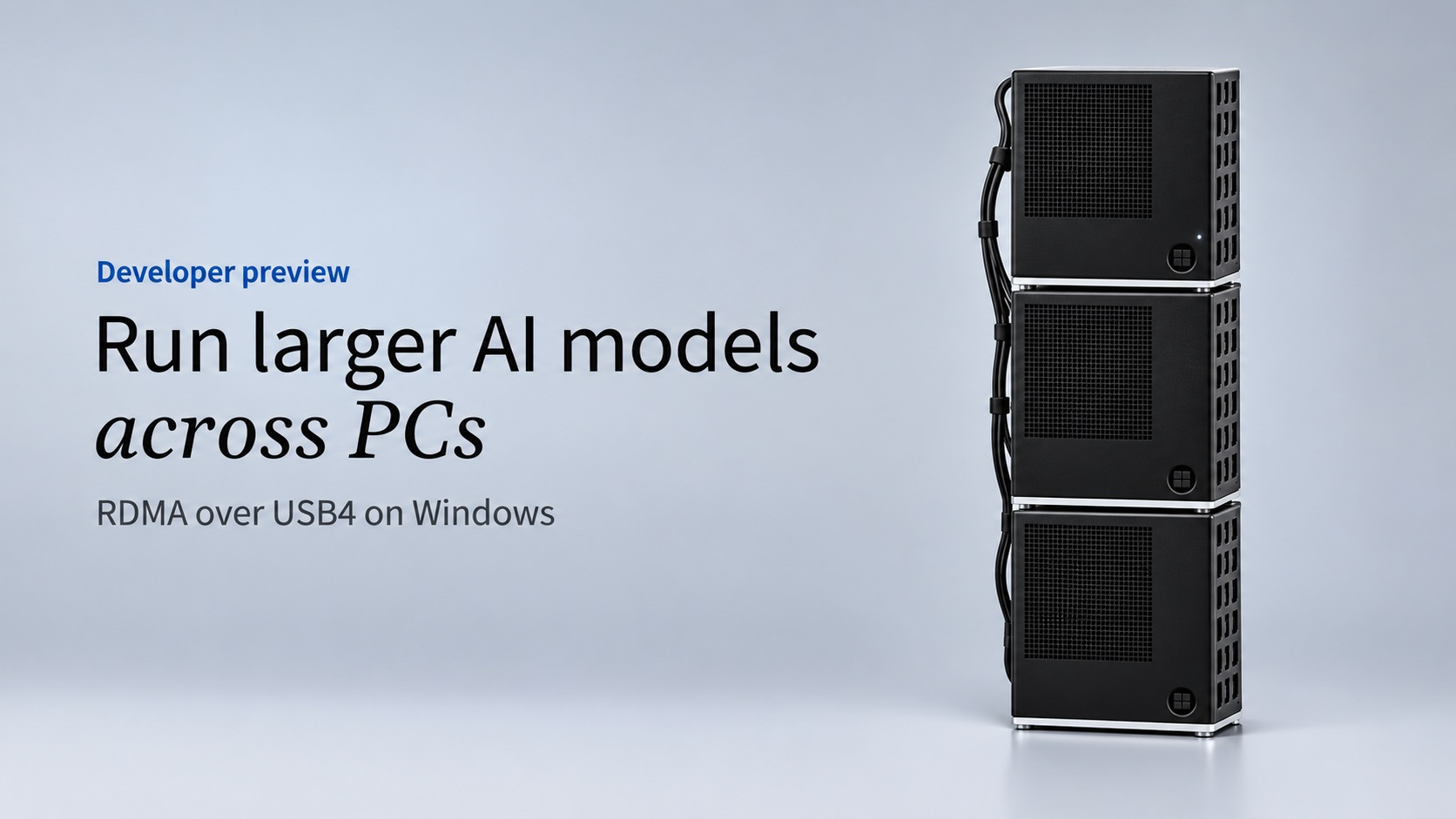
Microsoft has unveiled RDMA over USB4 for Windows 11, introducing a new technology that allows multiple computers to combine their memory and GPU computing resources to run large artificial intelligence models locally. Announced on November 19, 2026, during Microsoft Ignite, the experimental implementation delivers up to 4 times lower communication latency compared with conventional Ethernet networking over the same USB4 connection. Developed in collaboration with AMD and Intel, the technology could make large AI models more accessible without requiring expensive enterprise GPUs, specialized networking equipment, or cloud infrastructure.
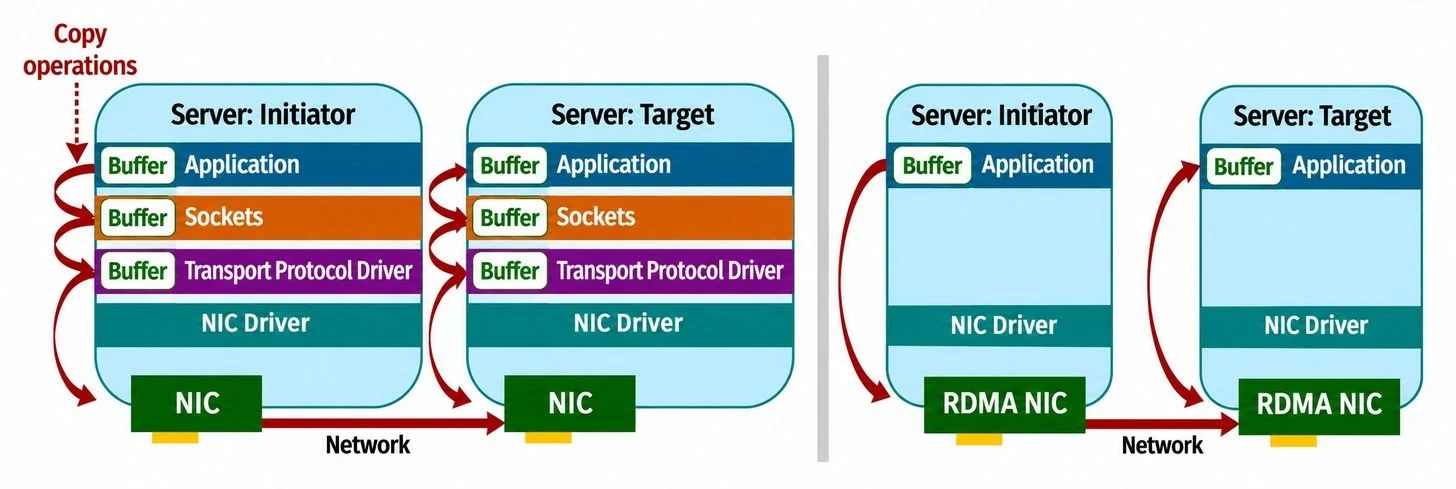
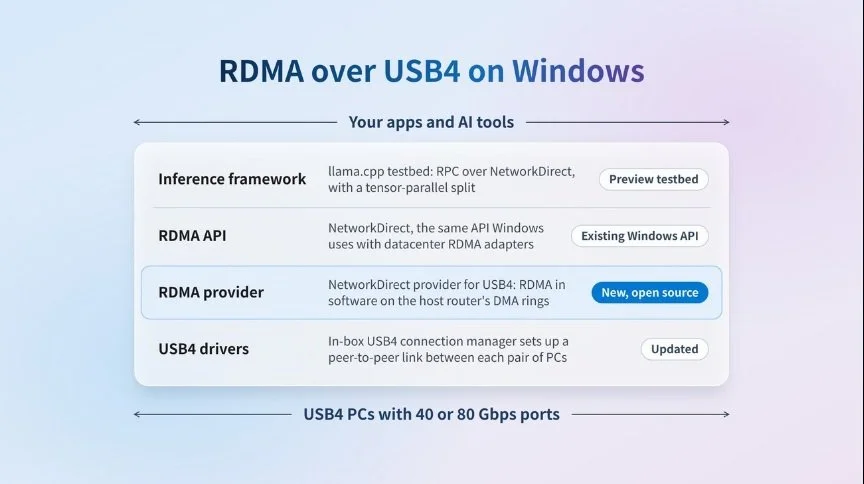
According to Microsoft's official technical announcement, the implementation uses Remote Direct Memory Access (RDMA) to transfer information directly between the memory of connected computers, bypassing much of the conventional networking stack. This reduces CPU overhead and communication delays, which are particularly important when running distributed AI inference across multiple GPUs. In Microsoft's testing, small message round trip latency dropped to approximately 28 to 50 microseconds, representing around 4 times lower latency than Ethernet over the same USB4 connection. The improvement applies specifically to communication latency and should not be interpreted as a 4 times increase in AI inference performance.
The technology supports USB4 connections operating at 40 Gbps and 80 Gbps, with the latter providing twice the available bandwidth. Microsoft uses the existing Windows NetworkDirect API alongside a new software based RDMA provider, allowing compatible inference frameworks to distribute model processing across several computers. Instead of requiring a single workstation with enough memory to load an entire AI model, users can divide the workload between multiple systems, taking advantage of their combined memory capacity and GPU processing power. However, the memory remains physically distributed between computers rather than becoming a single conventional shared memory pool.
Microsoft demonstrated the technology using AMD Ryzen AI Max and Intel Core Ultra Series 3 processors, with both manufacturers reporting promising results from their respective hardware configurations. In AMD's demonstration, 3 mini PCs equipped with Ryzen AI Max+ 395 processors, Radeon 8060S graphics, and 128 GB of unified memory each successfully executed the 235 billion parameter Qwen3 mixture of experts model using 4 bit quantization. The combined systems provided 384 GB of physical memory, with AMD reporting 21.98 tokens per second during text generation and 117.98 tokens per second during prompt processing.
Intel demonstrated a similar configuration using 3 and 4 Core Ultra Series 3 computers equipped with 64 GB of memory each, running the GPT OSS 120B model through Thunderbolt 4 connections. The systems generated approximately 49 tokens per second with 3 computers and 54 tokens per second with 4, demonstrating that adding more computing nodes can improve performance, although scaling remains dependent on software optimization, communication overhead, and hardware capabilities.
Microsoft RDMA Over USB4 Performance Results
| Configuration | AI Model | Reported Performance |
|---|---|---|
| 3 AMD Ryzen AI Max+ 395 PCs, 384 GB combined RAM | Qwen3 235B, 4 bit | 21.98 tokens/s |
| 3 Intel Core Ultra Series 3 PCs, 192 GB combined RAM | GPT OSS 120B | 49.4 tokens/s |
| 4 Intel Core Ultra Series 3 PCs, 256 GB combined RAM | GPT OSS 120B | 54.2 tokens/s |
| USB4 RDMA Communication | Small message round trip | 28 to 50 microseconds |
These results demonstrate that consumer computing platforms can execute models containing more than 100 billion parameters without depending on dedicated enterprise AI accelerators. However, the benchmarks were conducted using manufacturer optimized software and specific hardware configurations. The memory capacity listed represents the total physical memory across the connected systems, not the exact amount available for model weights, and real performance will vary depending on model architecture, quantization, context length, and GPU memory bandwidth.
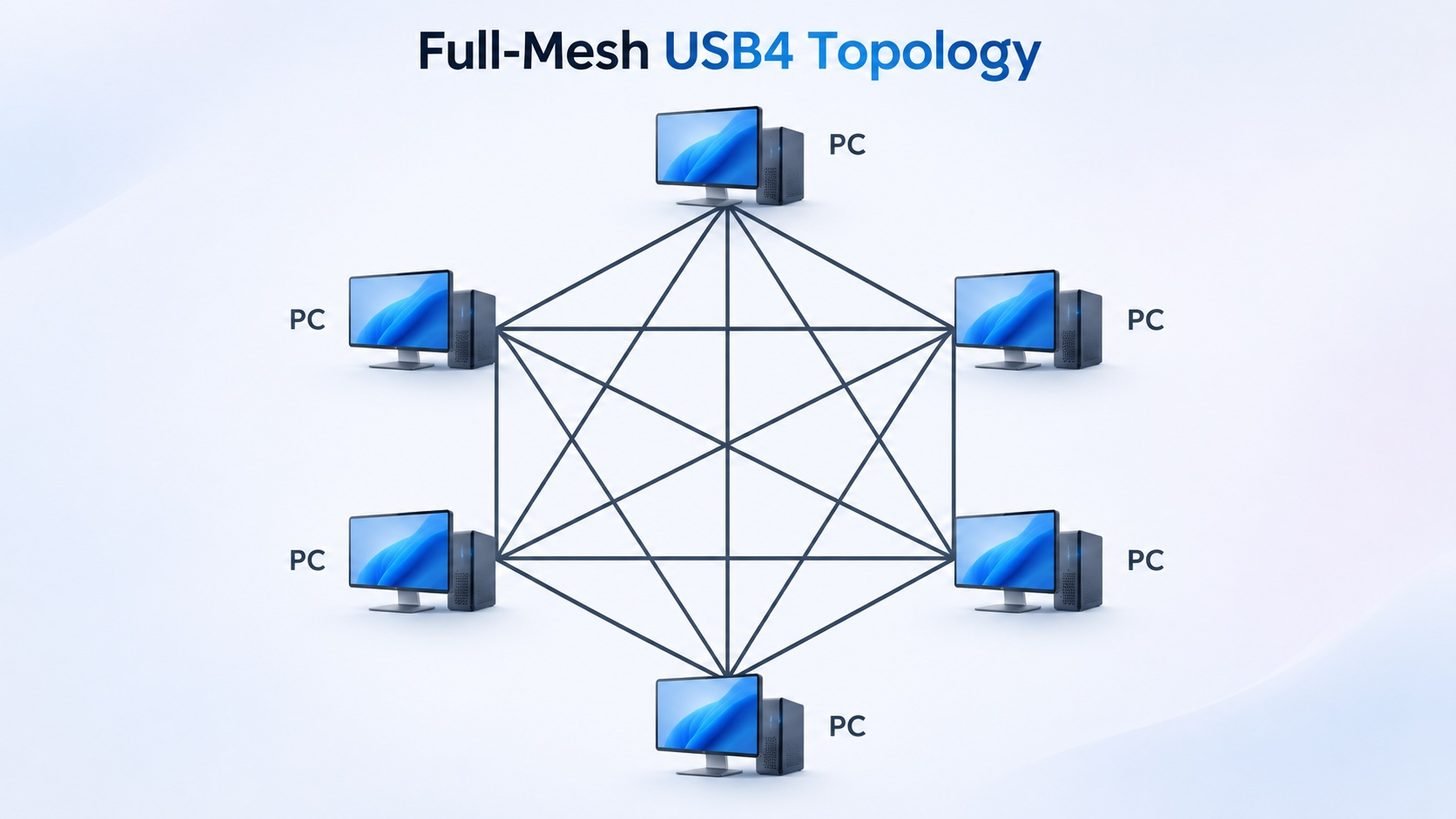
The implementation uses a modified llama.cpp inference framework, with Microsoft publishing its RDMA NetworkDirect provider and distributed inference sample for developers. The technology currently requires a direct connection between every participating PC. For example, a 3 computer cluster requires 2 USB4 ports on each machine and 3 cables connecting every system to the others. Microsoft warns that connecting computers in a chain significantly reduces performance.
The announcement also represents an important development compared with existing local AI networking solutions. NVIDIA previously introduced PAIR, which distributes independent AI requests between connected computers, but that implementation does not combine their memory to execute a single model. Microsoft's RDMA technology goes further by supporting distributed inference, allowing a model that exceeds the memory capacity of an individual system to operate across multiple compatible PCs.
This approach also complements Microsoft's Project Zenith initiative for AMD Ryzen AI Max systems, which focuses on simplifying local AI development through a preconfigured Windows environment. Combining accessible software tools with distributed computing could eventually make larger AI models practical for enthusiasts, independent developers, and smaller research teams.
For now, RDMA over USB4 remains an experimental developer preview, with Microsoft planning to introduce support through the Windows Insider Experimental Channel. The required Windows build has not yet been released, and initial testing requires enabling test signing and temporarily disabling Secure Boot. Microsoft therefore recommends dedicated testing machines rather than everyday computers. Broader Windows availability, supported hardware configurations, and final performance characteristics have not been announced.
Microsoft's RDMA over USB4 technology represents one of the most promising developments for local AI because it addresses a fundamental limitation facing PC enthusiasts: the inability to use the combined memory capacity of multiple computers efficiently for a single large AI model.
Instead of purchasing an expensive workstation with 128 GB or 192 GB of unified memory, users could potentially connect existing compatible systems and distribute demanding AI workloads between them. This approach could extend the useful lifespan of older computers and reduce dependence on enterprise hardware, although the initial demonstration configurations still involve relatively expensive machines with substantial unified memory.
The most important advantage is greater control over computing resources. Local AI should not require consumers to depend exclusively on cloud subscriptions or continually replace functional hardware to access newer models. Enabling multiple PCs to cooperate creates opportunities for affordable home laboratories, independent AI development, and more flexible computing environments.
However, Microsoft's early implementation still requires substantial improvements in accessibility, software compatibility, and system security. Requiring experimental Windows builds and disabling Secure Boot is not a practical long term solution for everyday users. Broader compatibility with existing gaming desktops, discrete NVIDIA and AMD graphics cards, and mixed hardware configurations would make the technology considerably more valuable.
The future of local AI should focus on making better use of hardware people already own rather than forcing them into increasingly expensive systems. If Microsoft successfully integrates distributed inference into standard Windows installations, RDMA over USB4 could become an important step toward more accessible and independent personal AI computing.
Would you connect multiple existing PCs to run a massive AI model locally, or would you prefer investing in a single workstation with more GPU memory and fewer compatibility challenges?
