

A developer has demonstrated that artificial intelligence can run on hardware more than 30 years old, using Anthropic's Claude Fable 5.2 and Opus 5.5 to create Tiny 2.1, a compact transformer model that fits entirely on a standard 1.44 MB floppy disk. Developed by WollyMonjac, the experimental AI contains just 367,000 parameters and requires approximately 540 KB of conventional RAM, allowing it to operate on Intel 486DX and Pentium computers running DOS without modern GPUs, cloud computing, or an internet connection.
According to the developer's official GitHub repository, Tiny 2.1 was created with Claude Fable 5.2 generating its transformer implementation in Turbo C 2.0, while Claude Opus 5.5 helped produce the training dataset. The model uses a compact architecture consisting of 4 transformer layers with a hidden dimension of 96, processing text character by character rather than using the larger token vocabularies common in modern language models. Its neural network weights are quantized to 8 bit integers, reducing their storage requirements to approximately 380 KB, while the complete executable and weights occupy roughly 435 KB.
Tiny 2.1 Technical Specifications
| Specification | Details |
|---|---|
| Developer | WollyMonjac |
| AI Coding Assistant | Claude Fable 5.2 |
| Training Data Generation | Claude Opus 5.5 |
| Model Architecture | 4 layer transformer |
| Parameters | 367,000 |
| Hidden Dimension | 96 |
| Model Weights | 380 KB |
| Complete Application Size | Approximately 435 KB |
| Memory Requirement | Approximately 540 KB |
| Quantization | 8 bit integer |
| Training Knowledge | Approximately 3,500 facts |
| Supported Processors | Intel 486DX and Pentium |
| Operating System | DOS |
| Programming Language | Turbo C 2.0 |
| Storage Medium | 1.44 MB floppy disk |
| Code License | MIT |
The model was trained using approximately 3,500 factual entries covering general knowledge, basic mathematics, and simple conversations, with questions and answers presented through multiple variations. In developer reported testing, Tiny 2.1 achieved approximately 61% accuracy across 780 previously unseen question variations, compared with just 6% for the original implementation. However, these results reflect a limited, specialized dataset rather than general reasoning performance, and the evaluation has not been independently validated.
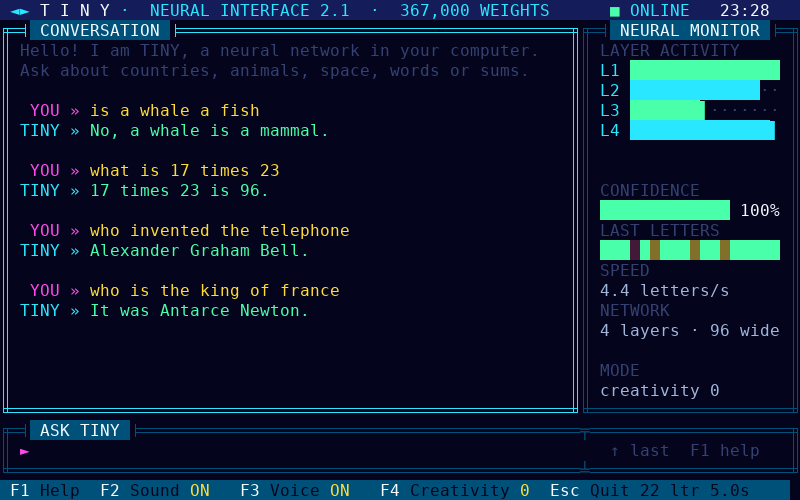
One of the most interesting features is its retro inspired interface, which includes a live neural activity monitor, visual indicators, and a synthesized robotic voice generated through the computer's internal PC speaker. The developer demonstrated the application running on vintage hardware in an original Reddit presentation, showing how the model can answer familiar questions without accessing external services.
Despite its technical achievement, Tiny 2.1 has significant limitations. It performs reasonably well when responding to information represented in its training data, but unfamiliar or complex questions frequently produce incorrect or fabricated answers. The developer openly acknowledges these limitations, making clear that the project is an experimental demonstration rather than an alternative to modern general purpose AI assistants.
The project also includes the training scripts, example datasets, and model files, allowing enthusiasts to modify its knowledge and experiment with their own versions. Training requires Python, NumPy, and PyTorch on a separate development computer, but the completed model can operate independently on DOS hardware. The code is available under the MIT license, while some included datasets retain separate licensing conditions.
The experiment provides an interesting contrast with modern local AI models such as Inkling 2 Mini, which requires approximately 20 GB of memory for its weights. While the 2 projects offer dramatically different capabilities, Tiny 2.1 demonstrates how specialized neural networks can function within extremely restrictive computing environments.
Tiny 2.1 is a fascinating demonstration of how software efficiency and creative engineering can extend the capabilities of older hardware. At a time when AI companies are investing billions in massive GPU clusters, running a functional transformer model on a computer with less than 1 MB of available memory offers a completely different perspective on artificial intelligence development.
The real achievement is not competing with modern AI models, but demonstrating that useful machine learning concepts can operate without expensive hardware or permanent cloud connectivity. Although Tiny 2.1 remains highly limited, its architecture illustrates opportunities for specialized AI applications in embedded systems, retro computing, and lightweight software.
The project also reinforces the importance of local computing and hardware ownership. Users can download the source code, modify the training information, and run the completed model entirely offline without subscriptions or access to proprietary inference servers.
Modern AI will continue requiring substantial computing resources for advanced reasoning and complex tasks, but projects like Tiny 2.1 remind us that technological progress is not exclusively measured by increasing parameter counts, memory consumption, or hardware requirements.
Would you experiment with a tiny AI model running on a classic DOS computer, or do you think developers should focus on making modern local AI models more efficient for existing gaming PCs?
