
Thinking Machines Lab has introduced Inkling 2 Mini, a new 26.4 billion parameter AI model capable of running locally on Apple Silicon computers with just 32 GB of unified memory. Released on November 20, 2026, the open weights model targets coding, advanced reasoning, autonomous AI agents, and multimodal applications while requiring approximately 20 GB of memory for its model weights. Its compact footprint and competitive benchmark results demonstrate how increasingly capable AI systems can operate on consumer hardware without depending entirely on expensive cloud infrastructure.
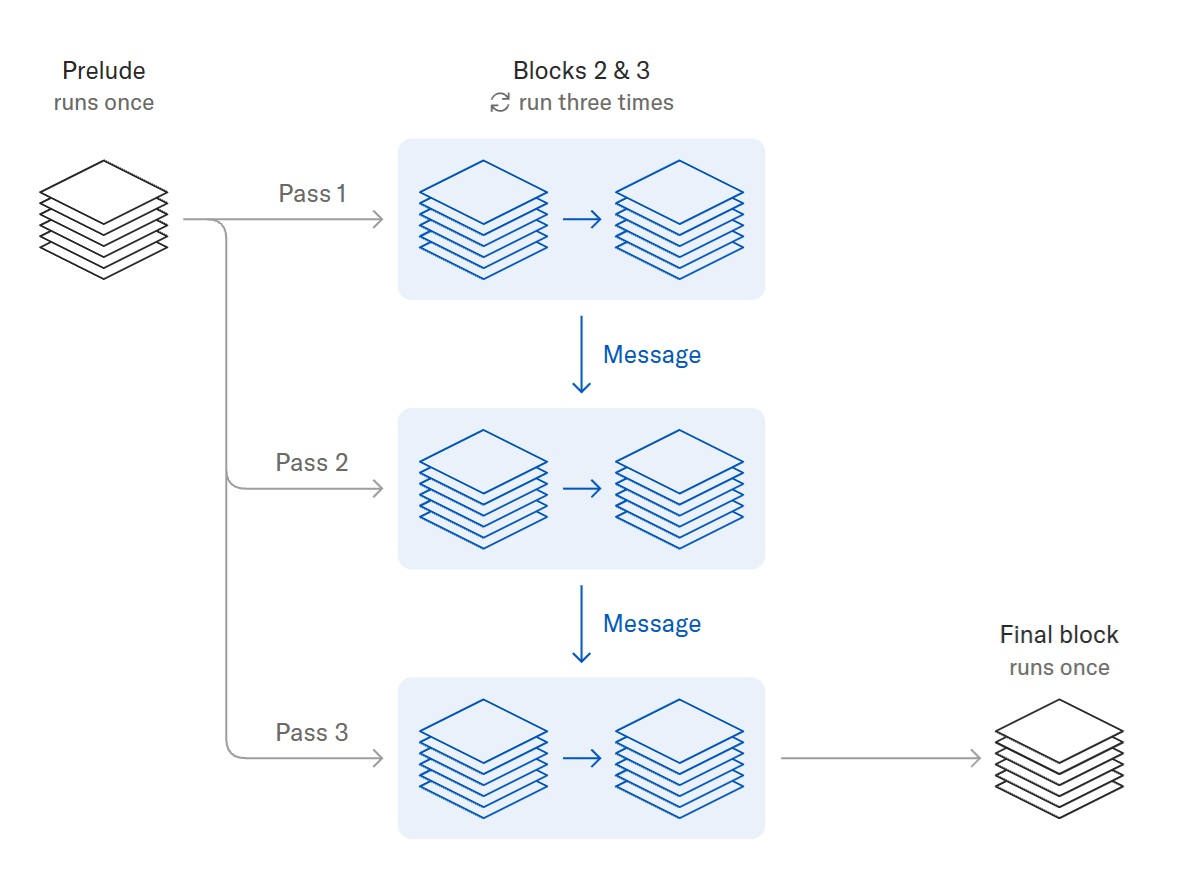
According to Thinking Machines Lab's official announcement, Inkling 2 Mini uses a Mixture of Experts architecture with 26.4 billion total parameters, but activates only 3.4 billion unique parameters per token. The model introduces a looped transformer design that processes its middle 12 layers 3 times, effectively performing additional reasoning without increasing the number of stored parameters. This results in approximately 5.4 billion effective parameter activations per token, improving reasoning efficiency while keeping memory requirements relatively low. The model also uses native NVFP4 and MXFP8 precision, reducing its overall memory footprint to approximately 20 GB.
Inkling 2 Mini Specifications
| Specification | Details |
|---|---|
| Developer | Thinking Machines Lab |
| Total Parameters | 26.4 billion |
| Active Parameters | 3.4 billion |
| Effective Activations per Token | 5.4 billion |
| Architecture | Looped Mixture of Experts |
| Transformer Layers | 24, with 12 repeated 3 times |
| Model Size | Approximately 20 GB |
| Precision | NVFP4 and MXFP8 |
| Context Window | Up to 1 million tokens |
| Input | Text and images |
| Output | Text |
| Minimum Supported Mac Memory | 32 GB |
| License | Apache 2.0 |
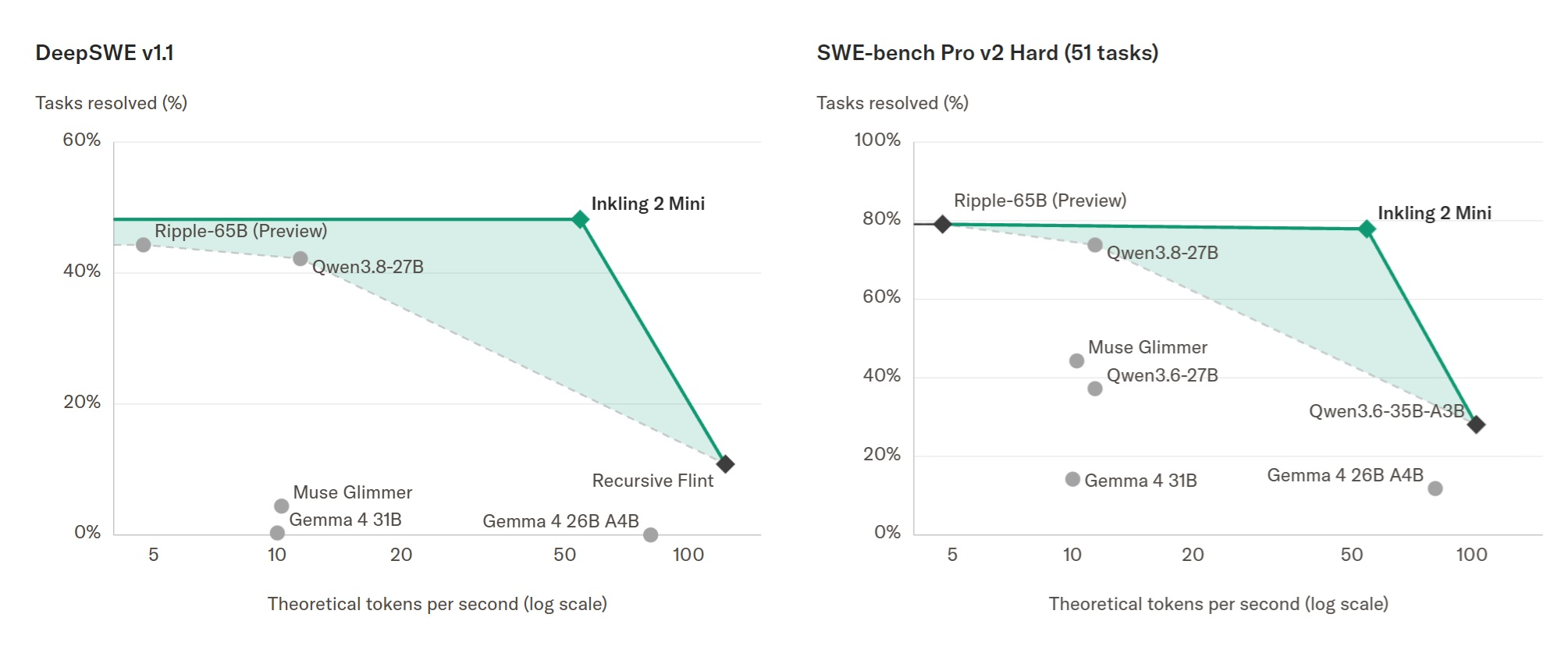
The performance results are particularly impressive for a model designed to run on consumer devices. In the developer's published evaluations, Inkling 2 Mini achieved 79.2% on SWE Bench Verified, 48.2% on DeepSWE v1.1, and 79% on BrowseComp, outperforming several similarly sized open models in coding and research tasks. It also reached 92.8% on OmniDocBench, demonstrating strong document processing capabilities. However, performance varies by workload, and competing models such as Qwen3.8 27B remain stronger in certain conversational and complex instruction following evaluations.
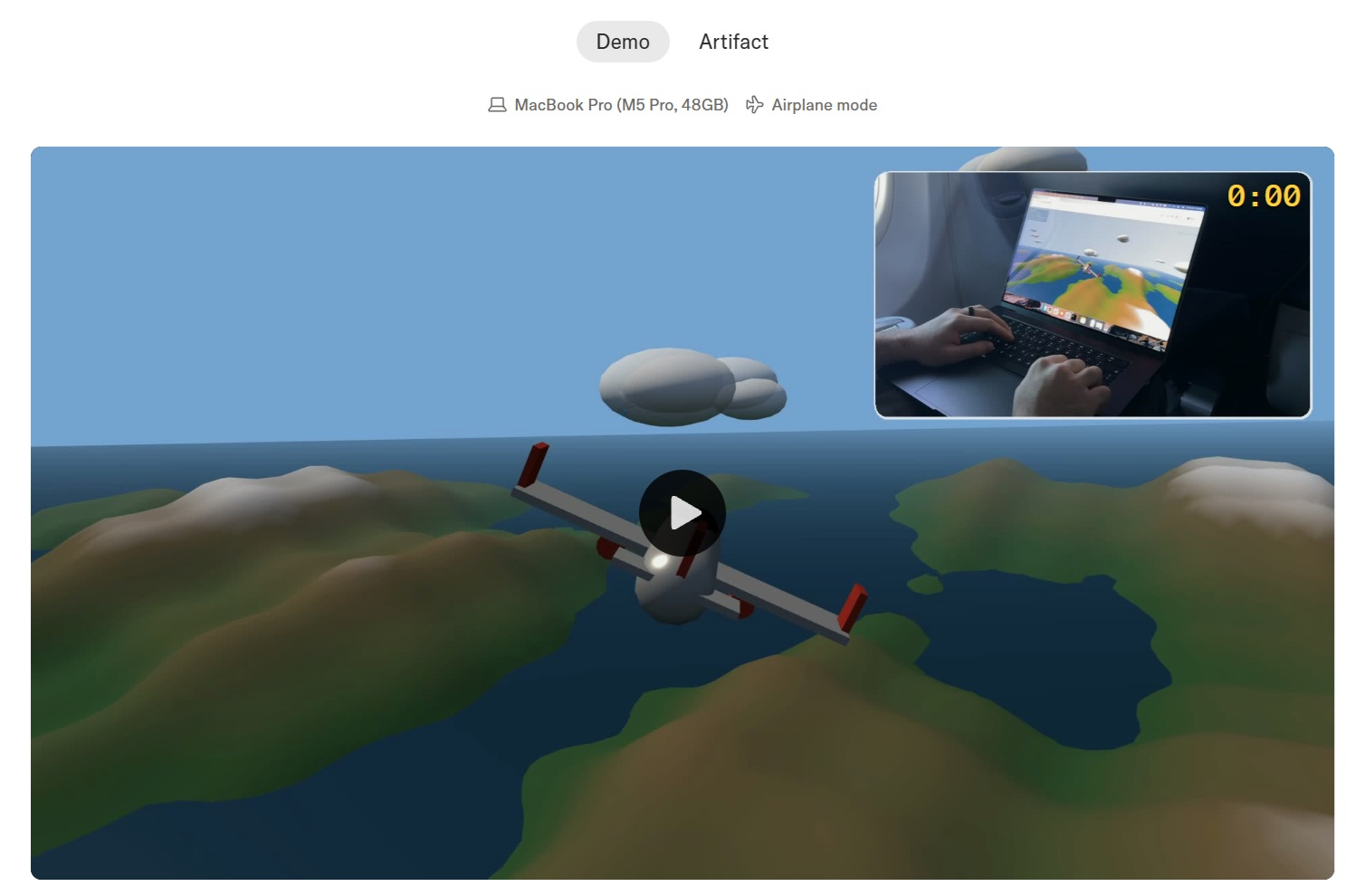
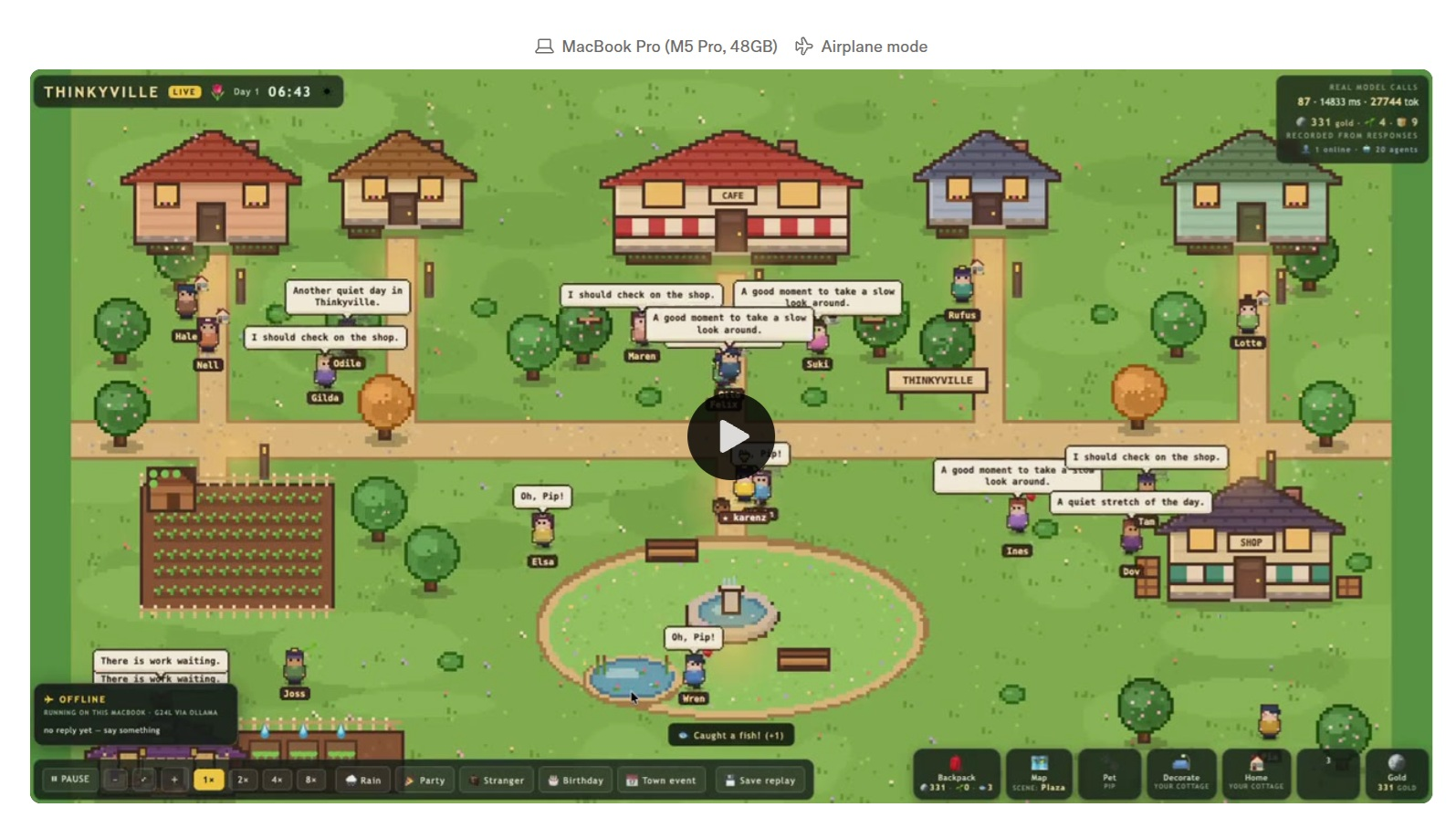
Thinking Machines demonstrated the model operating completely offline on a MacBook Pro equipped with an Apple M5 Pro processor and 48 GB of unified memory. During the demonstration, Inkling 2 Mini generated a playable flight simulator without internet connectivity. Another experiment showed the model controlling 20 autonomous characters simultaneously inside a simulated village, illustrating its potential for game development, persistent AI agents, and interactive applications. Both demonstrations are available in the official technical presentation.
The model is available through Ollama, allowing Apple Silicon Mac owners with at least 32 GB RAM to download and operate it locally. Developers can also access the official model weights on Hugging Face, alongside quantized GGUF configurations compatible with Unsloth and llama.cpp. NVIDIA DGX Spark is officially supported, while other GPU platforms are possible with 32 GB or more VRAM recommended. Smaller quantizations may operate on less memory, although performance and compatibility depend on the hardware and software implementation.
While the advertised context window reaches 1 million tokens, users should remember that larger contexts introduce additional memory and processing requirements. A system with 32 GB RAM may successfully load the model without necessarily supporting its maximum context length efficiently.
The release arrives as manufacturers continue expanding unified memory systems for local AI, including AMD's Ryzen AI MAX platform with up to 192 GB of memory. However, Inkling 2 Mini demonstrates that improvements in model architecture and memory efficiency can also reduce the need for increasingly expensive hardware.
Inkling 2 Mini represents an important advancement for local AI accessibility. Rather than relying exclusively on larger models requiring multiple professional GPUs, Thinking Machines has demonstrated how architectural optimizations can deliver competitive reasoning and coding performance within a relatively modest memory footprint.
The ability to operate a capable 26B model offline on a 32 GB computer is more meaningful for consumers than another massive cloud model requiring expensive enterprise infrastructure. Local execution provides greater control over personal data, avoids mandatory subscription fees for inference, and allows developers to integrate AI into applications without depending on external services.
For PC enthusiasts, the next important development will be broader compatibility with standard gaming GPUs, particularly configurations featuring 16 GB or 24 GB VRAM. Efficient quantization and support for frameworks such as llama.cpp could expand accessibility across existing NVIDIA, AMD, and Intel hardware.
The future of consumer AI should prioritize efficiency, compatibility, and hardware ownership rather than forcing users into increasingly expensive systems.
Would you prefer running a capable 26B AI model locally on your own computer, or do you believe larger cloud AI models still offer enough advantages to justify subscription costs?
