
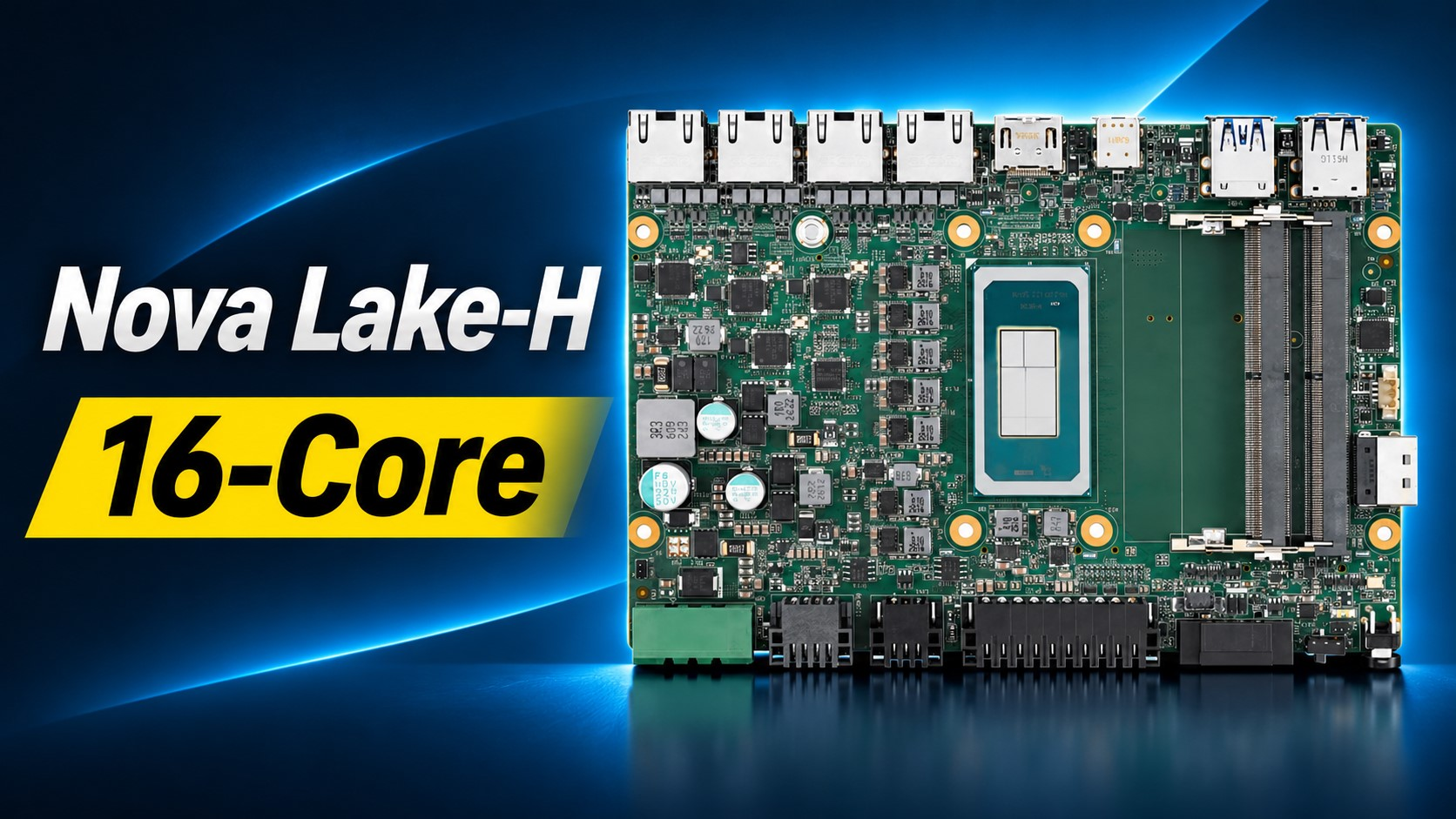
Intel's upcoming Core Ultra Series 4 Nova Lake H mobile processors have appeared in preliminary specifications, revealing a 16 core configuration with boost frequencies reaching 4.8 GHz, support for DDR5 memory at 8000 MT/s, and a 25W thermal design power. The information originates from industrial computing manufacturer Advantech, whose upcoming ASR A505 single board computer provides an early look at Intel's next generation mobile architecture before its official announcement.
According to Advantech's preliminary ASR A505 datasheet, the processor features 16 CPU cores, a 2.0 GHz Performance core base frequency, and 18 MB of last level cache. The manufacturer identifies the platform as Intel Core Ultra Series 4, codenamed Nova Lake H, with a configurable power range between 15W and 25W. Although the documentation targets industrial robotics and embedded computing systems, the specifications offer insight into the architecture expected to power future mobile devices.
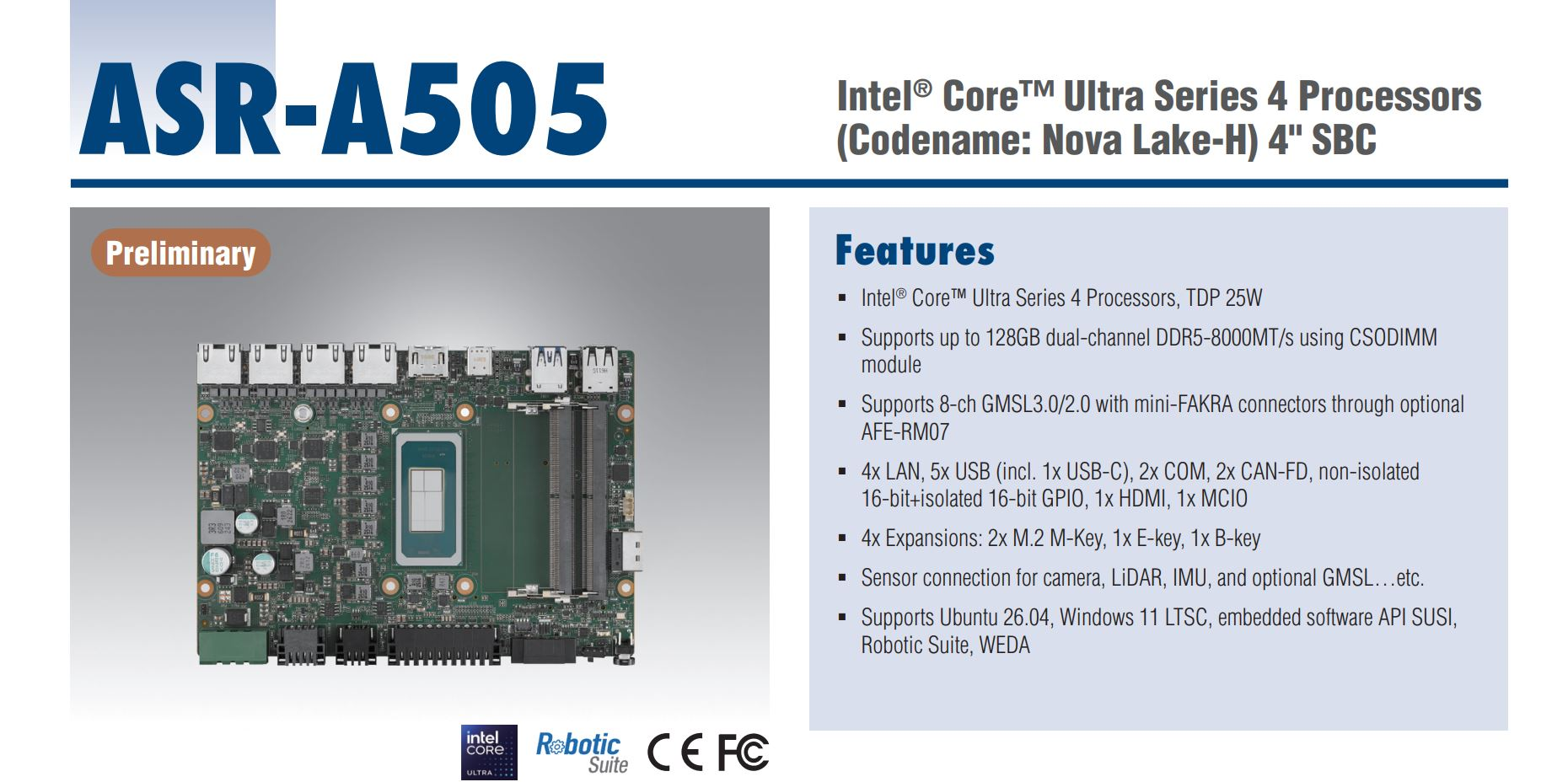
One particularly interesting detail is the listed 8 Performance cores, 4 Efficiency cores, and 4 Low Power Efficiency cores configuration. This differs from previous reports suggesting Nova Lake H would feature 4 Performance cores, 8 Efficiency cores, and 4 Low Power Efficiency cores. The discrepancy could indicate a preliminary documentation error or an alternative processor configuration, but Intel has not confirmed either possibility.
Leaked Intel Nova Lake H Specifications
| Specification | Preliminary Details |
|---|---|
| Processor Family | Intel Core Ultra Series 4 |
| Architecture | Nova Lake H |
| CPU Cores | 16 |
| Listed Configuration | 8P + 4E + 4LPE |
| Previously Reported Configuration | 4P + 8E + 4LPE |
| Performance Core Base Clock | 2.0 GHz |
| Maximum Boost Frequency | 4.8 GHz |
| Last Level Cache | 18 MB |
| TDP | 25W, configurable from 15W |
| Memory | DDR5 8000 MT/s |
| Maximum Memory Capacity | 128 GB |
| Memory Configuration | Dual channel, 2 CSODIMM slots |
| Integrated Graphics | Intel Arc |
| Maximum Graphics Frequency | 2.3 GHz |
| Graphics Execution Units | Not disclosed |
The processor is paired with Intel Arc integrated graphics capable of reaching 2.3 GHz, although the number of graphics execution units remains undisclosed. Advantech's platform documentation references configurations with 4 or 12 Xe cores, but it does not establish that both will be available on this particular 16 core processor. The 12 Xe configuration also appears to affect PCIe connectivity on the board, suggesting different graphics implementations could require additional platform compromises.
Memory support represents another significant improvement, with dual channel DDR5 8000 and maximum capacities reaching 128 GB. This could benefit demanding productivity applications, compact workstations, and integrated graphics performance, where memory bandwidth is especially important.
The Advantech ASR A505 also incorporates 4 Ethernet connections supporting up to 2.5 GbE each, dual M.2 storage connections with PCIe 5.0 capabilities, and specialized interfaces for robotic sensors and cameras. Its industrial design confirms that Intel's upcoming processors are being prepared for applications beyond conventional consumer laptops.
The disclosure follows earlier information surrounding Intel's 16 core Nova Lake desktop architecture, which suggested substantially higher power limits and more capable integrated graphics configurations. Unlike those desktop variants, the newly documented mobile processor appears focused on efficiency and compact computing environments.
Intel has not officially announced the final Nova Lake H lineup, processor model numbers, pricing, or release dates. The specifications also remain subject to revision, and no independent performance benchmarks are currently available.
The most interesting aspect of this leak is Intel's apparent effort to combine 16 CPU cores with a configurable 15W to 25W power envelope. If the company can deliver meaningful generational improvements within those limits, Nova Lake H could become an attractive platform for efficient laptops, compact workstations, and industrial computers.
However, the 25W specification should not be confused with maximum processor power consumption, particularly when boost frequencies and sustained workloads can require additional electrical and thermal headroom.
For PC gamers, the integrated graphics configuration will be particularly important. Intel's continued development of Arc graphics and faster DDR5 memory support could create more capable compact gaming systems without dedicated graphics cards.
The industry needs more efficient processors that deliver practical performance improvements without increasing cooling requirements or hardware costs. Nova Lake H could represent progress in that direction, but real gaming benchmarks, sustained power measurements, and pricing will ultimately determine its competitiveness against AMD's mobile Ryzen processors.
Would you choose a 16 core Intel Nova Lake laptop with a 25W power rating for better efficiency and battery life, or would you prefer a higher power processor delivering stronger sustained gaming performance?
