
AMD Pushes Ryzen AI MAX 400 Gorgon Halo To 192 GB Unified Memory For Local 300B+ AI Models
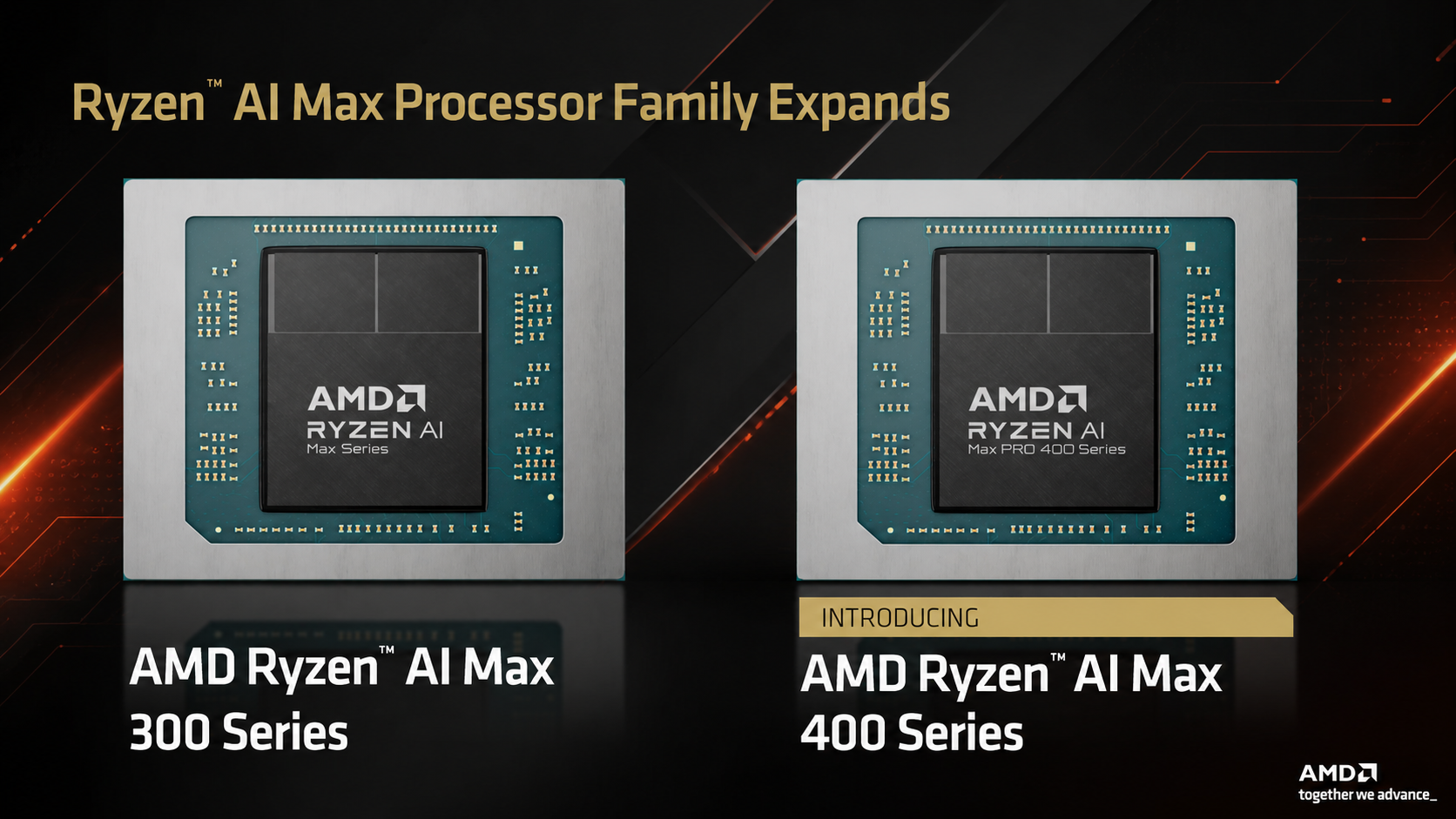
AMD has officially introduced its new Ryzen AI MAX 400 and Ryzen AI MAX PRO 400 SoCs, expanding its client AI processor lineup with a major memory upgrade designed for local large language model workloads, creator applications, engineering software, and advanced agentic AI workflows. The new chips are part of AMD’s Gorgon Halo family and continue the same foundation used by the Ryzen AI MAX 300 lineup, combining Zen 5 CPU cores, RDNA 3.5 graphics, and an XDNA 2 AI NPU inside a single platform. While the core architecture remains familiar, AMD is raising the ceiling with higher CPU and GPU clocks, broader memory support, and a much stronger focus on local AI model execution.
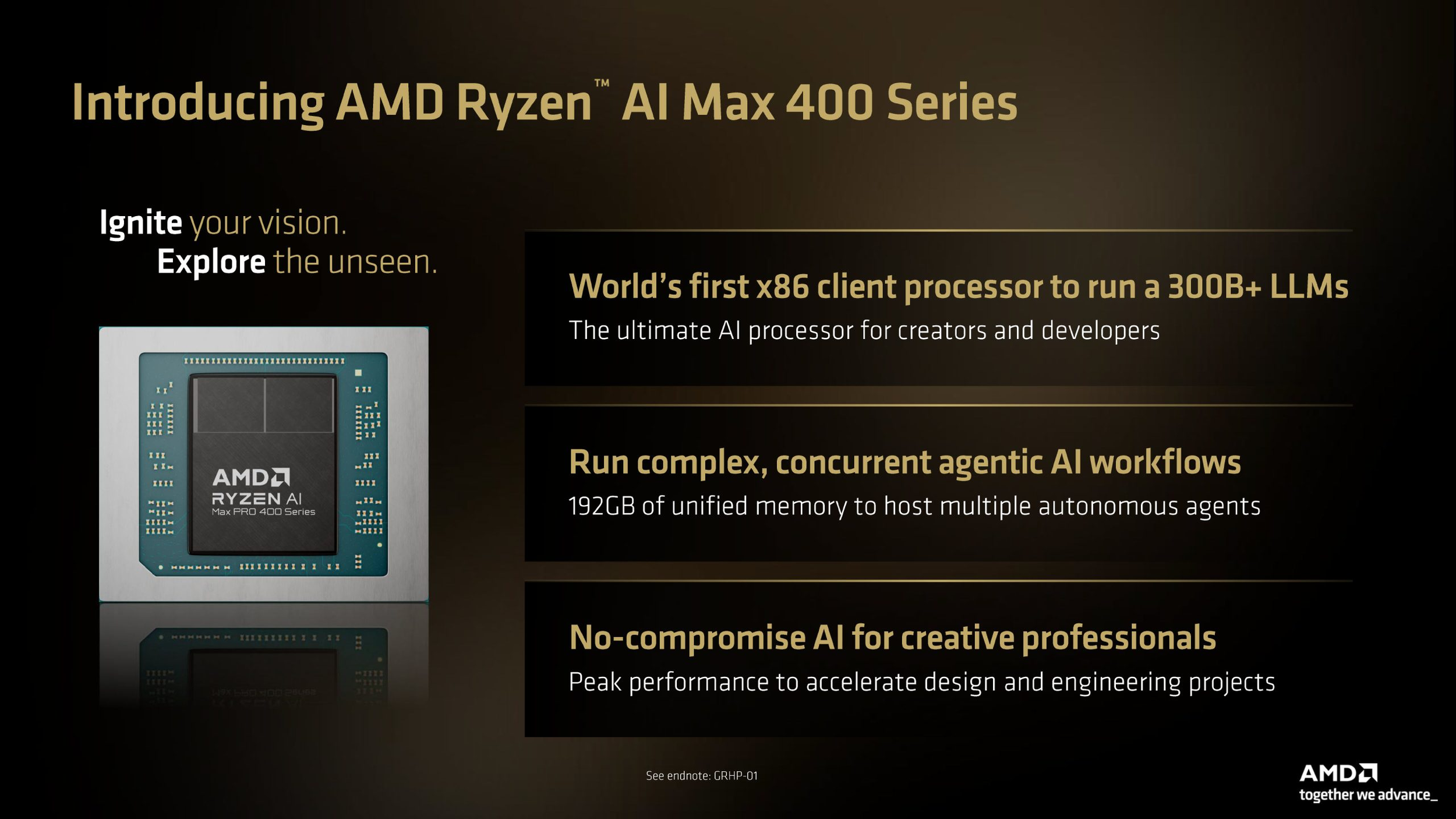
The biggest change is support for up to 192 GB of unified memory. This gives Ryzen AI MAX 400 systems enough memory capacity to run massive local AI models, including 300B+ parameter LLMs, directly on an x86 client processor. For developers, researchers, creators, and AI power users, this is a major shift because it allows large workloads to run locally without relying completely on cloud infrastructure.
AMD is also allowing users to allocate up to 160 GB of VRAM to the integrated GPU, a significant increase from the current 112 GB allocation available on 128 GB Ryzen AI MAX configurations. This added GPU memory headroom is especially important for AI inference, multi agent workloads, content creation, rendering, simulation, and professional applications that depend on large memory pools.
The Ryzen AI MAX 400 family will include 3 chips at launch: Ryzen AI MAX+ PRO 495, Ryzen AI MAX+ PRO 490, and Ryzen AI MAX+ PRO 485. These processors match the core configurations of existing Ryzen AI MAX 300 models but receive higher operating clocks across both CPU and GPU components.
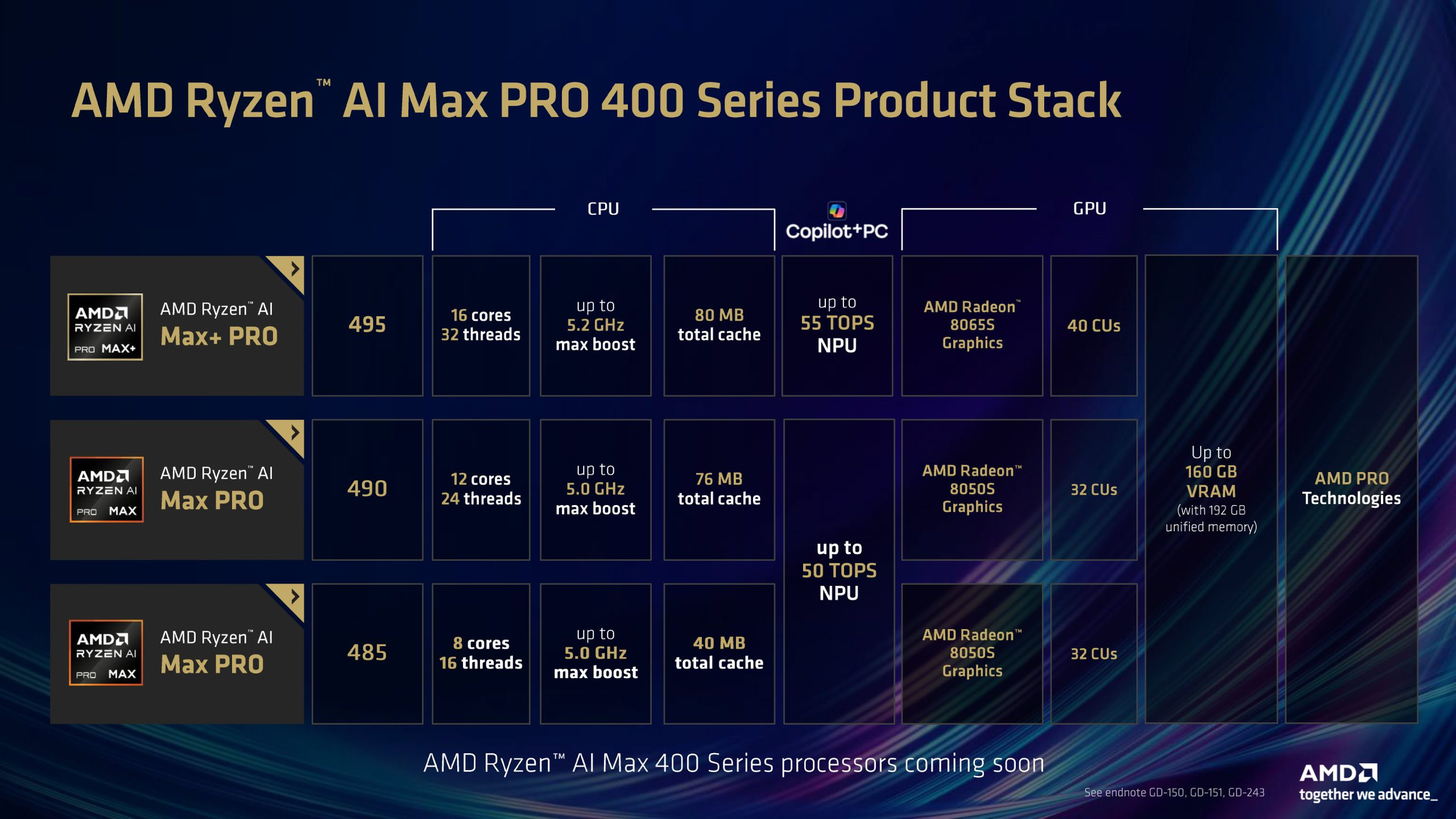
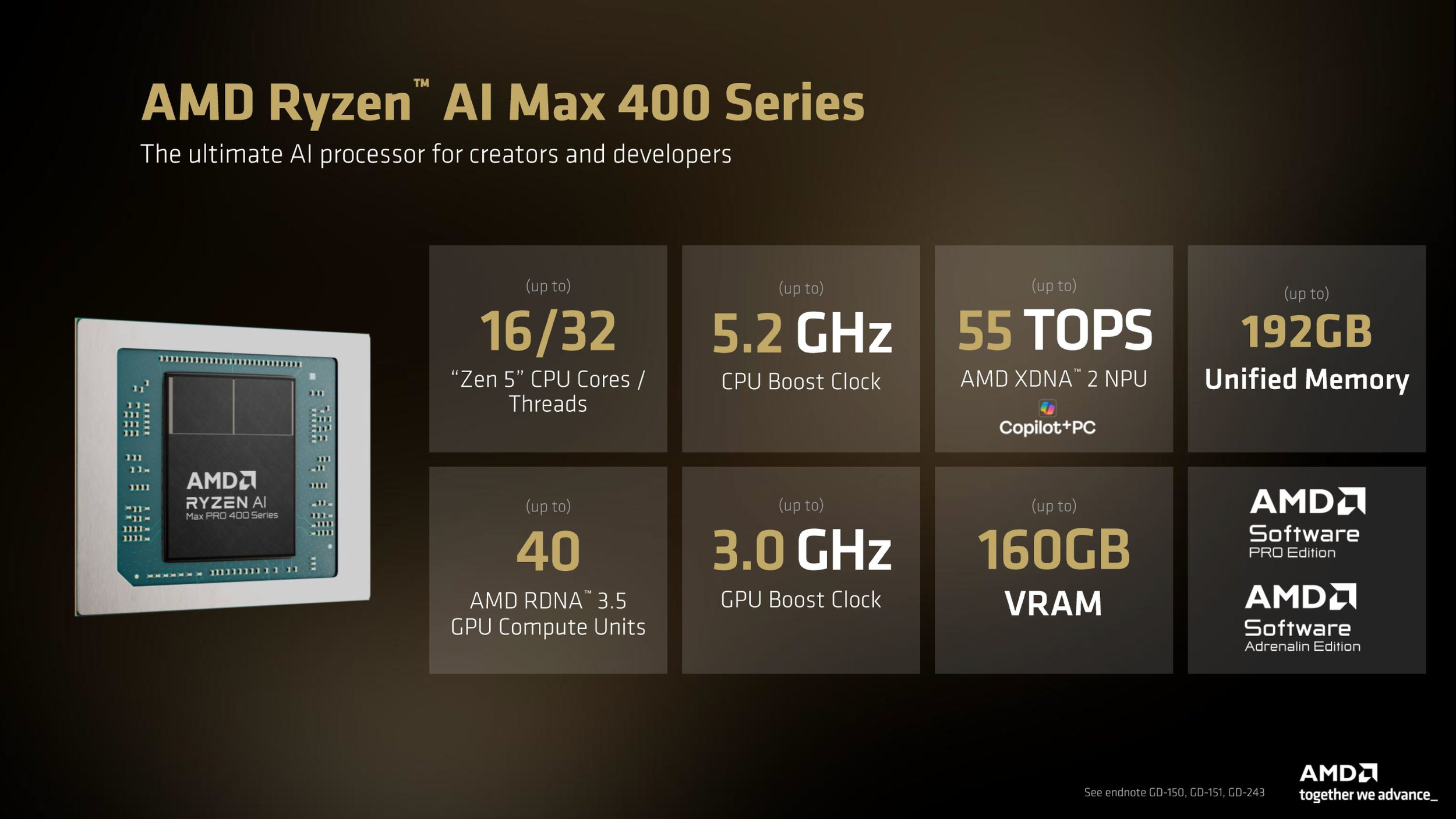
The flagship Ryzen AI MAX+ PRO 495 features 16 Zen 5 CPU cores and 32 threads, paired with a Radeon 8065S iGPU with 40 RDNA 3.5 compute units. The CPU now reaches a 3.1 GHz base clock and 5.2 GHz boost clock, representing a 100 MHz increase over the prior generation. The integrated GPU also receives a 100 MHz uplift, now boosting up to 3.0 GHz. The XDNA 2 NPU remains rated at 55 TOPS, giving the platform dedicated AI acceleration alongside CPU and GPU compute resources.
Power configuration remains flexible. The Ryzen AI MAX 400 chips feature a 55 W base TDP, with configurable operation down to 45 W or up to 120 W, depending on system design and performance requirements. This gives OEMs room to build a wide range of devices, from compact professional systems to higher performance AI workstations.
AMD is positioning the Ryzen AI MAX 400 family for developers, creators, and professional users who need local AI performance without moving into full desktop workstation territory. The unified memory model is central to that strategy, allowing AI acceleration, graphics, and compute resources to access a much larger shared memory pool. For local AI agents, generative workloads, model testing, creative rendering, and engineering applications, this could make Ryzen AI MAX 400 one of AMD’s most important client AI platforms yet.
The chip family also reflects a broader shift in the PC market. AI PCs are no longer focused only on small assistant features or background acceleration. AMD is now pushing toward systems that can handle larger local models, concurrent agentic workflows, and heavier professional workloads directly on device. With 192 GB unified memory, Ryzen AI MAX 400 becomes less of a traditional mobile processor and more of a compact AI workstation platform.
AMD expects the first Ryzen AI MAX PRO 400 systems to arrive in Q3 2026 through major OEM partners including ASUS, HP, and Lenovo. These systems will target users who need workstation class performance for AI development, design, rendering, simulation, and engineering applications.
The standard Ryzen AI 400 Gorgon SoCs are also expected to arrive soon, positioning AMD against Intel’s upcoming Core Ultra Series 3 Panther Lake processors. With Panther Lake entering the market, AMD’s Ryzen AI MAX 400 launch shows that the company is preparing to compete not only on CPU and GPU performance, but also on memory capacity, local AI capability, and full platform versatility.
With up to 16 Zen 5 cores, 40 RDNA 3.5 compute units, 55 TOPS NPU performance, 192 GB unified memory, and support for 300B+ parameter AI models, Ryzen AI MAX 400 represents AMD’s most aggressive step yet into high capacity local AI computing for client systems.
Do you think 192 GB unified memory on Ryzen AI MAX 400 is enough to make local AI workstations more practical for developers and creators?
