
NVIDIA PAIR Turns Idle PCs Into Local AI Network as RTX Spark Arrives in October
NVIDIA is making a major push to move artificial intelligence workloads away from the cloud and onto hardware users already own. At IFA 2026, the company introduced NVIDIA PAIR, delivered new llama.cpp and vLLM optimizations providing up to 1.9x higher local inference throughput, and confirmed that the first RTX Spark Windows PCs powered by its N1X platform will begin arriving in October. Together, the announcements show NVIDIA building a local AI ecosystem where gaming PCs, workstations, DGX systems, and upcoming RTX Spark machines can increasingly operate as interconnected personal AI infrastructure.
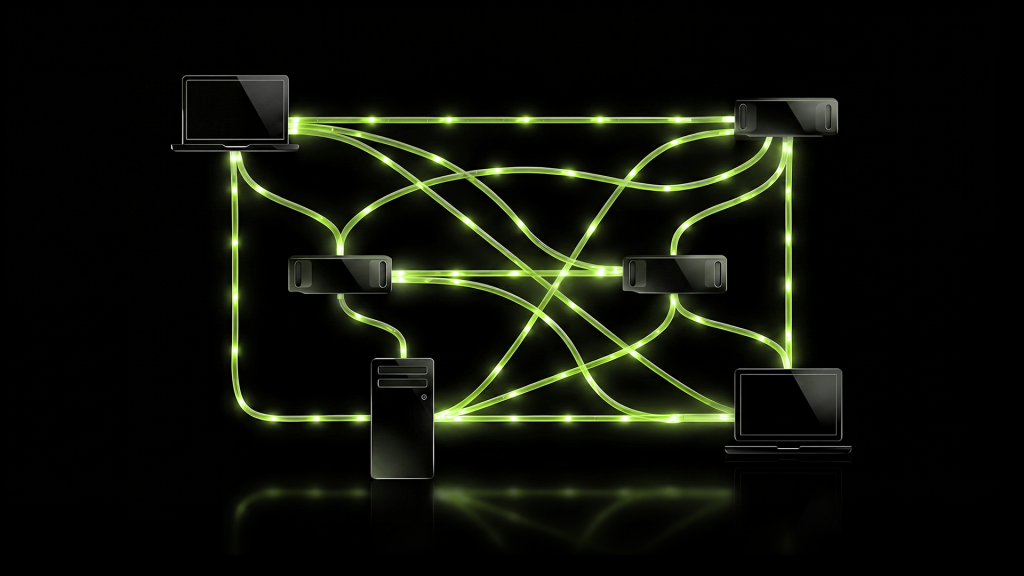
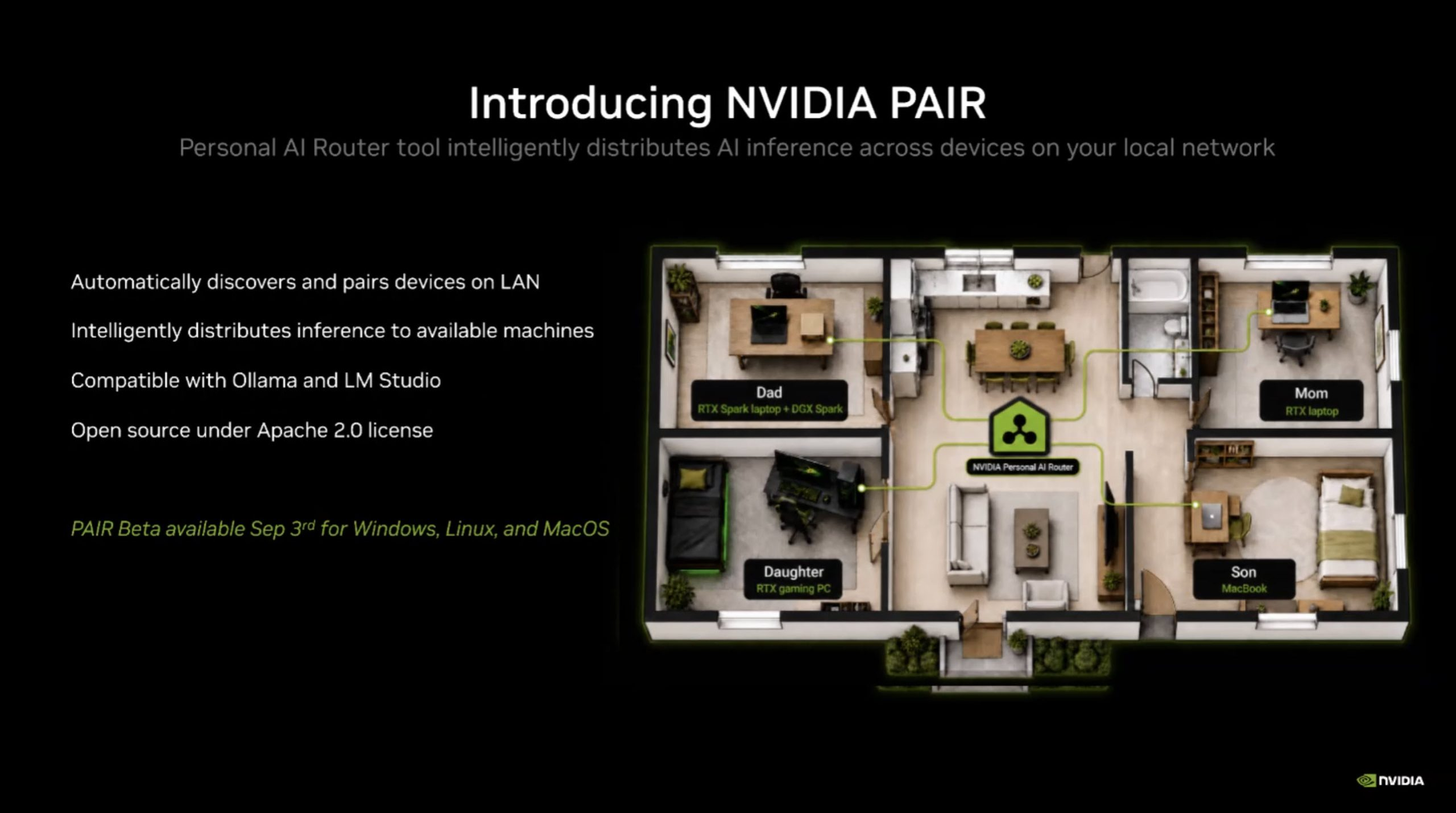
The most unusual addition is NVIDIA Personal AI Router, or PAIR. The free and open source software allows compatible computers on the same local network to contribute inference capacity, automatically routing independent AI requests toward systems that have the required model available and enough resources to process the workload. Instead of leaving a second gaming PC, workstation, or DGX Spark mostly unused, PAIR can redirect suitable AI tasks toward that hardware while keeping the primary machine available for gaming, rendering, development, or other interactive workloads.
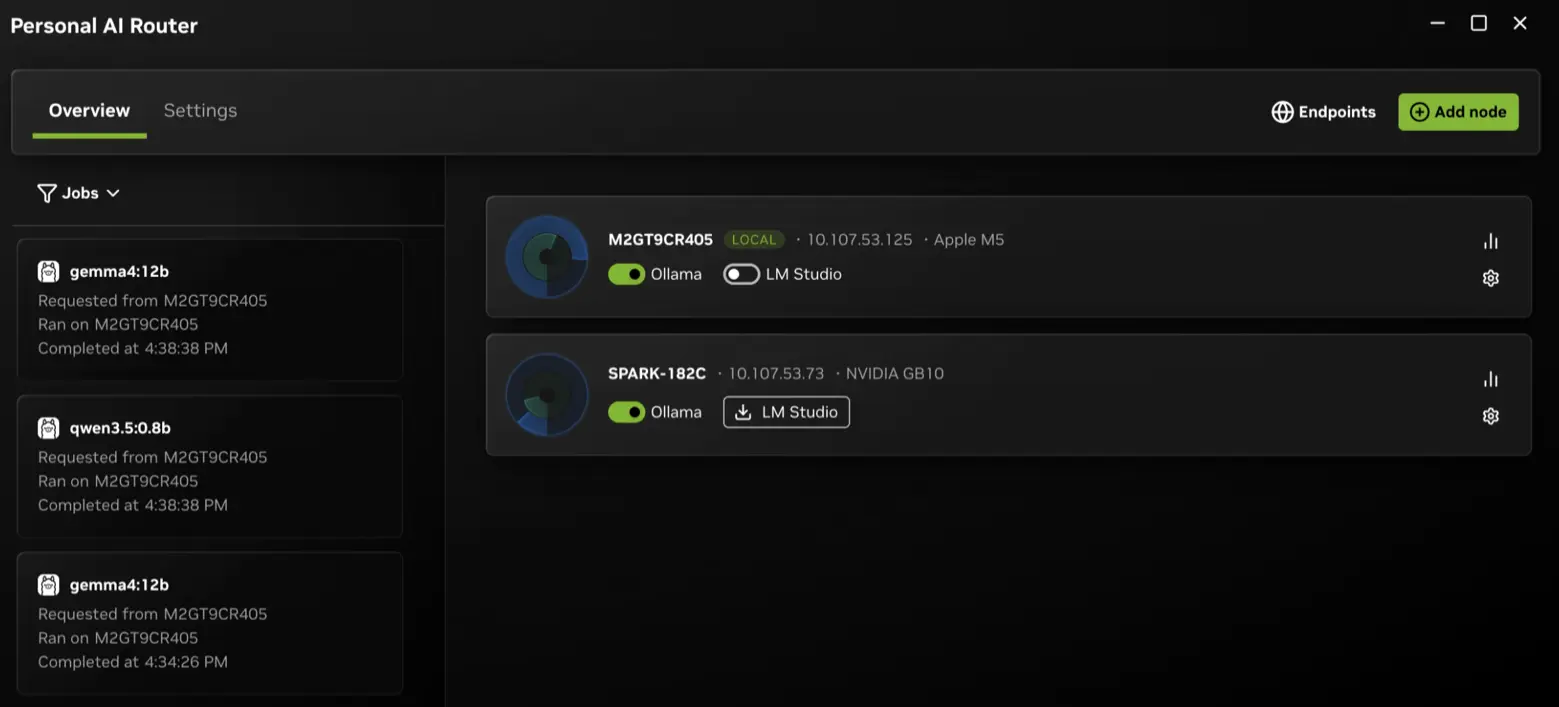
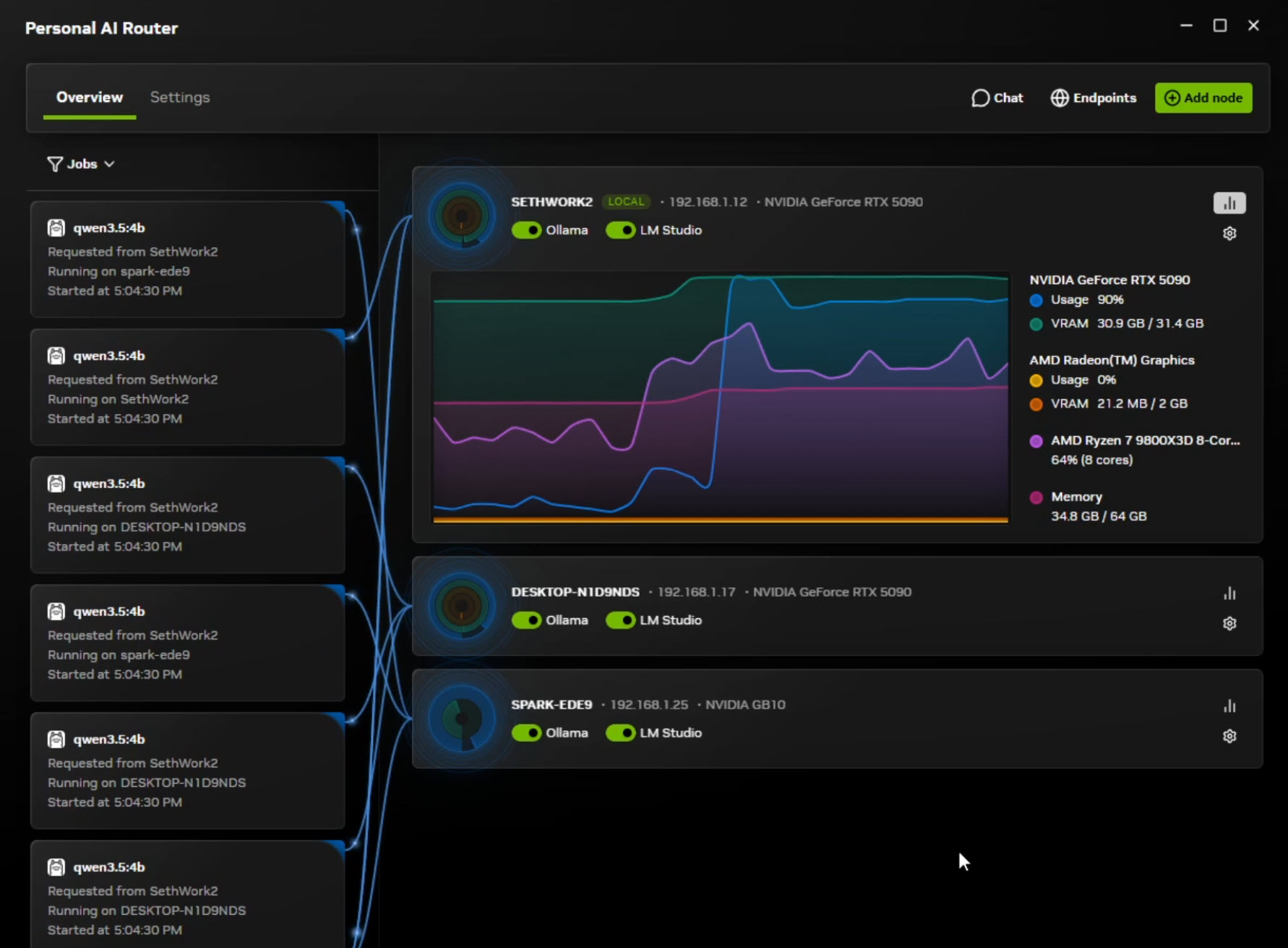

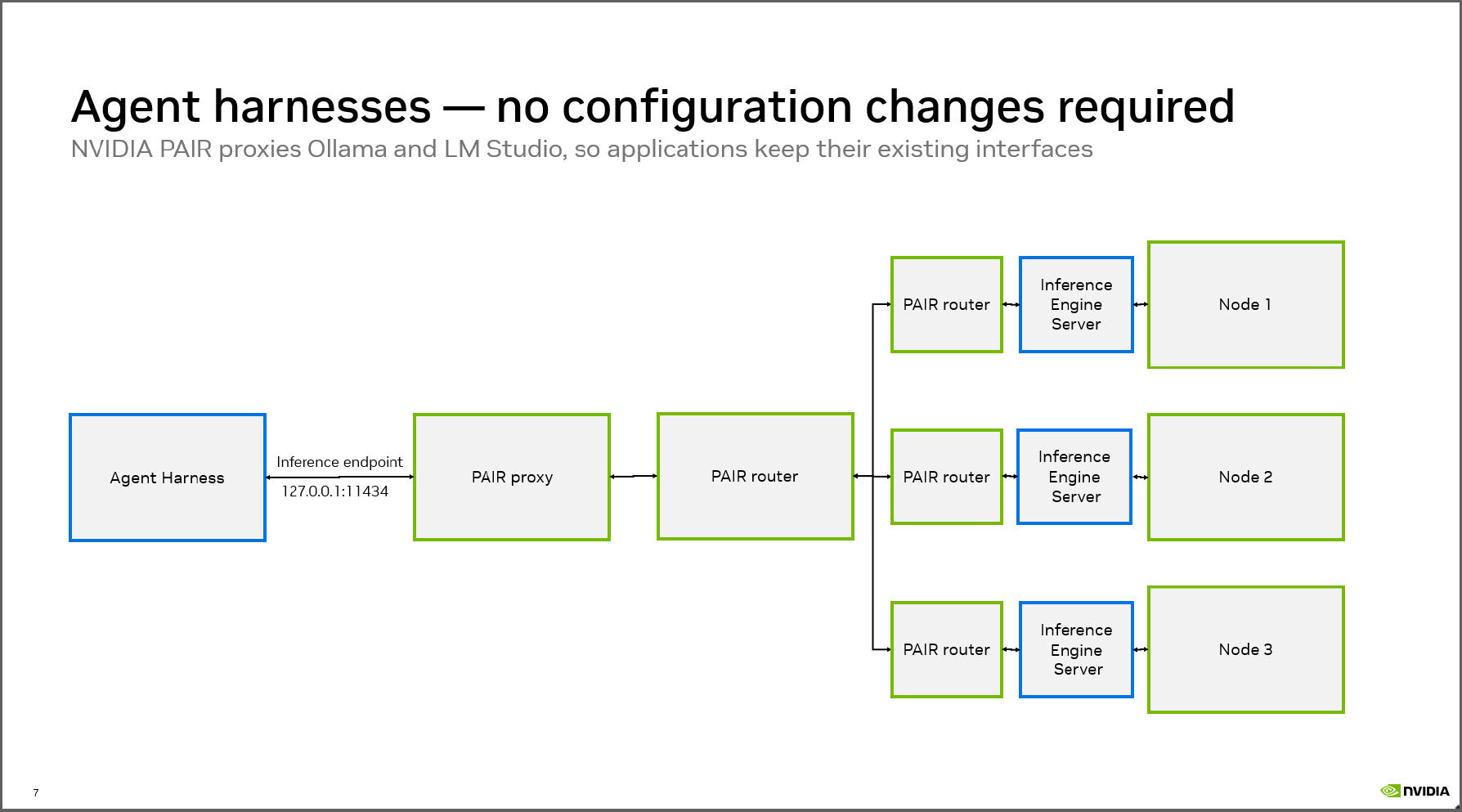
PAIR integrates with Ollama and LM Studio and presents compatible OpenAI and Ollama interfaces to applications, meaning existing software does not need to understand that a cluster exists. Each computer runs PAIR locally, discovers trusted systems across the network, and can be connected using a temporary 6 digit pairing code. Requests and responses sent between nodes are protected through encrypted communication, while scheduling considers whether a system is reachable, which inference engine is running, whether the requested model is installed, current workloads, and GPU utilization.
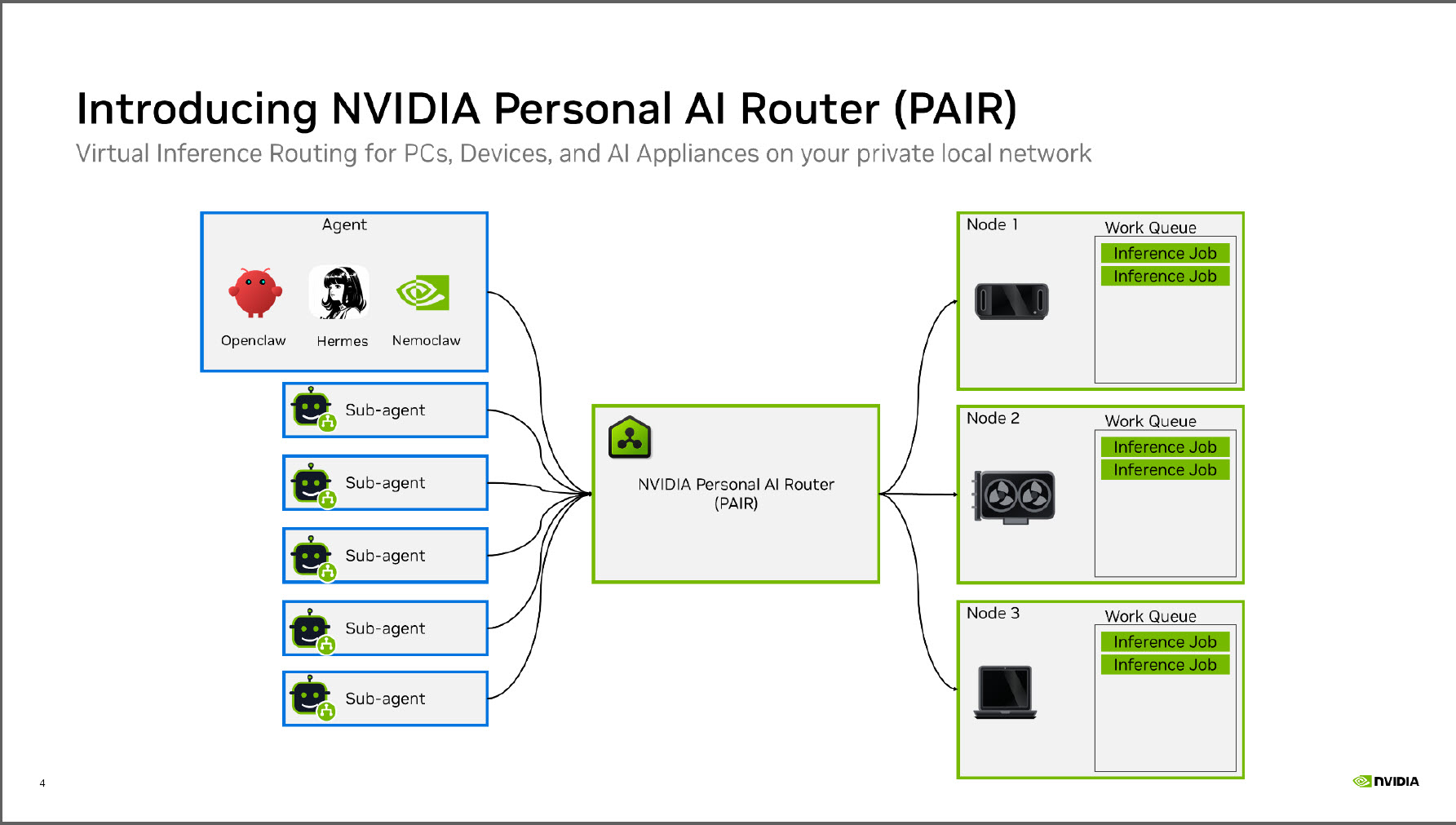
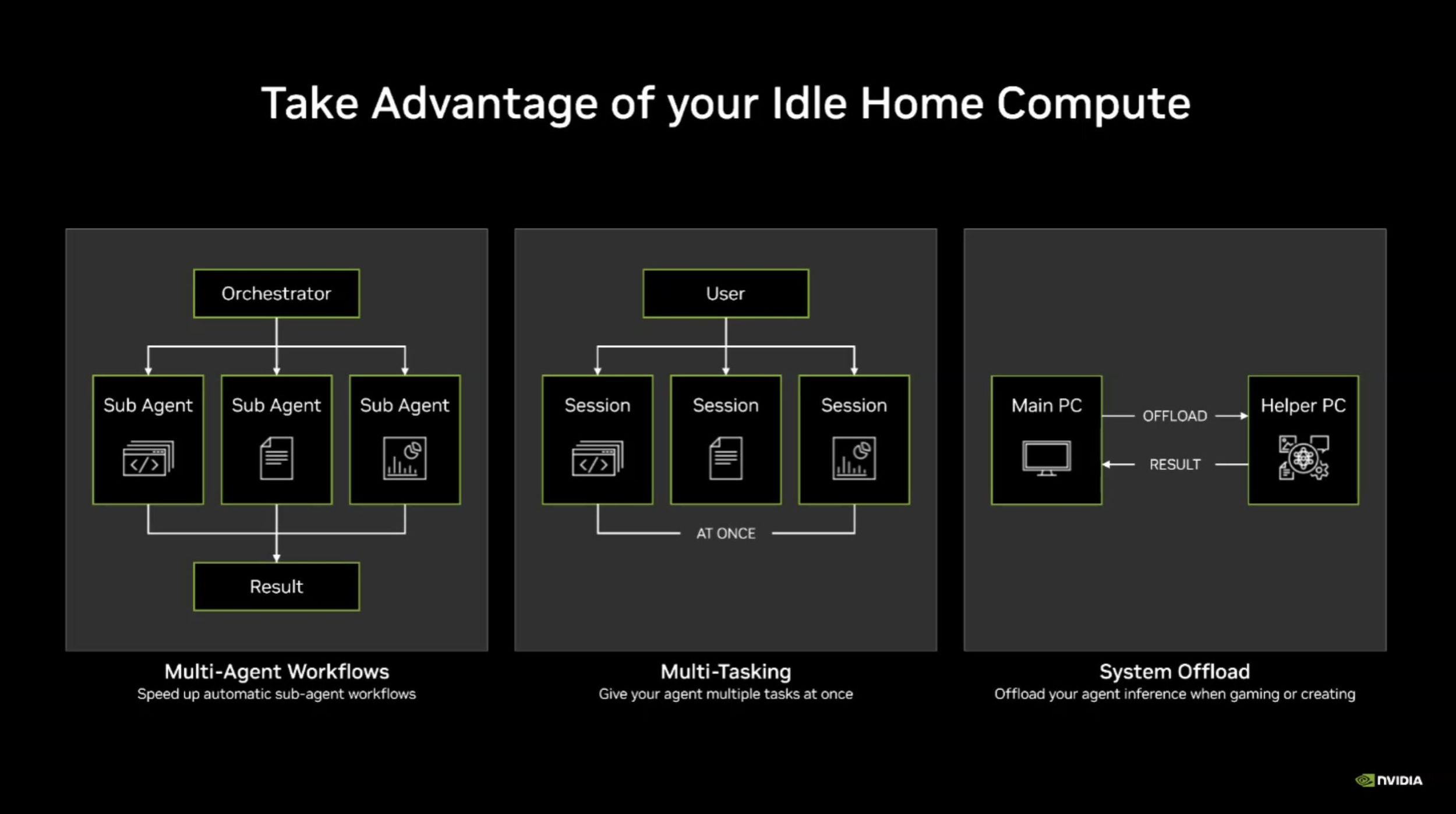
There is an important limitation. PAIR is not turning several graphics cards into one larger GPU. It does not combine VRAM, split a single model between systems, or distribute one inference request across several processors. Each individual request is assigned entirely to one eligible machine. Its biggest advantage therefore appears in multi agent workflows and multitasking, where many independent requests can be processed simultaneously instead of waiting behind one another on a single GPU.
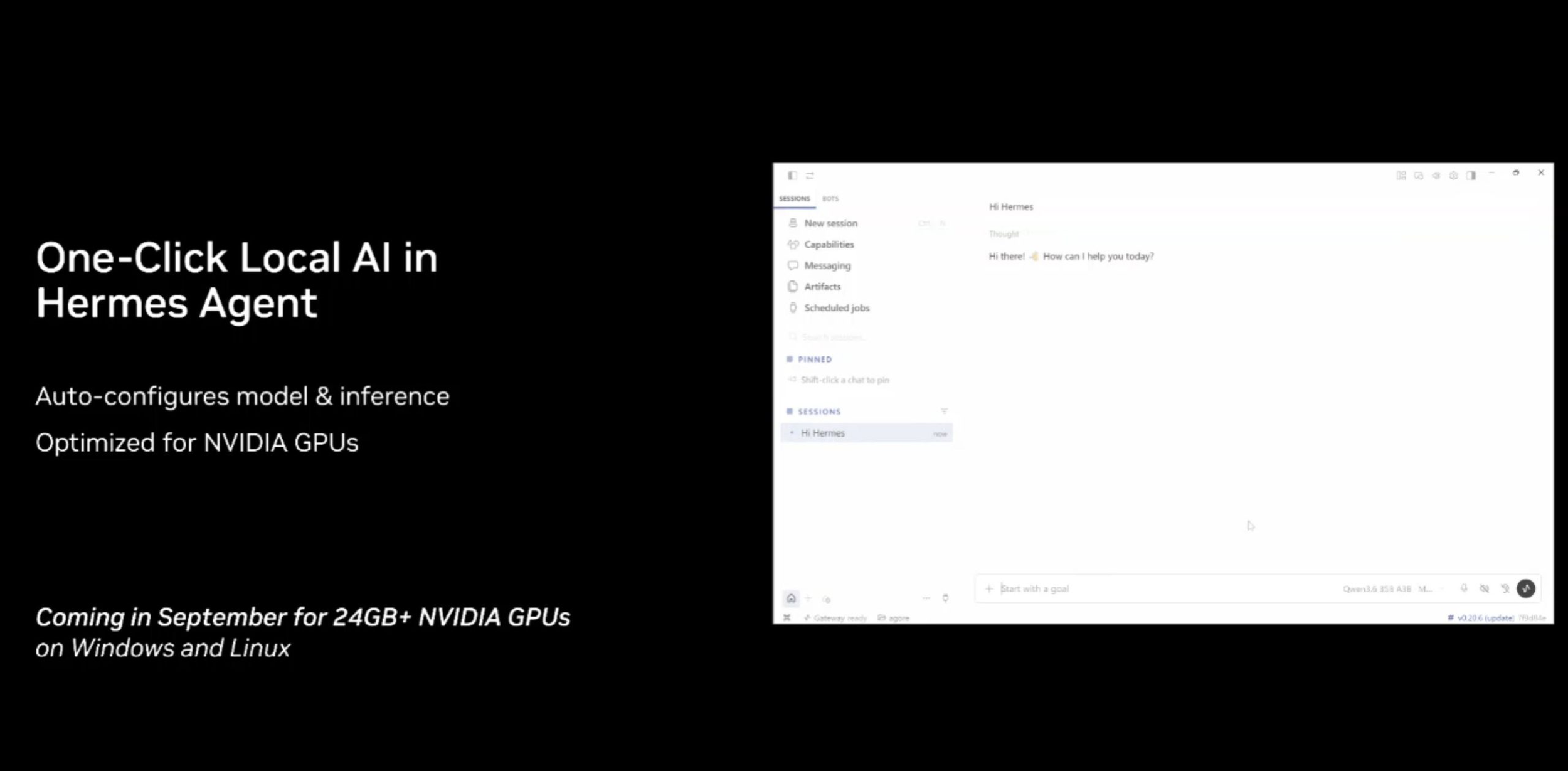
NVIDIA demonstrated that advantage using a Hermes workflow containing 5 subagents. A single RTX Spark laptop completed the workload in 18 minutes, while a 3 device PAIR configuration reduced completion time to 8 minutes and 48 seconds. The result is workload and configuration specific rather than evidence that every application will scale similarly, but it demonstrates how otherwise unused systems can reduce inference queues when an agent creates several independent tasks.
The current PAIR beta supports Windows, Linux, and macOS through graphical and terminal interfaces. NVIDIA officially lists GeForce RTX 20 Series GPUs and newer, RTX PRO workstation GPUs based on Turing or newer architectures, DGX Spark, and Apple systems using M4 silicon or newer. The project also makes NVIDIA's local AI strategy considerably broader than a single piece of hardware because users can build around systems they already own rather than purchasing a dedicated server immediately.
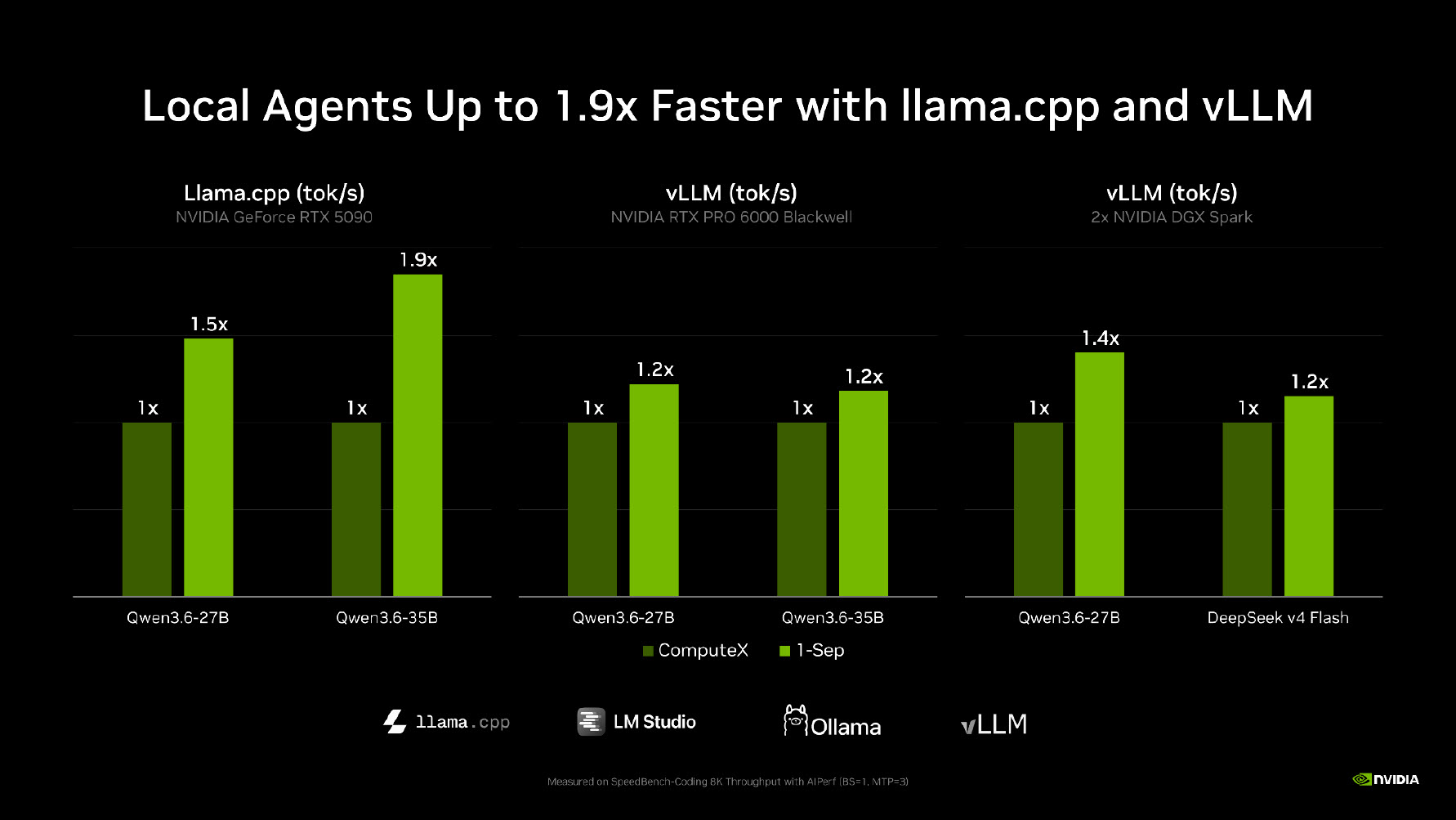
That strategy connects naturally with NVIDIA's continued software optimization. New llama.cpp improvements deliver up to 1.9x higher throughput on a GeForce RTX 5090, combining optimized kernels, improved speculative decoding, and faster prefill processing. vLLM receives separate improvements, reaching 1.2x higher performance on an RTX PRO 6000 Blackwell Workstation Edition and up to 1.4x across a 2 DGX Spark configuration, according to NVIDIA testing. The improvements are available through the llama.cpp and vLLM inference backends and can also be accessed through applications including LM Studio and Ollama.
These optimizations build on the company's rapidly expanding local AI ecosystem across RTX and DGX hardware, where NVIDIA has been adding open models for agentic AI, coding, image generation, video creation, robotics, and multimodal reasoning. The broader goal is becoming increasingly clear: allow developers to begin with a GeForce PC, move heavier workloads onto RTX PRO or DGX hardware, and maintain much of the same CUDA based software environment as workloads scale.
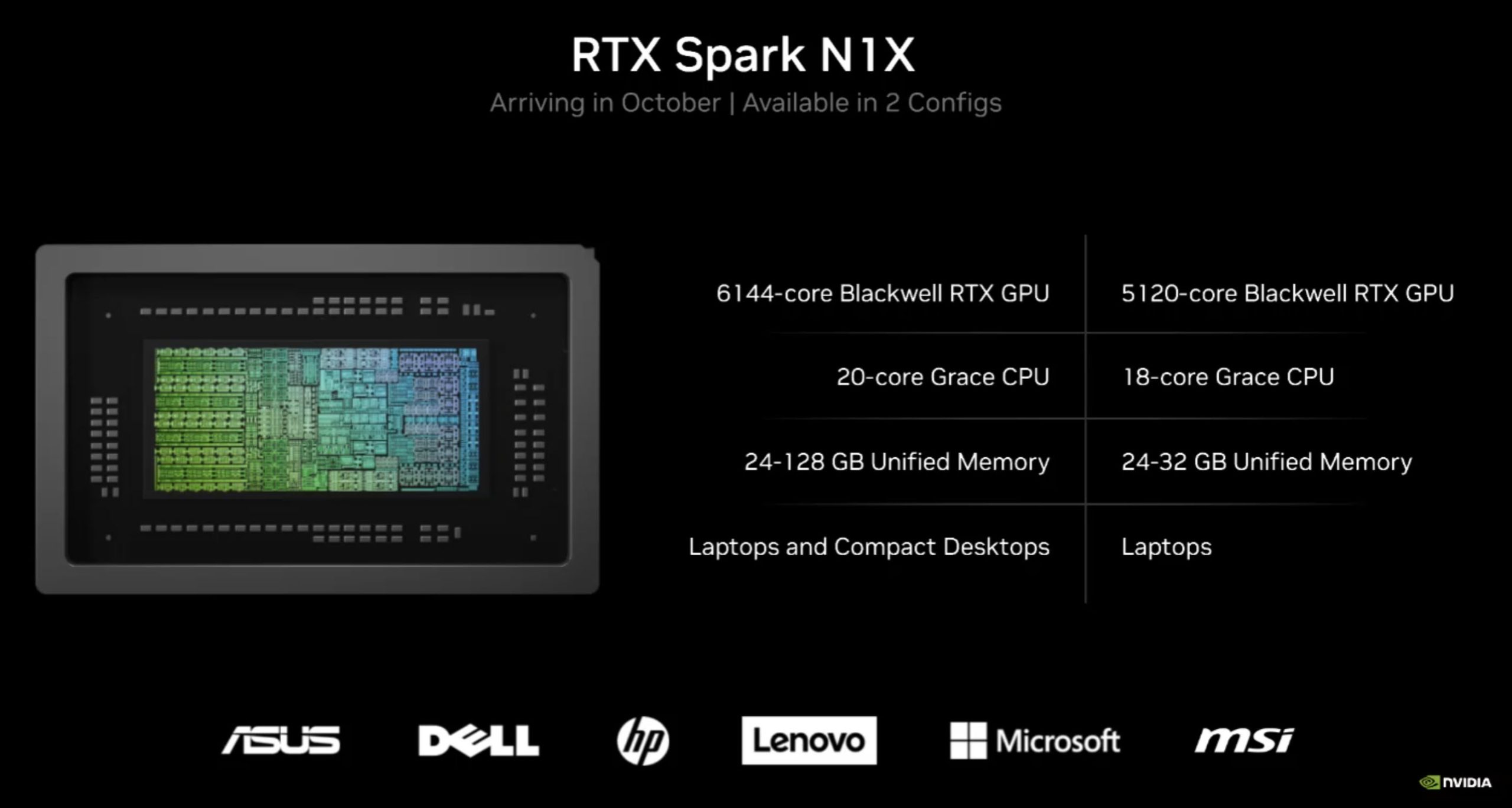
RTX Spark will become another major piece of that strategy when the first systems ship in October. NVIDIA's N1X platform combines a Grace Arm CPU, Blackwell RTX graphics, unified LPDDR5X memory, Windows 11, CUDA, RTX graphics technologies, and dedicated AI acceleration inside laptops and compact desktops. NVIDIA is currently listing 2 laptop configurations alongside a higher performance desktop implementation.
| Specification | RTX Spark N1X High Configuration | RTX Spark N1X Lower Configuration | RTX Spark Desktop |
|---|---|---|---|
| CPU | 20 core NVIDIA Grace | 18 core NVIDIA Grace | 20 core NVIDIA Grace |
| GPU | 6144 core Blackwell RTX | 5120 core Blackwell RTX | 6144 core Blackwell RTX |
| Memory | Up to 128 GB LPDDR5X | Up to 64 GB LPDDR5X | Up to 128 GB LPDDR5X |
| Memory Type | Unified | Unified | Unified |
| TDP | 45 to 80 W | 45 to 80 W | 140 W |
| Ray Tracing Cores | 4th Generation | 4th Generation | 4th Generation |
| Tensor Cores | 5th Generation | 5th Generation | 5th Generation |
| DLSS | DLSS 5 | DLSS 5 | DLSS 5 |
| Operating System | Windows 11 | Windows 11 | Windows 11 |
NVIDIA's current official specifications are particularly notable because the company now lists up to 64 GB of unified memory for the 5120 core N1X configuration. Early IFA information described this version with a maximum of 32 GB, but NVIDIA's updated product page currently places the official maximum at 64 GB. The flagship N1X retains up to 128 GB, while the compact desktop implementation raises total power to 140 W.
At the top end, NVIDIA claims RTX Spark can deliver up to 1 petaflop of FP4 AI performance and use as much as 128 GB of unified memory, allowing the CPU and GPU to access the same memory pool. The company is positioning these systems for local agents, model development, creative production, and gaming, including support for models reaching 120 billion parameters depending on configuration and precision. The platform also supports DLSS 5, Reflex 2, DirectX 12 Ultimate, PCI Express Gen 5, DisplayPort 2.1b, and hardware accelerated video encoding and decoding.
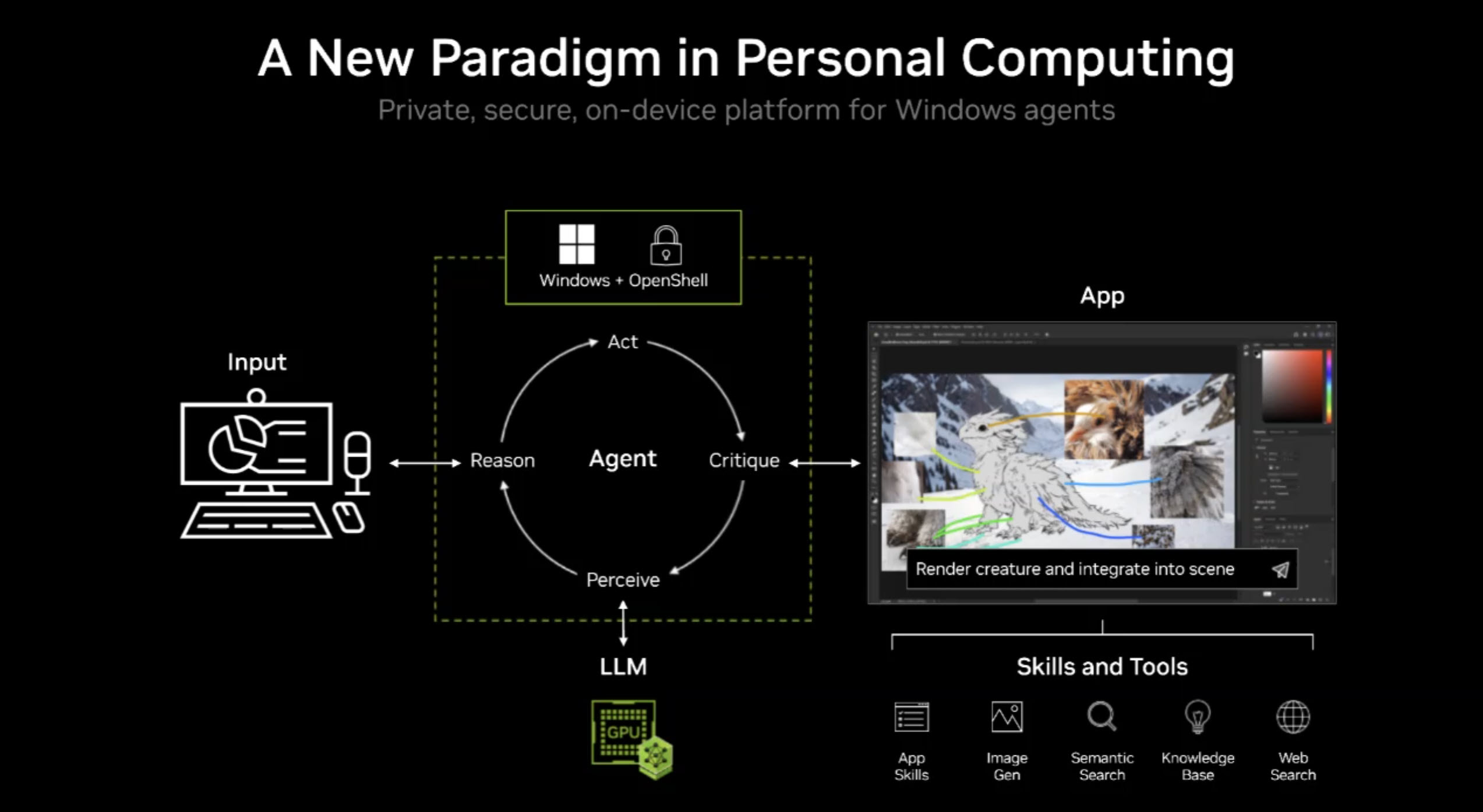
The October window also provides a firm target for hardware that has been appearing throughout 2026. RTX Spark receiving its first native Windows on Arm drivers, giving developers access to CUDA 13.4 and native Arm64 development before consumer systems arrive. More recently, ASUS reported that its initial RTX Spark allocation was already fully booked, while MSI has also reported strong early demand for N1X based hardware.
Acer, ASUS, Dell, GIGABYTE, HP, Lenovo, Microsoft, and MSI are among the manufacturers preparing RTX Spark products. NVIDIA specifically showed an Acer compact desktop at IFA alongside Lenovo's Yoga Pro 9n and Yoga 9n 2 in 1, while its current product page also lists systems including the ASUS ProArt P16, Dell XPS 16, HP OmniBook X 14, Microsoft Surface Laptop Ultra, and MSI Prestige N16 Flip AI+.
The combination of PAIR and RTX Spark may ultimately be more significant than either product independently. A powerful N1X machine can operate as a dedicated local AI system, but PAIR means it does not necessarily need to work alone. A household or small studio could theoretically route parallel agent tasks between an RTX Spark notebook, a gaming desktop, an RTX PRO workstation, and DGX Spark depending on which hardware is available at that moment.
NVIDIA's local AI strategy is starting to look less like another collection of GPU features and more like an attempt to build a miniature private cloud inside the home or studio.
PAIR is particularly interesting because NVIDIA is not demanding that users replace existing hardware to participate. An RTX gaming system sitting unused for most of the day suddenly becomes another inference node, while a primary PC can hand AI workloads to another machine when the user starts gaming or rendering.
There is an important distinction between routing and true distributed inference. PAIR cannot add the VRAM of 2 RTX GPUs together to run a model that neither can accommodate individually. That prevents it from becoming a substitute for technologies designed specifically to divide massive models across accelerators. For multi agent systems generating many independent requests, however, routing could be considerably more useful than simply making one GPU faster.
RTX Spark then gives NVIDIA dedicated hardware designed specifically around this future. Up to 128 GB of unified memory, Blackwell graphics, full CUDA support, Windows 11, and a 20 core Grace CPU already make N1X unusual for a consumer PC. Connecting that system with the RTX hardware users already own makes the proposition significantly more ambitious.
Cloud AI is not disappearing, but NVIDIA is clearly betting that a growing amount of inference can happen locally. If software such as PAIR makes multiple PCs behave like one coordinated pool of available compute without demanding complicated server administration, the gaming PC sitting in another room may soon have considerably more work to do when nobody is playing on it.
Would you connect your gaming PCs and laptops through NVIDIA PAIR to run local AI workloads, or would you rather keep AI on one dedicated machine such as RTX Spark or DGX Spark?
