

Microsoft and AMD have officially introduced Project Zenith on the Ryzen AI Halo developer platform, delivering a preconfigured Windows 11 environment designed for local artificial intelligence development, software engineering, and automated coding workflows. Announced on November 9, 2026, the initiative initially targets systems powered by AMD's Ryzen AI Max+ PRO 495 processor, offering up to 192 GB of unified memory, 160 GB of GPU accessible memory, and 273 GB/s of memory bandwidth. The collaboration aims to simplify local AI development by eliminating much of the software configuration normally required when preparing a new workstation.
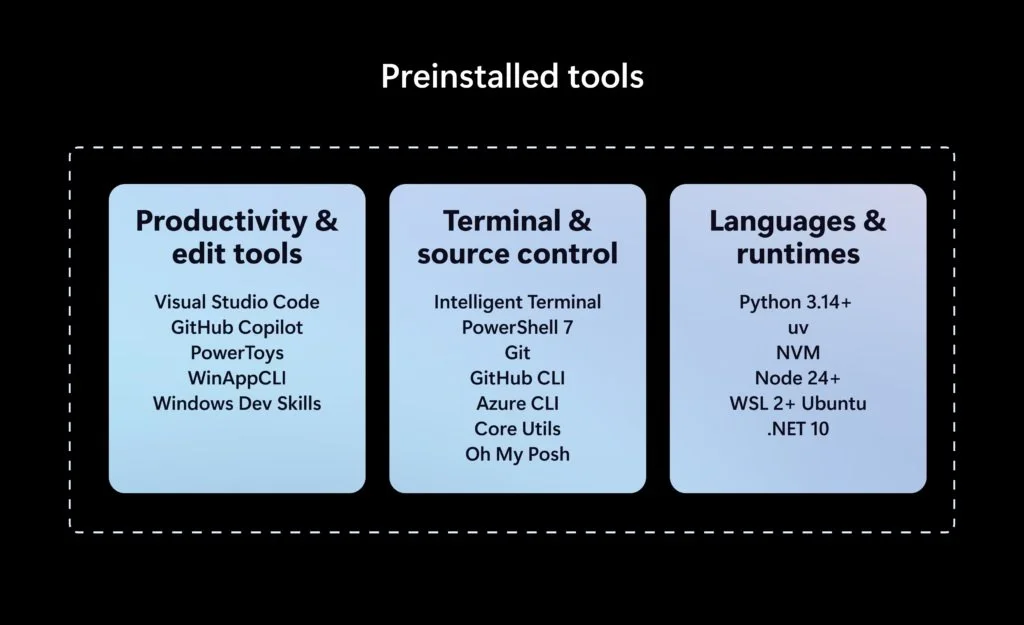
According to AMD's official announcement, Project Zenith builds upon Microsoft's developer focused Windows 11 experience first revealed at IFA 2026. Rather than introducing an entirely new operating system, the platform provides an optimized Windows installation with commonly used development applications, tools, and system configurations already prepared. These include Visual Studio Code, Git, GitHub CLI, GitHub Copilot CLI, Azure CLI, Python, Node.js, .NET, PowerShell 7, and Windows Subsystem for Linux (WSL). Microsoft has also adjusted File Explorer, Search, and other Windows settings to reduce distractions and improve productivity.
AMD complements this environment with its Ryzen AI Developer Center and validated AI software configurations. Developers receive access to ROCm accelerated PyTorch, ComfyUI for image generation, LM Studio for local language models, Qwen3 Coder for programming assistance, and n8n for workflow automation. AMD also provides guided AI Playbooks to simplify deployment, helping users experiment with models and applications without manually configuring every dependency.

The hardware foundation is equally important. The Ryzen AI Max+ PRO 495 combines 16 Zen 5 CPU cores, 32 threads, Radeon 8065S integrated graphics with 40 RDNA 3.5 compute units, and an XDNA 2 NPU delivering 55 TOPS. Compared with the previous Ryzen AI Halo platform, which supports up to 128 GB of unified memory, the latest model increases capacity to 192 GB while allowing as much as 160 GB to be allocated to graphics workloads.
AMD Ryzen AI Halo Specifications
| Specification | Ryzen AI Max+ PRO 495 |
|---|---|
| CPU Architecture | AMD Zen 5 |
| Cores and Threads | 16 cores, 32 threads |
| Maximum Boost | 5.2 GHz |
| Integrated GPU | Radeon 8065S |
| GPU Architecture | RDNA 3.5, 40 compute units |
| NPU Performance | 55 TOPS |
| Unified Memory | Up to 192 GB LPDDR5X |
| Maximum GPU Memory Allocation | 160 GB |
| Memory Bandwidth | Up to 273 GB/s |
| Local AI Model Support | Up to 300B parameters, AMD claim |
| Operating Environment | Windows 11 with Project Zenith |
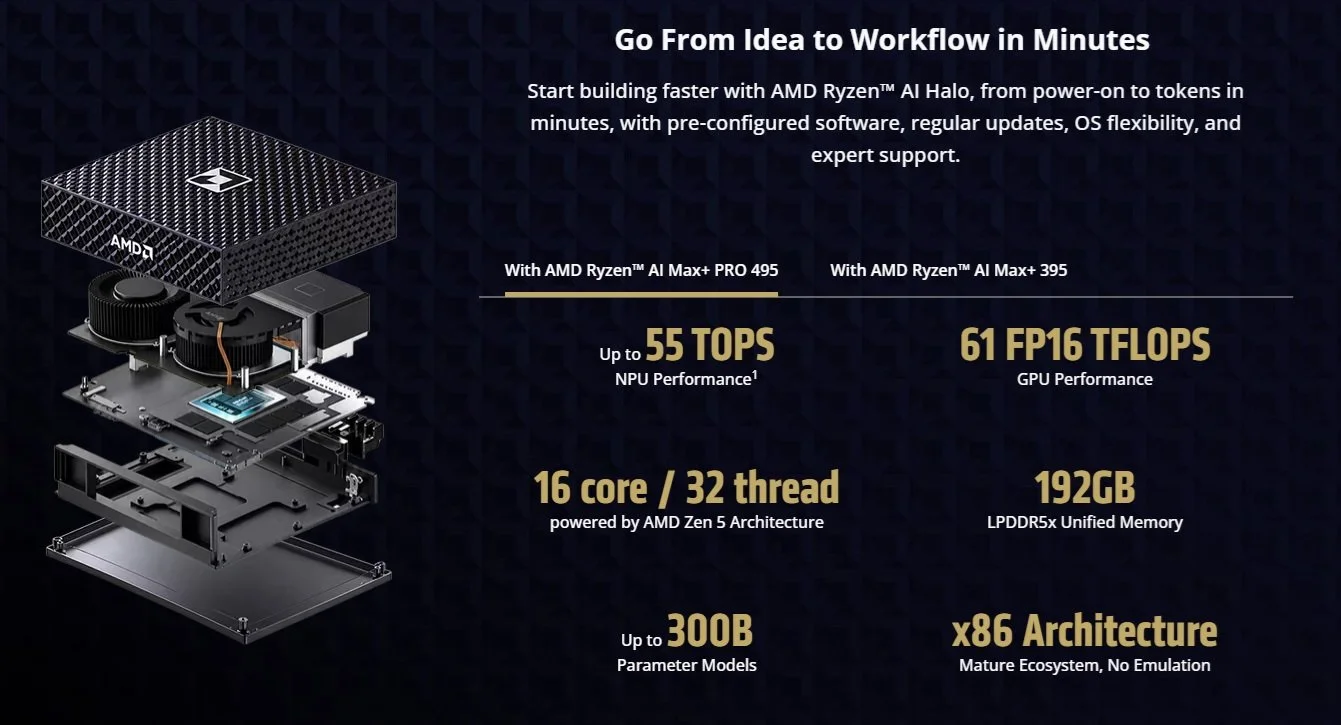
AMD claims the expanded memory capacity can accommodate AI models containing up to 300 billion parameters, potentially enabling workloads that would otherwise require multiple dedicated graphics cards. However, achieving this requires appropriate quantization and compatible software, while inference speeds will depend on model architecture, available memory, and processing requirements. The high memory capacity is particularly useful for local language models, coding assistants, and multiple simultaneous AI workloads.
Project Zenith also emphasizes software flexibility. Existing Windows equipped Ryzen AI Halo owners can recreate the developer environment using Microsoft's open source Windows Developer Config project, while AMD plans to expand availability to additional Ryzen AI Max devices.

However, pricing remains a significant barrier. Micro Center currently lists the Ryzen AI Max+ PRO 495 model with 192 GB of memory and Linux for $7,299.99, compared with $3,999.99 for the earlier 128 GB configuration. Although AMD has announced Project Zenith availability, a corresponding 192 GB Windows retail configuration has not been independently confirmed.
Project Zenith represents a positive direction for Windows 11, particularly because Microsoft and AMD are focusing on improving the development experience rather than simply introducing additional AI features that depend on cloud subscriptions.
The combination of 192 GB of unified memory and a prepared ROCm development environment makes Ryzen AI Halo particularly interesting for local AI enthusiasts. Running larger language models, ComfyUI workflows, and coding assistants directly on personal hardware gives developers greater control over their data, models, and computing resources.
However, the $7,299.99 hardware price places the platform well beyond the reach of most consumers. While the memory capacity is impressive, users should evaluate whether their workloads genuinely require such a large unified memory pool or could operate more efficiently on an upgradeable desktop with a dedicated GPU.
More importantly, the availability of Windows Developer Config is a welcome decision. Software optimization and development tools should remain accessible to existing hardware owners rather than becoming exclusive benefits of expensive new systems. The future of local AI should prioritize open software, hardware flexibility, and consumer ownership.
Would you invest in a compact AI workstation with 192 GB of unified memory for local language models and content creation, or would you prefer building an upgradeable desktop with dedicated graphics cards?
