
Micron Taiwan Union Reportedly Reviews Strike Options Over 200% Bonus Cap
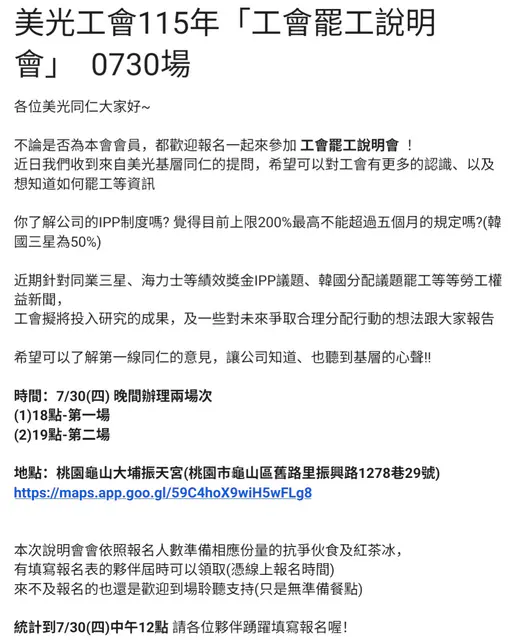
A union representing Micron employees in Taoyuan reportedly held an information meeting on July 30, 2026 to discuss worker rights, potential strike procedures, and concerns surrounding the company’s annual performance bonus policy. The meeting was revealed through an anonymous Dcard post.
According to the reported meeting handout, the union planned to explain how strikes operate and share research into recent labor action at Samsung in South Korea. The material reportedly questions whether Micron’s 200% bonus cap remains appropriate during the current artificial intelligence memory boom and claims the company’s annual IPP payout can reach no more than 5 months of salary. The anonymous Dcard author also alleged that benefits have declined, salary adjustments have progressed slowly, and union membership has increased nearly 10 times. None of these claims has been independently confirmed by Micron or the union.
Micron’s official Taiwan benefits page confirms that employees can receive cash incentives based on individual and company performance, along with selected recognition bonuses and discounted stock purchasing opportunities. However, the company does not publicly specify a 200% limit or a maximum payout equivalent to 5 months of salary on that page.
The reported discussion follows a major labor dispute at Samsung, where semiconductor workers threatened an 18 day strike over wages and profit distribution. Samsung eventually agreed to abolish its previous 50% bonus cap and allocate approximately 10.5% of agreed semiconductor operating performance toward special employee bonuses. The settlement was reached shortly before the planned strike and followed months of negotiations over how profits generated by the artificial intelligence and memory boom should be distributed.
The dispute previously created measurable production concerns, with a major Samsung union rally reportedly disrupting memory and foundry output. Samsung’s experience may now be influencing compensation discussions elsewhere in the semiconductor industry as employees compare wages, incentives, and profit sharing across Micron, Samsung, and SK hynix.
The timing is particularly sensitive because Micron recently reported record fiscal Q3 2026 revenue of $41.46 billion, compared with $23.86 billion during the previous quarter and $9.30 billion during the same period 1 year earlier. Chief Executive Officer Sanjay Mehrotra attributed the performance to the strategic importance of memory during the artificial intelligence era and rapidly expanding customer demand.
The reported meeting does not confirm that Micron employees will strike, and an anonymous social media post should not be treated as an official union announcement. However, the discussion reflects a broader change across the semiconductor workforce. Employees are increasingly questioning whether traditional salary based bonus caps remain appropriate when artificial intelligence demand is generating record revenue and profit across the memory industry.
Samsung demonstrated that organized labor can force major changes to profit sharing policies when production disruption becomes a credible business risk. Micron now faces the challenge of maintaining employee confidence while continuing to expand output during an exceptionally profitable memory cycle.
Should semiconductor employees receive bonuses linked directly to company profit, or should manufacturers retain fixed limits to protect long term investment?
