
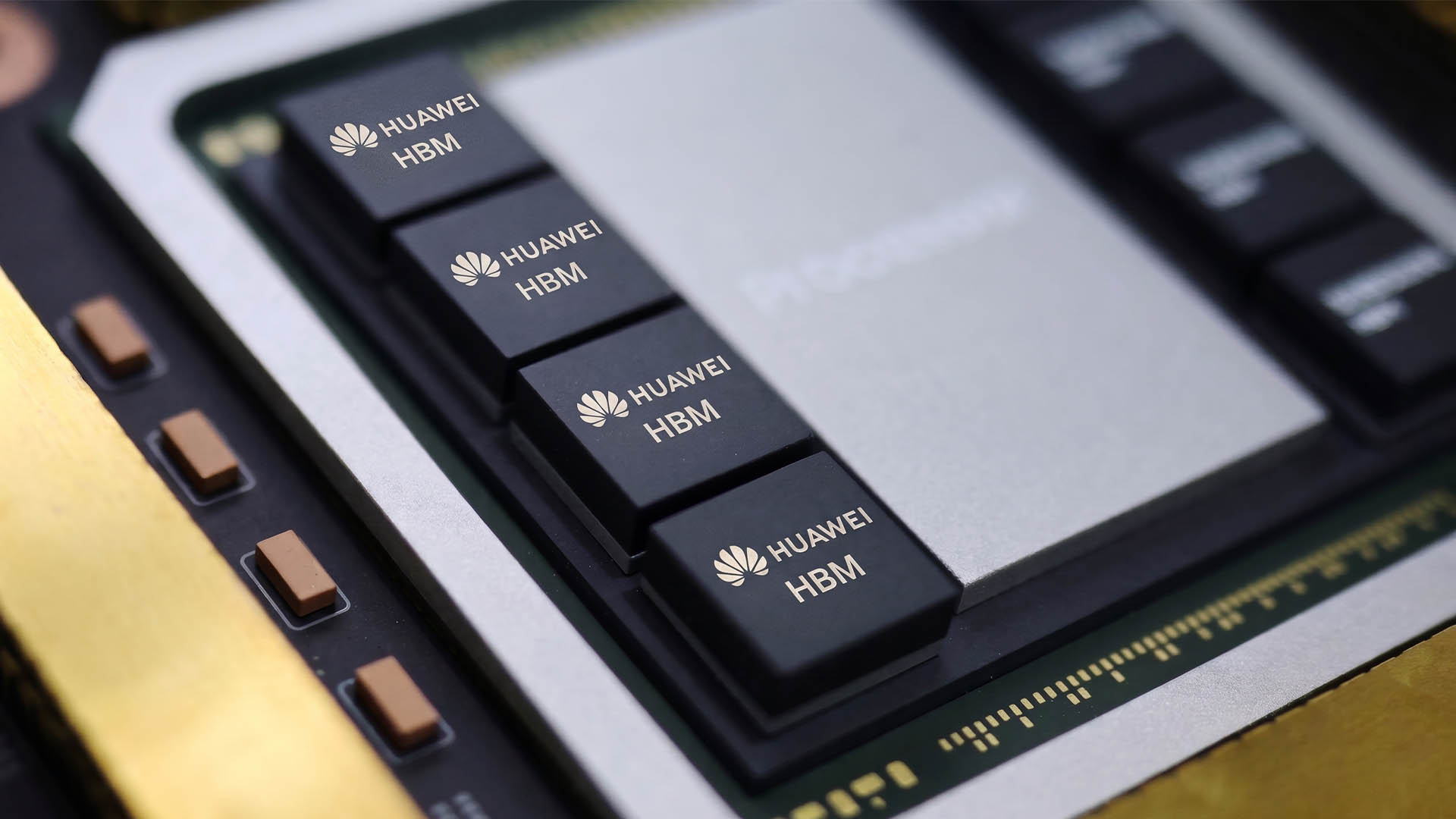
Huawei is preparing to unveil a new custom High Bandwidth Memory (HBM) architecture featuring a 4,096 bit memory interface, twice the width of the current HBM4 standard. The development could significantly strengthen China's domestic AI semiconductor ecosystem while reducing its dependence on advanced memory technologies supplied by Samsung, SK hynix, and Micron.
According to the preliminary IEEE ISSCC 2027 conference program, Huawei will present its research on February 16, 2027, in San Francisco. The design incorporates 64 memory channels, 4,096 data connections, integrated memory controllers, and 5 layers connected through wafer to wafer hybrid bonding.
The wider interface enables more data to be transferred simultaneously between memory and processing units. Theoretically, Huawei's architecture could deliver twice the bandwidth of HBM4 operating at an identical transfer rate per pin. However, the company has not disclosed its operating frequencies, memory capacity, power consumption, or measured bandwidth.
| Specifications | Standard HBM4 | Huawei Custom HBM |
|---|---|---|
| Memory Interface | 2,048 bit | 4,096 bit |
| Memory Channels | 32 | 64 |
| Interface Width | 1x | 2x |
| Memory Controller | Implementation dependent | Integrated |
| Bonding Technology | Manufacturer dependent | Wafer to wafer hybrid bonding |
| Layer Configuration | Varies | 5 bonded layers |
| Actual Bandwidth | Product dependent | Undisclosed |
| Development Status | Commercial production | Research disclosure |
| Commercial Availability | Available | Unconfirmed |
According to TrendForce, Huawei's adoption of hybrid bonding represents an alternative approach to increasing interconnect density without relying exclusively on more advanced semiconductor manufacturing nodes. However, the technology introduces significant challenges involving wafer alignment, manufacturing yields, thermal management, and production scalability.
The development complements Huawei's expanding Ascend 960 AI processor roadmap and Atlas 960E SuperPoD architecture. The company's existing Ascend 950PR reportedly features 128 GB of memory with 1.6 TB/s of bandwidth, while the Ascend 950DT offers 144 GB and 4 TB/s.
China's broader memory industry is also accelerating its development capabilities, with CXMT securing $8.6 billion to expand DRAM and HBM production, alongside YMTC's expansion into DRAM and HBM development.
Meanwhile, Samsung is scheduled to present its own 48 GB HBM4E design operating at 17 Gbps per pin during the same conference. Huawei's wider memory interface therefore represents a promising architectural development, but does not yet establish a measurable performance advantage over competing products.
Huawei's custom HBM architecture demonstrates how advanced packaging and vertical silicon integration could help overcome limitations in semiconductor manufacturing. If commercially viable, the technology could introduce meaningful competition into a memory market dominated by 3 major manufacturers.
However, expanding domestic HBM production must not come at the expense of conventional DDR5 and GDDR memory availability. With CXMT reportedly reallocating part of its DRAM capacity toward HBM production, even emerging memory manufacturers are increasingly prioritizing enterprise AI demand.
Greater semiconductor competition should ultimately improve hardware affordability and accessibility for gamers, independent developers, and local AI enthusiasts rather than exclusively benefiting large technology corporations.
Do you believe Huawei's custom HBM technology could eventually challenge Samsung, SK hynix, and Micron, or will growing AI memory demand continue placing pressure on consumer hardware prices?
