
DDR5 MRDIMM Reaches 16,000 MT/s as 17,600 MT/s Target Moves Closer
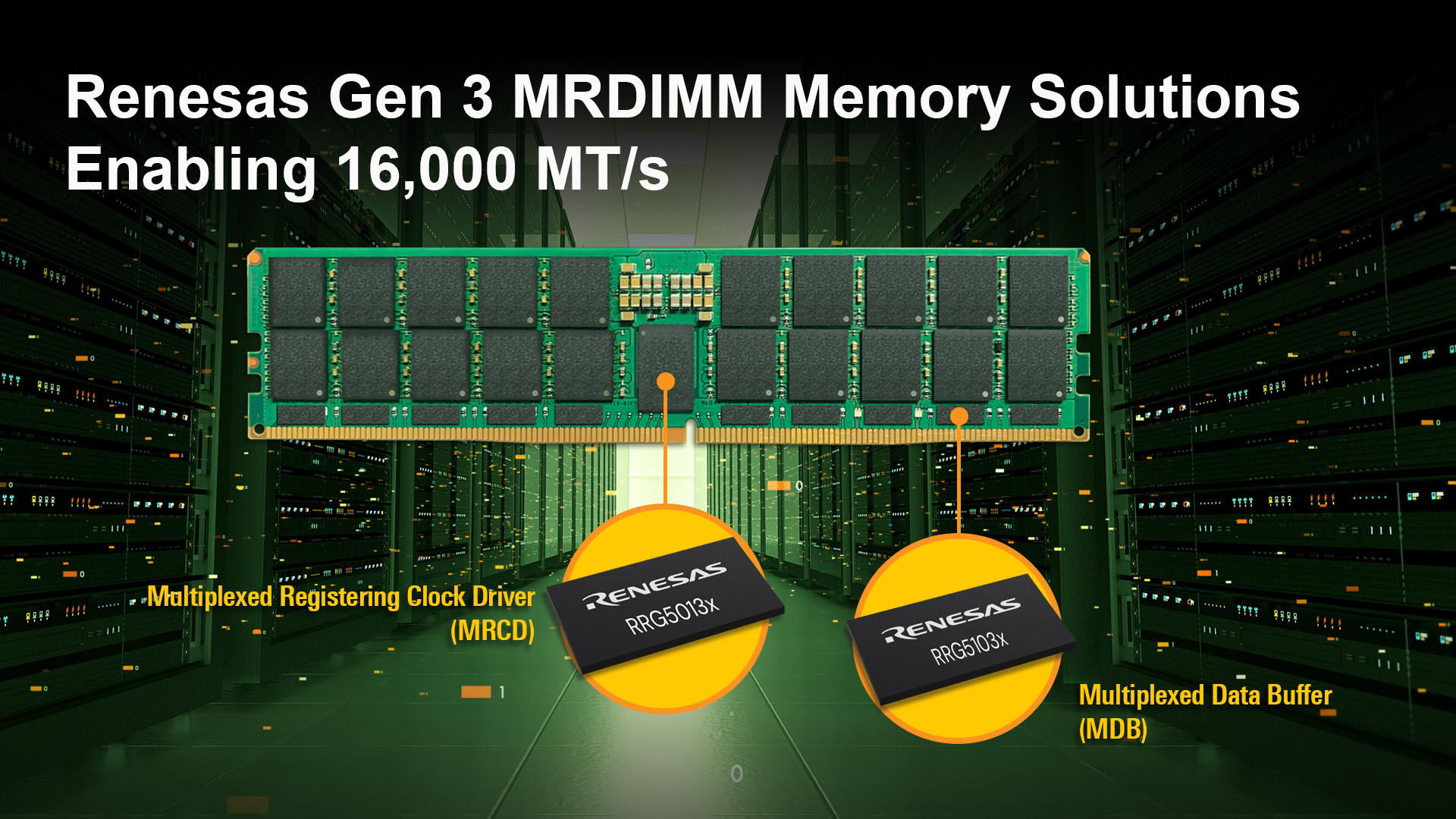
DDR5 MRDIMM development is accelerating as memory and component manufacturers prepare faster server memory for artificial intelligence, cloud computing, and high performance computing platforms. Renesas has announced its third generation MRDIMM chipset with support for speeds reaching 16,000 MT/s, bringing the technology closer to the reported long term target of 17,600 MT/s. According to the roadmap could allow DDR5 infrastructure to approach early DDR6 bandwidth levels without immediately requiring a completely new memory platform.
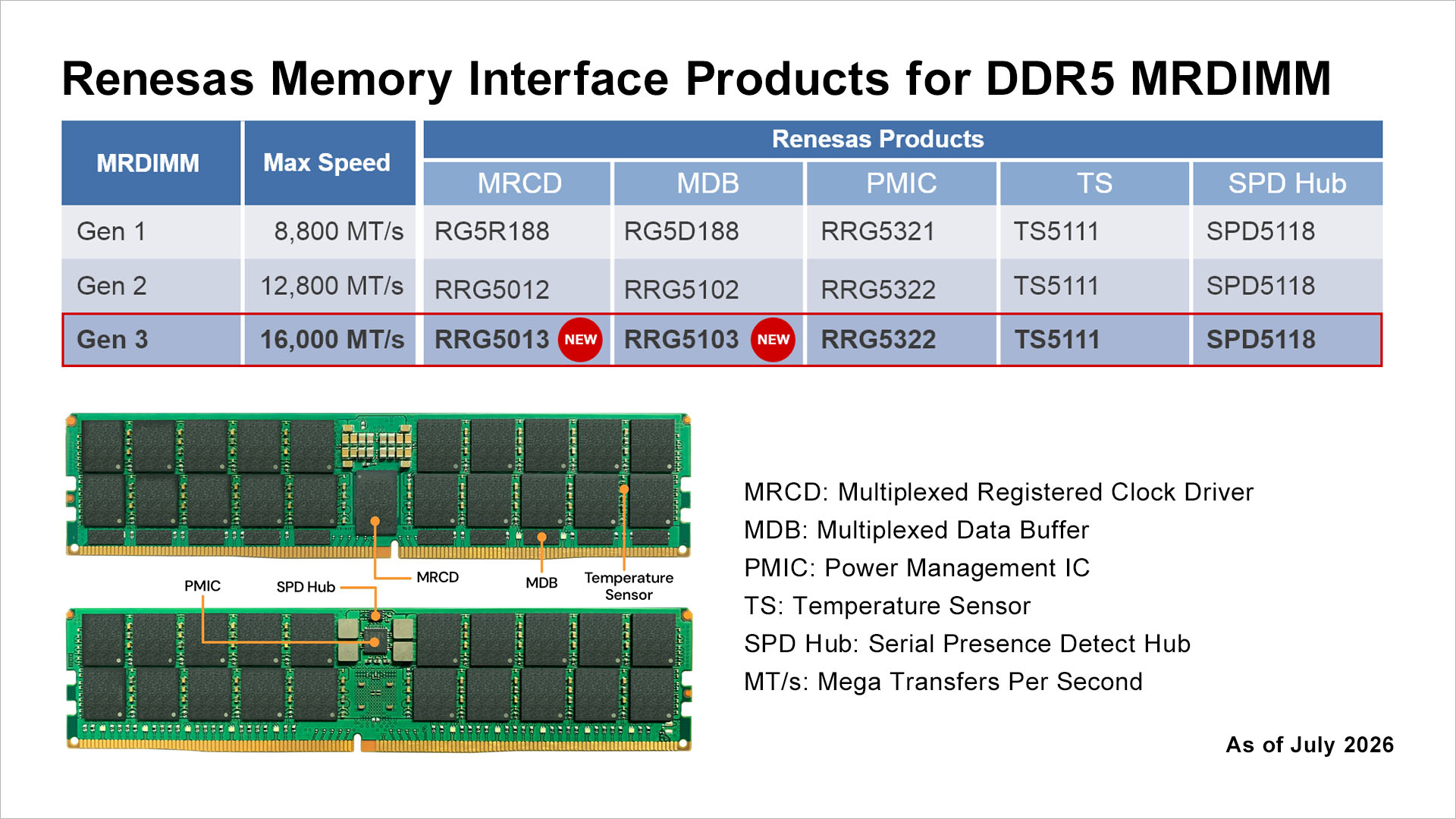
MRDIMM, or Multiplexed Rank Dual Inline Memory Module, uses a Multiplexed Registering Clock Driver and Multiplexed Data Buffers to access 2 memory ranks simultaneously. The additional logic combines their data flow before sending it to the processor, increasing effective module bandwidth while reducing pressure on the CPU memory controller. The modules retain the standard 287 pin DDR5 server memory form factor, although processors, firmware, and motherboards must specifically support MRDIMM operation.
The first generation of DDR5 MRDIMM reached 8,800 MT/s, with Micron currently listing capacities from 32 GB through 256 GB. Micron says its existing modules can provide up to 39% more bandwidth and up to 40% lower loaded latency for selected capacity and bandwidth sensitive workloads compared with conventional DDR5 RDIMM configurations.
The second generation is now expanding the performance ceiling considerably. Innodisk lists DDR5 MRDIMM products operating at 12,800 MT/s in 32 GB, 48 GB, 64 GB, 96 GB, and 128 GB capacities. The company claims a 60% bandwidth increase over DDR5 8,000 MT/s RDIMM while maintaining 1.1 V operation and the standard server memory form factor.
Micron has extended second generation speeds further by listing 12,800 MT/s and 14,400 MT/s MRDIMM products. Its catalog includes a 96 GB module operating at 14,400 MT/s with CL58 timings and a 192 GB version using the same transfer rate, 1.1 V operating voltage, and x80 bus width. The 14,400 MT/s specification represents an 80% raw transfer rate increase over DDR5 8,000 MT/s RDIMM.
| MRDIMM Stage | Maximum Reported Speed | Example Status | Performance Increase Over 8,000 MT/s RDIMM |
|---|---|---|---|
| First Generation | 8,800 MT/s | Available from Micron and supported by Intel Xeon 6 | 10% |
| Second Generation | 12,800 MT/s | Listed by Innodisk and supported by AMD EPYC 9006 | 60% |
| Extended Second Generation | 14,400 MT/s | Listed by Micron in 96 GB and 192 GB configurations | 80% |
| Third Generation | 16,000 MT/s | Renesas chipsets sampling to selected customers | 100% |
| Long Term Roadmap Target | 17,600 MT/s | Future target reported for third generation development | 120% |
The next major step comes from Renesas, which has introduced third generation MRCD and MDB components capable of supporting DDR5 MRDIMM at 16,000 MT/s. The company says the new chipset provides 25% more bandwidth than its 12,800 MT/s second generation solution while preserving the existing DDR5 infrastructure and standard DIMM form factor. Sampling has started with selected customers, including all major DRAM suppliers, while production availability is planned for the second half of 2027.
"Innovations in next generation memory form factors such as MRDIMM are important to helping the industry deliver higher bandwidth and greater efficiency."
— Quote by: Amit Goel.
AMD is positioned as an important platform partner for the expanding MRDIMM ecosystem. The new AMD EPYC 9006 Venice architecture supports up to 16 channels of DDR5 MRDIMM operating at 12,800 MT/s, delivering up to 1.638 TB per second of theoretical memory bandwidth per socket. AMD has also publicly supported the Renesas third generation chipset as part of the industry’s movement toward open and standardized server memory technologies.
The rapid progression extends the JEDEC MRDIMM roadmap from 12,800 MT/s toward speeds that were previously associated with future DDR6 platforms. It also creates a wider difference between standard RDIMM and specialized memory intended for servers containing hundreds of processor cores. As CPU core counts increase, additional compute resources can become underused when the memory subsystem cannot supply data quickly enough.
The current Intel Xeon 6 memory roadmap includes 8,000 MT/s RDIMM and 8,800 MT/s MRDIMM support. AMD has moved further with 12,800 MT/s support on EPYC 9006, while the Renesas announcement establishes a clear component path toward 16,000 MT/s platforms from 2027 onward.
MRDIMM is becoming one of the most important technologies for extending DDR5 inside modern data centers. Moving from 8,800 MT/s to 16,000 MT/s within several generations shows that the server memory ecosystem can continue scaling bandwidth without waiting for DDR6 or replacing the established DIMM form factor.
The largest challenge will be platform adoption. Physical compatibility with DDR5 slots does not mean that existing servers can automatically use these modules. Processor memory controllers, motherboard routing, firmware, power delivery, thermal design, and validation must all support the higher transfer rates.
AMD’s adoption of 12,800 MT/s MRDIMM gives the format an immediate path into high core count servers, while Renesas is establishing the component foundation for 16,000 MT/s systems. The reported 17,600 MT/s target is now only 10% beyond the announced third generation speed, making it increasingly realistic before DDR6 becomes widely deployed.
Will MRDIMM extend DDR5 throughout the next generation of AI servers, or will DDR6 and SOCAMM2 become more important before 17,600 MT/s products reach production?
