
Chinese Chip Tool Profits Jump Over 400% as Global Equipment Backlogs Hit 24 Months
China’s semiconductor equipment industry is gaining momentum as the global AI infrastructure boom pushes chip manufacturing tools into increasingly severe supply constraints. According to Wccftech, lead times for some equipment from major overseas suppliers have stretched to as much as 24 months, creating an opportunity for Chinese manufacturers to accelerate domestic adoption while expanding production of etching, deposition, cleaning, testing, and other semiconductor manufacturing systems.
Data compiled by Chinese semiconductor publication JW Insights shows that most major domestic equipment suppliers recorded double digit revenue growth during H1 2026, while selected companies specializing in areas including deposition and etching reported profit increases ranging from approximately 300% to more than 400%. The figures are not uniform across the industry, with some companies continuing to record losses as aggressive research and development spending remains necessary to close the technology gap with established international suppliers.
AMEC provides one of the clearest examples of the expansion. The Chinese etching equipment manufacturer expects H1 2026 net profit of between CNY 2.7 billion and CNY 2.9 billion, representing growth of approximately 282% to 311% compared with the previous year. Revenue increased around 35% to CNY 6.7 billion. However, part of the extraordinary profit increase came from approximately CNY 2 billion in investment and fair value gains, while adjusted profit excluding those contributions still approximately doubled.
The opportunity is being amplified by an industry wide equipment shortage. Semiconductor manufacturers including TSMC, Samsung, SK hynix, Micron, SMIC, CXMT, and YMTC are investing heavily in new logic, memory, NAND, HBM, testing, and advanced packaging capacity. At the same time, equipment manufacturers face their own component and production bottlenecks. Chinese industry research indicates that some overseas semiconductor equipment delivery periods have extended from conventional schedules of several months to between 12 and 24 months, with selected high end machines reaching the upper end of that range.
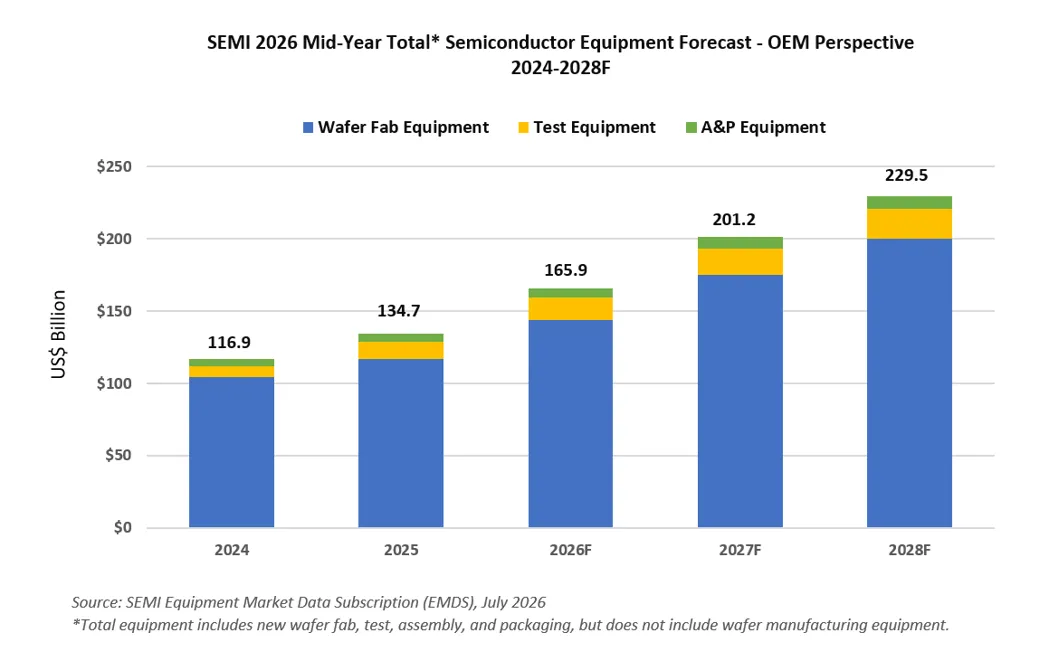
The expansion is not limited to China. SEMI forecasts worldwide semiconductor manufacturing equipment sales will reach a record 165.9 billion$ during 2026, increasing 23.2% year over year, before climbing to approximately 229.5 billion$ by 2028. Wafer fabrication equipment alone is expected to generate 143.9 billion$ during 2026, while DRAM equipment spending is projected to increase 39% to 38.8 billion$ as manufacturers expand HBM and advanced memory production.
"AI is accelerating demand for more powerful and efficient chips, driving increased investment across the semiconductor capital equipment market."
— Quote by: Ajit Manocha, SEMI President and CEO
China is becoming one of the main beneficiaries because domestic manufacturers are under simultaneous commercial and political pressure to increase local equipment adoption. Domestic semiconductor tools reportedly reached approximately 35% of equipment used by Chinese fabs during 2025, exceeding an earlier 30% localization target. Adoption is already substantially higher in selected categories, with domestic equipment taking more than 40% in areas such as etching and thin film deposition.
Memory expansion is providing another major catalyst. Industry estimates indicate that CXMT and YMTC could purchase approximately CNY 55 billion to CNY 63 billion of equipment during 2026 as both companies expand DRAM and NAND manufacturing capacity. Those projects create large domestic order opportunities at precisely the moment when importing foreign machines can involve significantly longer delivery schedules.
Chinese suppliers are also beginning to attract attention outside their traditional domestic customer base. Reuters previously reported that Samsung and SK hynix have evaluated equipment from AMEC as the Korean memory manufacturers consider alternatives to United States supplied tools for their Chinese production facilities. Samsung and SK hynix denied that they were testing AMEC equipment for deployment at those facilities, but the report illustrates how improving Chinese equipment technology is increasingly entering procurement discussions beyond local semiconductor companies.
Lithography remains the largest technological barrier. China has made progress in etching, deposition, cleaning, thermal processing, and testing, but advanced lithography continues to depend heavily on ASML. Domestic immersion DUV systems are only beginning early production and remain far behind ASML in commercial scale, throughput, overlay accuracy, reliability, and proven manufacturing yield. Shanghai Aishengna reportedly plans to manufacture only around 5 systems during 2026 and 20 during 2027, compared with ASML shipping 131 comparable machines during 2025.
The same domestic equipment push could directly support companies including CXMT, which is expected to receive early Chinese immersion DUV systems as it expands DRAM production. CXMT’s access to domestic DUV equipment demonstrates how China is attempting to build a more complete semiconductor production chain rather than relying on isolated breakthroughs in chip design or manufacturing alone.
The most important shift is not simply that Chinese semiconductor equipment companies are reporting enormous profit growth. The global AI expansion has created an environment where delivery time itself has become a competitive advantage.
A fab cannot generate revenue from production capacity that is waiting 18 or 24 months for equipment. If Chinese suppliers can provide acceptable process performance with significantly shorter lead times, customers have a strong incentive to validate them even when an overseas alternative remains technically superior.
That does not mean China has eliminated its semiconductor equipment gap. Lithography, advanced metrology, inspection, process control, long term reliability, and manufacturing consistency remain significant weaknesses. But every domestic machine successfully validated inside a production fab generates data, engineering experience, service capability, and repeat orders.
Export restrictions were intended to limit China’s access to advanced semiconductor technology. One secondary effect has been creating an increasingly large commercial market for domestic equipment suppliers to improve inside. With global equipment sales moving toward 229.5 billion$ by 2028, that opportunity is becoming much larger than a purely domestic substitution story.
Could long equipment backlogs accelerate Chinese semiconductor self sufficiency faster than export restrictions can slow it down?
