
AMD Helion Packs Up to 32,768 Zen 6 EPYC Cores Into One Agentic AI Rack
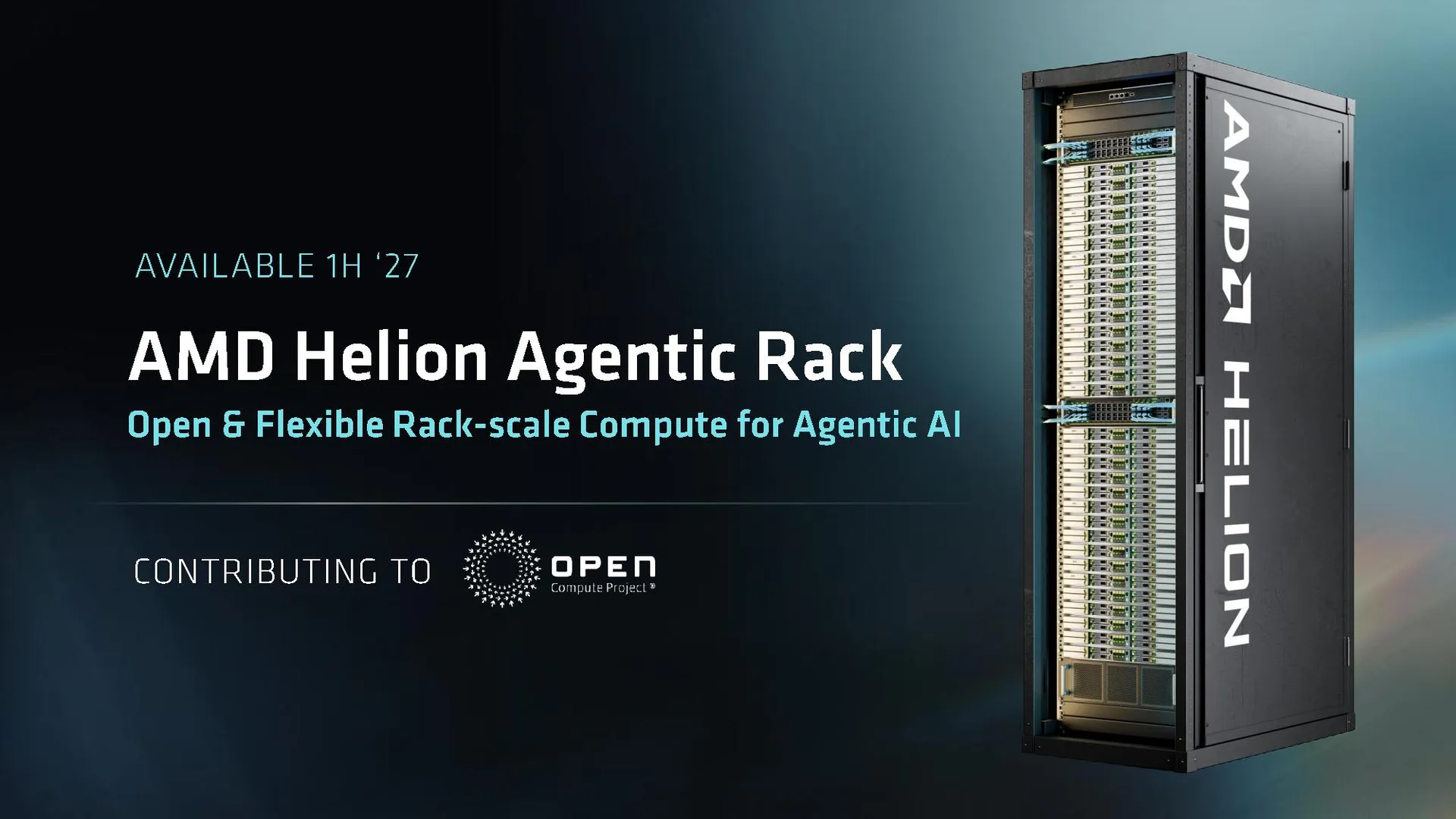
AMD has introduced Helion, an open rack scale reference design for agentic AI that can support up to 32,768 Zen 6 EPYC cores inside a single rack. Announced on October12, AMD Helion is built around 6th Gen EPYC 9006 processors and targets hyperscalers, neocloud providers, sovereign AI operators, and enterprises deploying large numbers of autonomous agents.
Helion is a reference architecture rather than a finished AMD rack. The company plans to contribute the specification to the Open Compute Project, while OEM and ODM partners build commercial systems around it. Partner configurations are expected to begin arriving in November 2026.
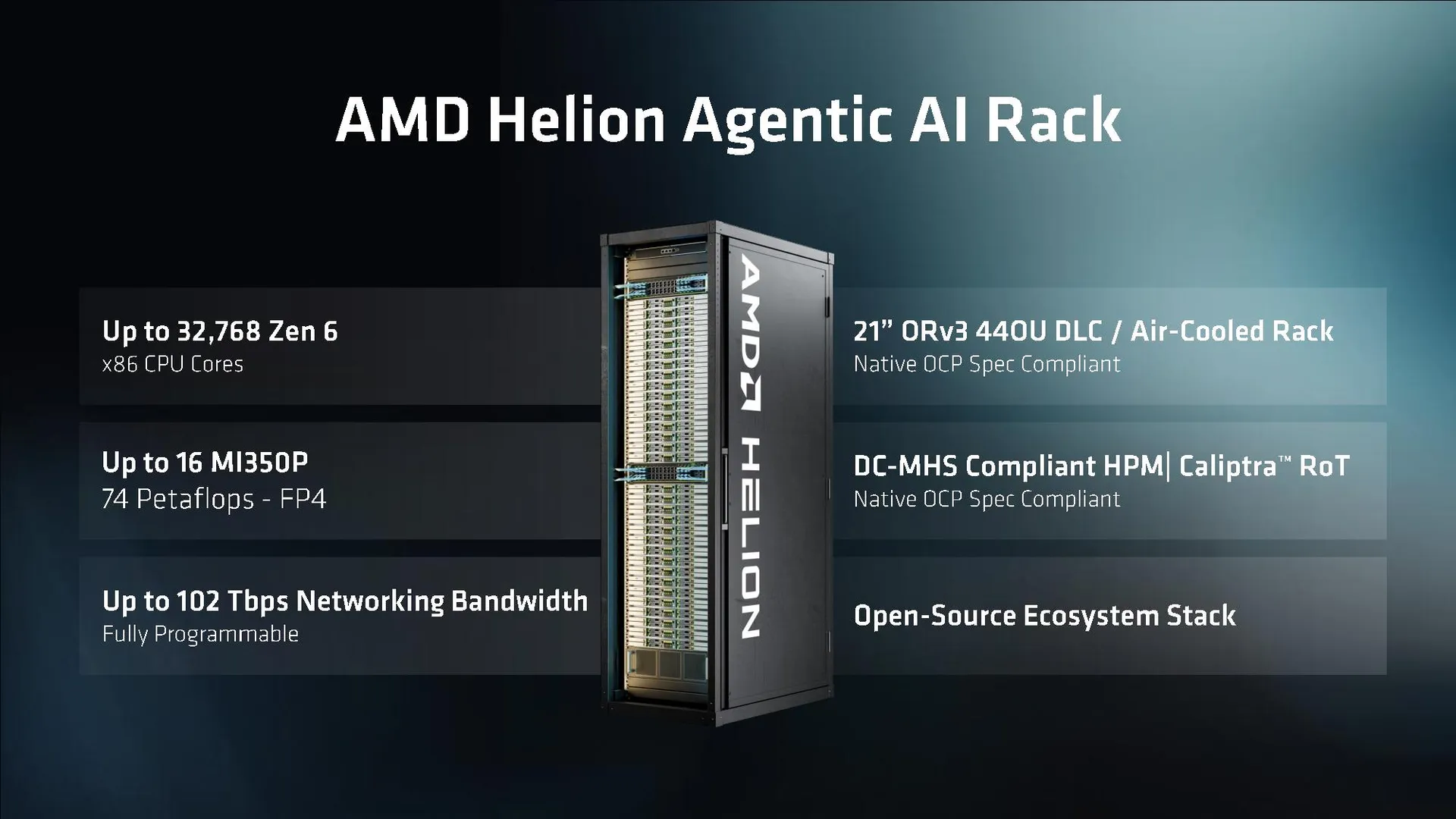
The headline configuration reaches up to 32,768 Zen 6 CPU cores. AMD specifies the total core capacity rather than a fixed processor count, but reaching that maximum with 256 core EPYC processors would mathematically require 128 CPUs.
That density comes from AMD's EPYC 9006 Venice generation, which scales to 256 Zen 6 cores per processor.
| Helion CPU Profile | EPYC Configuration | Intended Use |
|---|---|---|
| Dense | 256 cores at 400 W | Large numbers of personal agents |
| Balanced | 256 cores at 600 W | Enterprise agent workloads |
| Performance | 96 cores at up to 5.0 GHz | Technical and latency sensitive agents |
AMD is positioning the CPU focused configuration for workloads where agents need to execute code, access databases, manage files, operate isolated environments, interact with software tools, and maintain large numbers of simultaneous sessions.
More demanding model inference can remain on separate accelerator infrastructure, allowing Helion to focus on the surrounding agent workload instead of dedicating expensive GPUs to every task.
This is also what separates Helion from AMD's Helios rack scale AI platform. Helios centers on large scale GPU training and inference with 72 Instinct MI455X accelerators, while Helion is designed around the general purpose compute requirements of agentic AI.
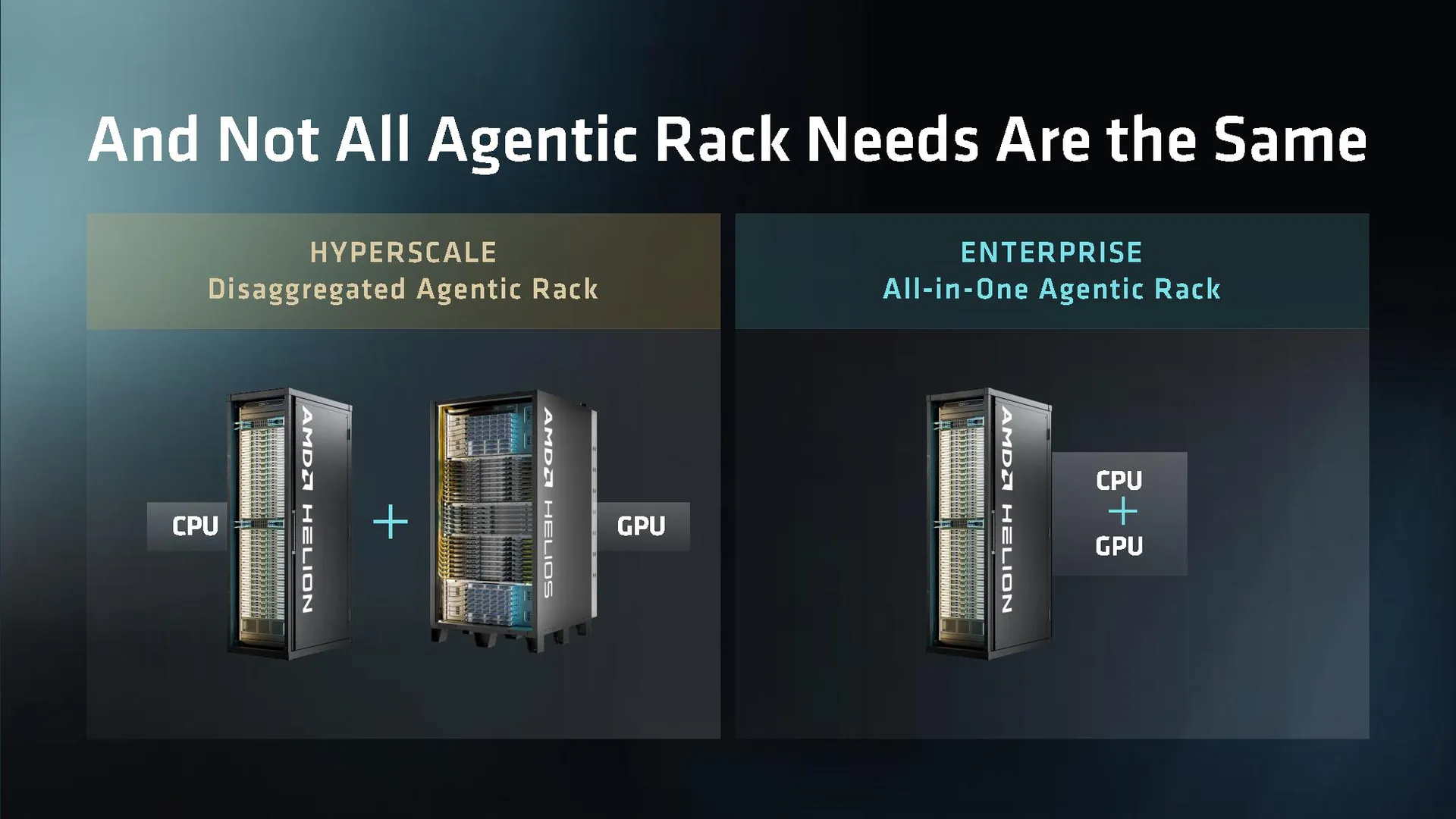
AMD presents flexibility as a central part of Helion, combining EPYC performance, open software, and adaptable rack configurations depending on whether customers prioritize dense CPU execution or local accelerator capacity.
Enterprises can also choose a mixed configuration combining EPYC CPU blades with up to 16 Instinct MI350P GPUs arranged across 2 independent 8 GPU servers. This provides local acceleration for organizations that want CPU and GPU resources within the same rack without turning Helion into a Helios style rack scale GPU system.
| AMD Helion Specification | Maximum |
|---|---|
| CPU Cores | 32,768 Zen 6 cores |
| GPU Capacity | 16 Instinct MI350P GPUs |
| Networking Bandwidth | 102 Tbps |
| Rack Format | 21 inch OCP rack |
| Rack Capacity | 44OU |
| Cooling | Air or direct liquid cooling |
| CPU Platform | EPYC 9006 |
| Architecture | Open OCP based reference design |
Helion also includes an integrated token router capable of directing requests between frontier models hosted elsewhere and open source models running locally, allowing workloads to be routed according to performance, cost, or infrastructure requirements.
The platform follows several OCP standards, including ORv3 rack infrastructure, DC MHS modular hardware, DC SCM management and security, HPRv2 power shelves, OCP NIC 3.0 networking, and Caliptra for silicon root of trust.
Helion also fits into AMD's wider push toward open AI infrastructure. Previous industry estimates suggested AMD's advanced packaging requirements could rise sharply in 2027 as agentic AI drives EPYC Venice deployments, highlighting the growing role CPUs could play alongside accelerators in future AI data centers.
Helion's most interesting idea is not simply the 32,768 core headline. It is AMD's argument that agentic AI creates a new class of CPU heavy infrastructure demand.
GPUs remain essential for large model inference, but agents also generate substantial workloads around those models through code execution, databases, networking, security, orchestration, and isolated compute sessions.
Helion is designed to handle that layer efficiently while allowing accelerator systems such as Helios to focus on the workloads they are best suited for.
If agentic AI scales to millions of persistent software workers, CPU density may become a much larger part of the AI infrastructure conversation.
Could CPU density become just as important as GPU performance as companies deploy millions of autonomous AI agents?
