
TSMC Q2 Employee Bonuses Surge More Than 50% as AI Talent Competition Intensifies
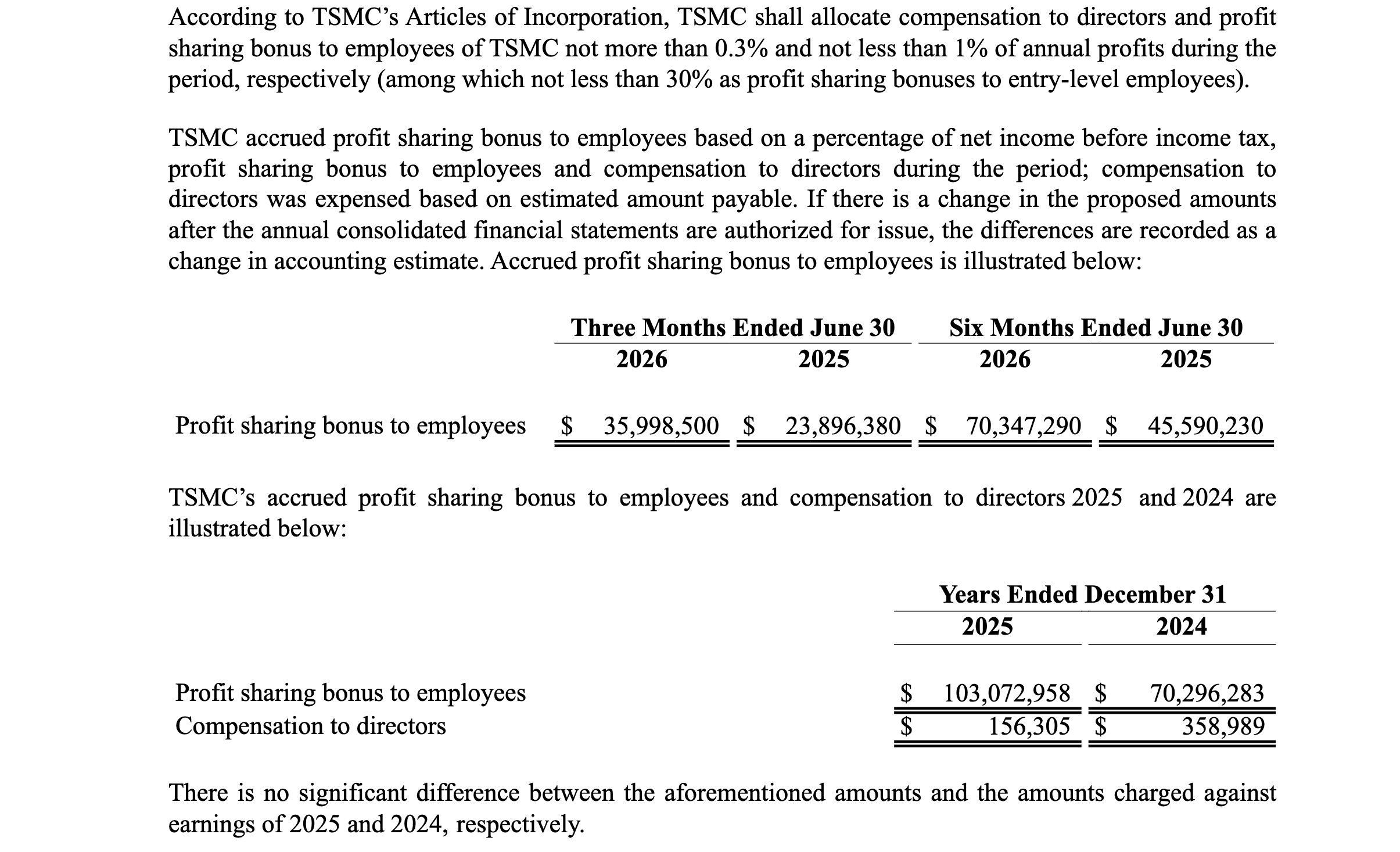
TSMC is spending considerably more to reward and retain its workforce as the artificial intelligence boom intensifies competition for semiconductor talent. Employee bonuses for Q2 2026 reached approximately NT$36 billion, or around $1.14 billion, increasing more than 50% from the same period in 2025. The increase was substantially faster than TSMC's 36% annual revenue growth during the quarter, highlighting how compensation is rising alongside the enormous demand for advanced semiconductor manufacturing.
The underlying numbers show just how quickly TSMC's business has expanded. Q2 revenue reached NT$1.27 trillion compared with NT$933.79 billion a year earlier, while net income surged 77.4% to a record NT$706.56 billion. Employee bonuses therefore increased faster than revenue, although they remained well behind the company's earnings growth. TSMC also reached a 67.7% gross margin and 60.3% operating margin during the quarter.
The trend becomes even more apparent across the first 6 months of 2026. TSMC distributed approximately NT$70.35 billion in employee bonuses during H1, representing a 54.3% increase from the previous year. Over the same period, net income reached approximately NT$1.28 trillion, increasing 68.3%. The company traditionally distributes part of its employee compensation throughout the year before issuing additional profit sharing payments after shareholder approval.
This is not an entirely new development. TSMC's filings show employee profit sharing tied to 2025 reached NT$103.07 billion, compared with NT$70.30 billion for 2024, an increase of approximately 46.6%. When combined with the equivalent NT$103.07 billion distributed through business performance bonuses during 2025, total approved employee performance and profit sharing payments associated with that year reached approximately NT$206.15 billion.
Broader compensation costs were already moving upward as well. TSMC reported salary and bonus expenses of NT$314.78 billion for 2025, compared with NT$233.14 billion during 2024. Average salary and bonus per employee increased 22.95%, while the average employee count rose from approximately 70,037 to 76,916. TSMC finished 2025 with more than 90,000 employees worldwide as its manufacturing footprint continued expanding across Taiwan, the United States, Japan and Europe.
AI is one of the primary forces supporting those economics. High Performance Computing represented 66% of TSMC's Q2 2026 revenue, increasing 20% sequentially, while smartphones accounted for 22%. Advanced process technologies at 7 nm and below represented 77% of wafer revenue, including 3% from the newly ramping 2 nm process, 30% from 3 nm and 33% from 5 nm.
Those numbers help explain why skilled semiconductor engineers are becoming increasingly valuable. Leading edge manufacturing now requires TSMC to expand several technologies simultaneously, including 2 nm fabrication, 3 nm capacity and advanced packaging such as CoWoS. The company has also been accelerating infrastructure investment as demand from NVIDIA, AMD, Apple and custom AI accelerator developers places greater pressure on both wafer production and packaging capacity. That expansion is already visible in the growing pressure around TSMC 2 nm, 3 nm and CoWoS capacity.
TSMC has responded by adding more tools specifically designed to retain critical employees. Its SEC filing confirms that the company introduced an annual Long Term Incentive bonus plan in 2025 for executives and critical talent. Awards are connected to individual performance, company financial results, shareholder returns and environmental objectives, with the final value placed into a trust used to purchase TSMC shares. The structure gives important employees another long term financial incentive to remain with the company as competition for experienced semiconductor engineers grows.
The challenge is becoming increasingly strategic because TSMC cannot expand advanced manufacturing simply by constructing more fabs. New facilities require experienced process engineers, equipment specialists, packaging experts and production teams capable of maintaining the yields demanded by leading edge customers. That becomes particularly important as technologies such as CoWoS scale toward increasingly complex AI processors. TSMC has already achieved CoWoS yields exceeding 98% across several AI products, making experienced manufacturing talent an important part of maintaining that advantage.
TSMC's rapidly growing bonuses are not simply a consequence of record profits. They demonstrate that semiconductor talent itself has become strategic infrastructure.
AI customers can commit billions of dollars toward GPUs, processors and data centers, but advanced chips still depend on highly specialized teams capable of developing processes, improving yields and moving new technologies into mass production. With 2 nm, advanced packaging and global fab expansion happening simultaneously, retaining experienced engineers may now be almost as important to TSMC as securing new equipment.
The important distinction is that bonus growth is not running ahead of the entire business. Q2 bonuses increased more than 50% and exceeded revenue growth of 36%, but TSMC's net income expanded even faster at 77.4%. For now, the company has sufficient profitability to spend more aggressively on its workforce while still delivering exceptional earnings. The real test will come if the competition for semiconductor talent continues escalating faster than the industry's profitability.
As AI drives semiconductor profits and engineering demand higher, do you think employee compensation will become one of the biggest competitive advantages between TSMC, Samsung, Intel and other chip manufacturers?
