
AMD ROCm 10 Brings Agentic AI Tools and Major Performance Gains
AMD has officially released ROCm 10, marking 10 years of development for its open GPU computing software stack while introducing one of its largest AI focused updates to date. The new release brings ROCm.AI into general availability, expands framework and hardware support, introduces new developer tools and delivers substantial inference and training improvements through coordinated software optimization. According to AMD, a system configured with ROCm.AI achieved an average 3.3x improvement in inference throughput and 2.4x improvement in training throughput compared with ROCm 7 in AMD testing.
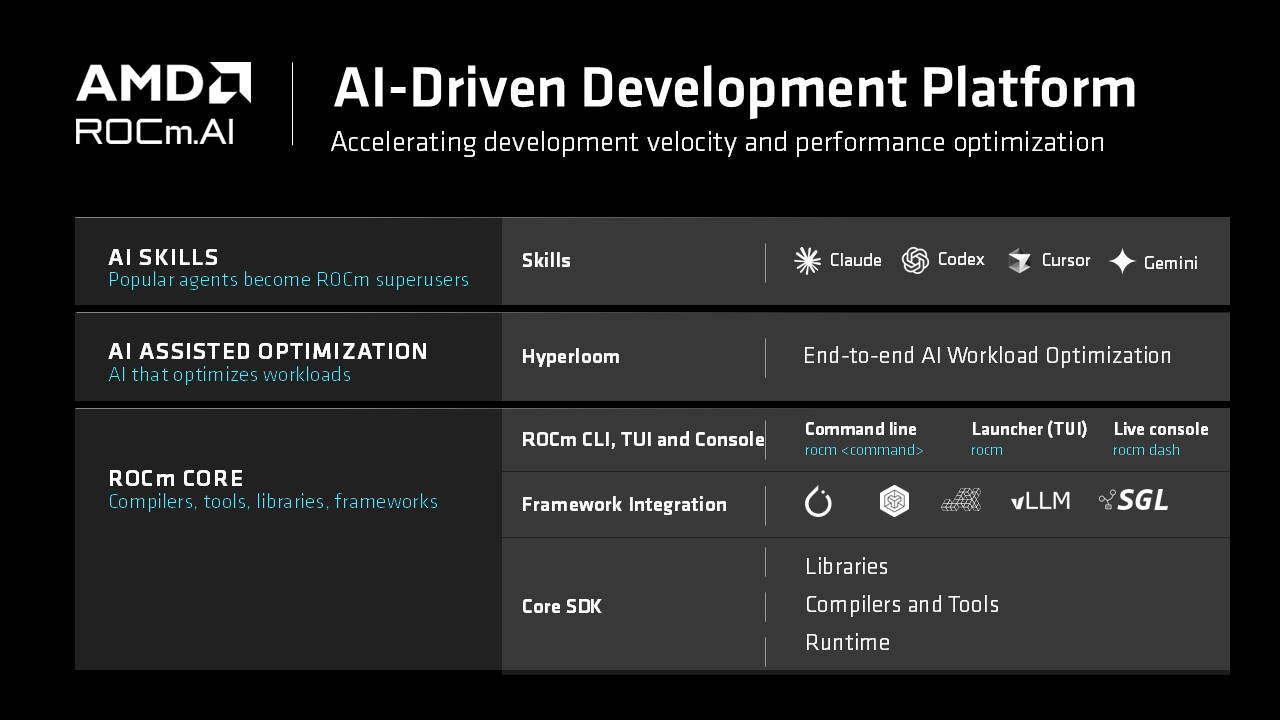
ROCm.AI sits at the center of the release and combines 3 major components: ROCm Hyperloom, AMD Skills and the ROCm CLI. Rather than treating AI development as a collection of separate software utilities, AMD is attempting to create a more integrated environment where developers can configure systems, deploy models, diagnose problems and optimize workloads through both traditional commands and AI agents. This software strategy is becoming increasingly important as AMD expands deployments of Instinct MI355X infrastructure and prepares its much larger Helios rack scale ecosystem.
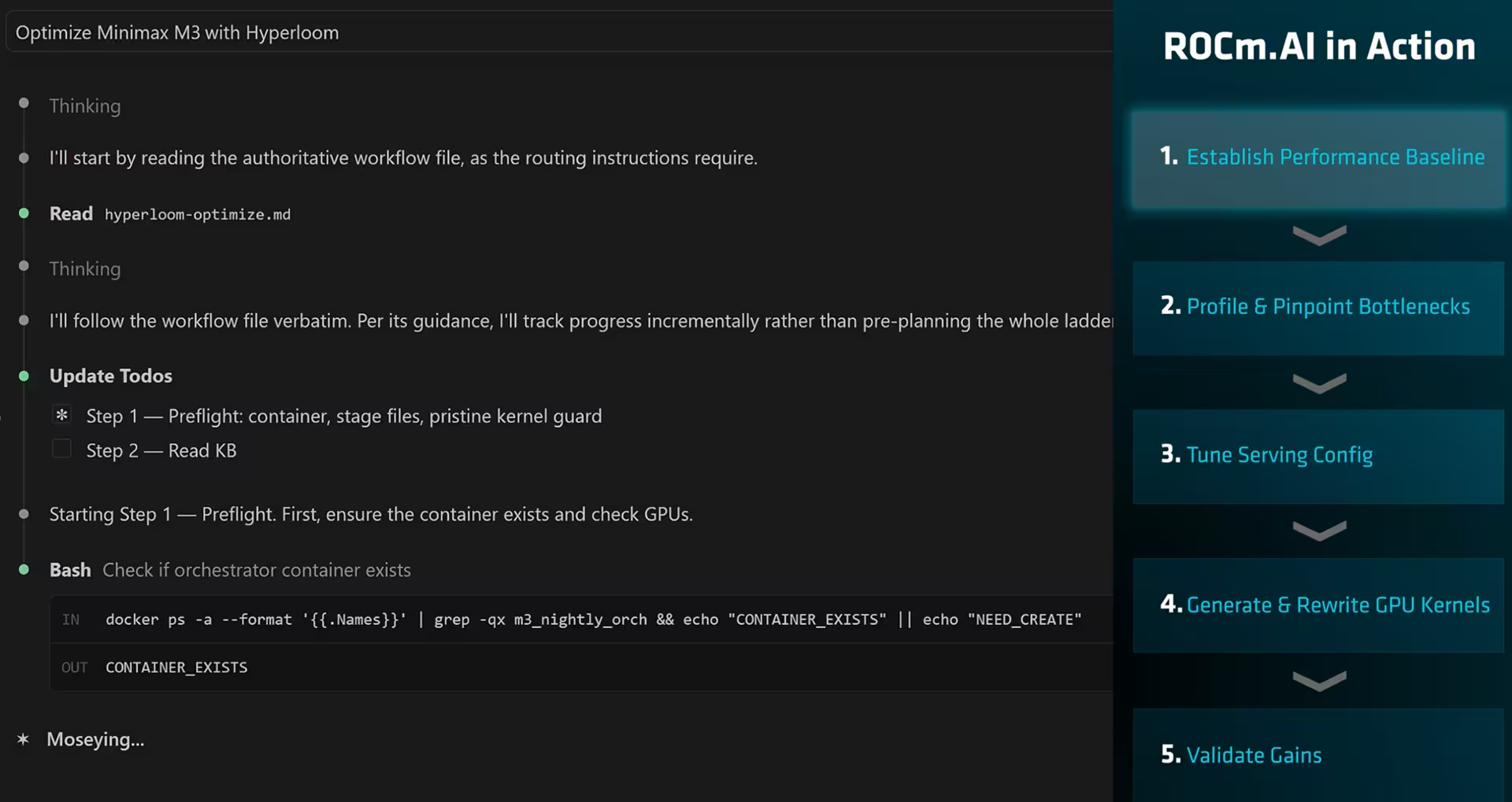
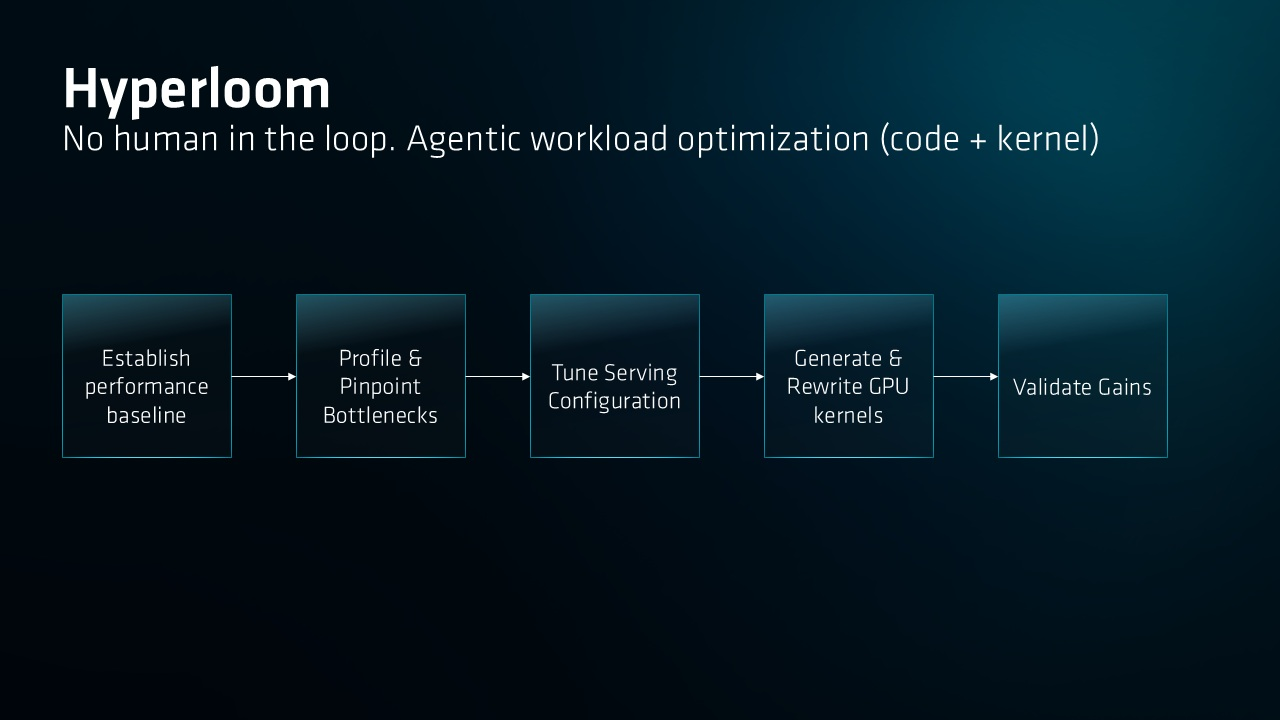
ROCm Hyperloom is perhaps the most technically interesting addition. AMD describes Hyperloom as an autonomous agentic optimization system capable of profiling complete inference workloads across both host code and GPU kernels. It can identify performance bottlenecks, explore possible optimizations, modify targeted portions of a workload, benchmark the resulting changes and validate both performance and correctness. ROCm 10 expands Hyperloom across AMD Instinct GPUs with support for vLLM and SGLang, while optimization targets can include HIP, Triton and FlyDSL code.
AMD Skills brings a different form of AI integration directly into coding assistants. The system provides curated AMD knowledge and validated workflows that developers can access through tools including Claude Code, Cursor and Codex. Available skills cover client AI development, diagnostics, optimization, model serving, profiling and server workflows involving AMD Instinct GPUs and EPYC processors. AMD says each published Skill undergoes structural and behavioral validation before release, with the catalog available through supported coding agent marketplaces and GitHub.
The new ROCm CLI attempts to simplify another longstanding challenge for AMD software adoption by providing a unified interface for managing AI environments. Developers can inspect hardware, create and manage ROCm environments, deploy models, perform diagnostics, update components and control runtimes from the same command line environment. The tool also supports multiple ROCm runtimes installed side by side, including activation and rollback capabilities. ROCm CLI currently remains a Technology Preview, but it is available for both Windows and Linux and does not require an existing ROCm installation before use.
ROCm Console, previously known as dash, complements the CLI by providing live monitoring of system and workload behavior. Supported AMD Instinct systems can expose metrics including GPU utilization, HBM consumption, power usage and tokens per watt, giving developers a more centralized view of both performance and infrastructure efficiency. This becomes increasingly important as AMD moves toward systems such as Helios, where software, networking, CPUs and dozens of Instinct accelerators have to operate as a coordinated rack scale platform.
Performance is one of AMD's biggest claims for the new software direction. On an 8 GPU Instinct MI355X system, AMD measured an average 3.3x increase in inference throughput across GLM 5, Kimi K2.5 and DeepSeek R1 0528. Training tests using DeepSeek V2 Lite, DeepSeek V3 16B and Qwen3 30B A3B produced an average 2.4x throughput improvement. Both measurements were performed in tokens per second.
These figures require an important qualification. AMD's measurements compare ROCm 7.0 against a preview ROCm.AI environment based on ROCm 7.2.2 with additional optimized kernels, parallelism and scheduling improvements. AMD specifically states that the results are dependent on workload and configuration and should not be presented as universal ROCm 10 performance increases. Instead, the tests demonstrate the potential gains available when improvements across kernels, memory management, communication, serving software and scheduling are applied together.
The underlying ROCm Core SDK is also receiving major updates. ROCm 10 documentation confirms support for PyTorch 2.13, JAX 0.11, vLLM 0.27, SGLang 0.5.15, TensorFlow 2.21, MIGraphX 2.17 and newer ONNX Runtime releases. AMD has also expanded HIP functionality, profiling capabilities and telemetry while continuing to improve API compatibility for developers moving compute workloads from other GPU ecosystems.
Hardware coverage continues expanding beyond Instinct accelerators as well. ROCm 10 supports the Instinct MI350, MI300, MI200 and MI100 families alongside a growing collection of Radeon and Ryzen hardware. The Radeon RX 9050 has been added in this release, while ROCm continues extending AI framework functionality across consumer Radeon GPUs and Ryzen AI systems. That broader strategy could make local AI development increasingly practical on desktop and workstation hardware before workloads are moved onto larger Instinct clusters.
The release is not without limitations. AMD's own documentation lists several known issues involving consumer hardware, including possible PyTorch training crashes or GPU resets on some Radeon RX 9070 Series and Radeon AI PRO R9700 systems, SGLang inference problems on selected Radeon GPUs and possible vLLM or ComfyUI crashes on some Ryzen AI configurations. AMD provides workarounds for several of these issues, but they demonstrate that broader Radeon and Ryzen support still requires additional maturity compared with the core Instinct environment.
ROCm 10 ultimately arrives at an important moment for AMD's AI strategy. Hardware deployments around the Instinct MI355X are growing, while the next generation Helios platform is moving toward large scale commercial deployments. Competing with NVIDIA therefore increasingly depends not only on accelerator performance, but also on whether developers can deploy and optimize models without facing significantly more software complexity. ROCm 10 represents AMD's latest and most aggressive attempt to close that gap.
ROCm has historically been one of the most important variables in any comparison between AMD Instinct and NVIDIA hardware. AMD can build extremely competitive accelerators, but hardware performance alone does not win AI infrastructure deployments when developers already have years of workflows, libraries and optimization expertise invested elsewhere.
ROCm 10 addresses that problem from a different angle. Hyperloom, AMD Skills and ROCm CLI are not simply additional libraries. They attempt to use AI itself to reduce the expertise required to optimize AI workloads on AMD hardware. If Hyperloom can reliably identify bottlenecks and generate meaningful optimizations across kernels, memory and scheduling, AMD could reduce one of the largest practical barriers separating competitive hardware from production ready infrastructure.
The 3.3x inference and 2.4x training figures should not be interpreted as automatic ROCm 10 performance gains, but they still demonstrate how much performance can remain hidden inside the software stack. With MI355X already expanding commercially and Helios pushing AMD toward much larger rack scale deployments, ROCm may now be just as strategically important as the next Instinct GPU itself.
Could ROCm 10 and its new AI assisted optimization tools finally give AMD the software ecosystem it needs to challenge NVIDIA more aggressively in large scale AI infrastructure?
