
TSMC Could Redirect Capacity Toward AI if Apple Chip Inventory Builds, Taiwan Analyst Says

TSMC may be able to mitigate the impact of any potential Apple chip inventory buildup by redirecting production capacity toward AI and high performance computing products, according to a Taiwanese industry analyst. The argument follows reports claiming that TSMC could be holding roughly $1 billion worth of Apple A20 Pro processors as memory shortages complicate downstream production, although that figure remains disputed by other analysts. Taiwan Institute of Economic Research Director Liu Pei Chen believes TSMC has enough flexibility across its manufacturing operations to respond to changing demand.
The reasoning is supported by the dramatic transformation of TSMC's revenue mix as AI infrastructure spending accelerates. TSMC's official Q2 2026 management report shows that high performance computing represented 66% of company revenue during the quarter, increasing 20% sequentially. Smartphones accounted for only 22%, down from 26% during Q1 2026. Advanced technologies at 7 nm and below represented 77% of wafer revenue, while the new 2 nm process already contributed 3%.
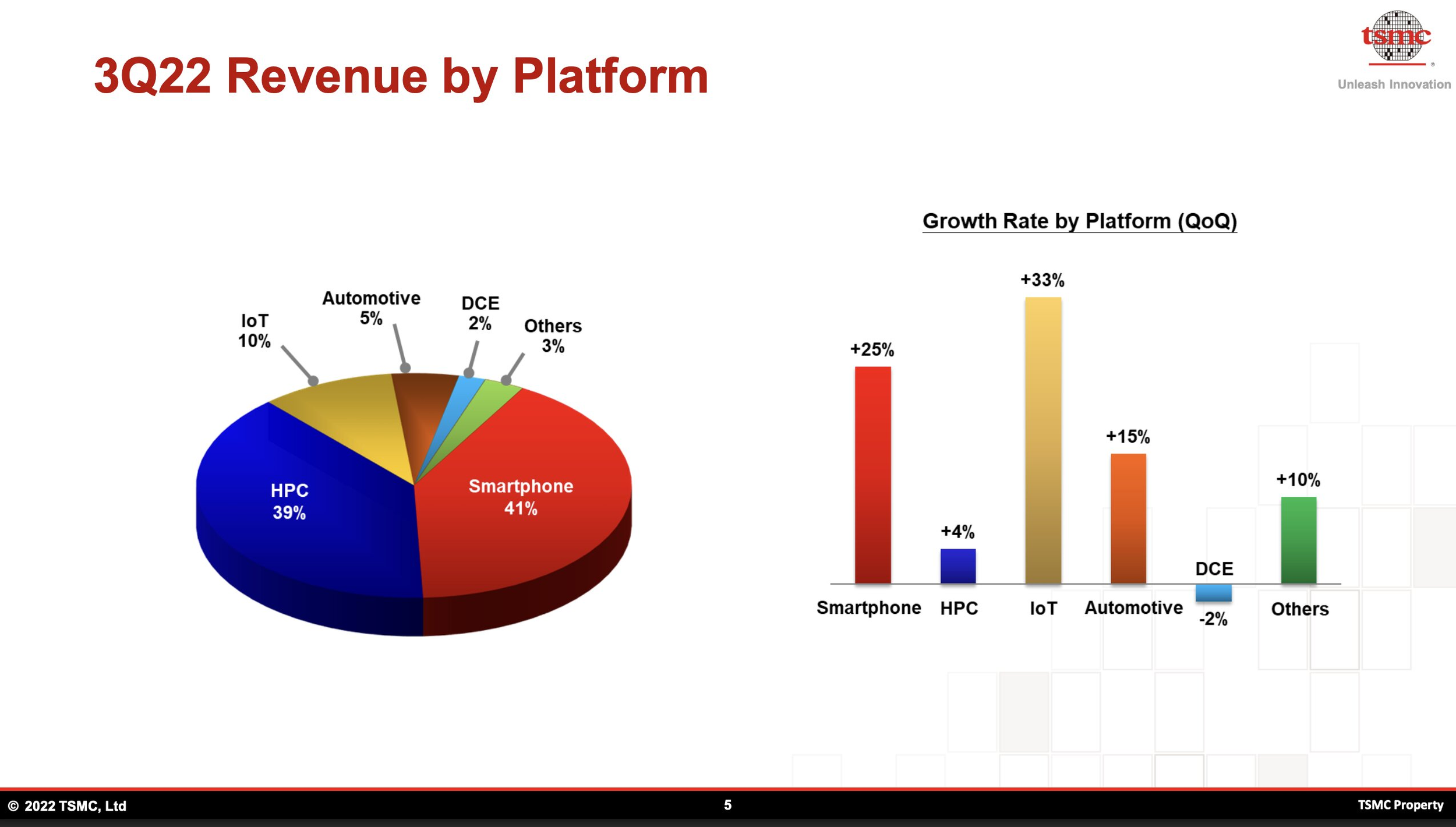
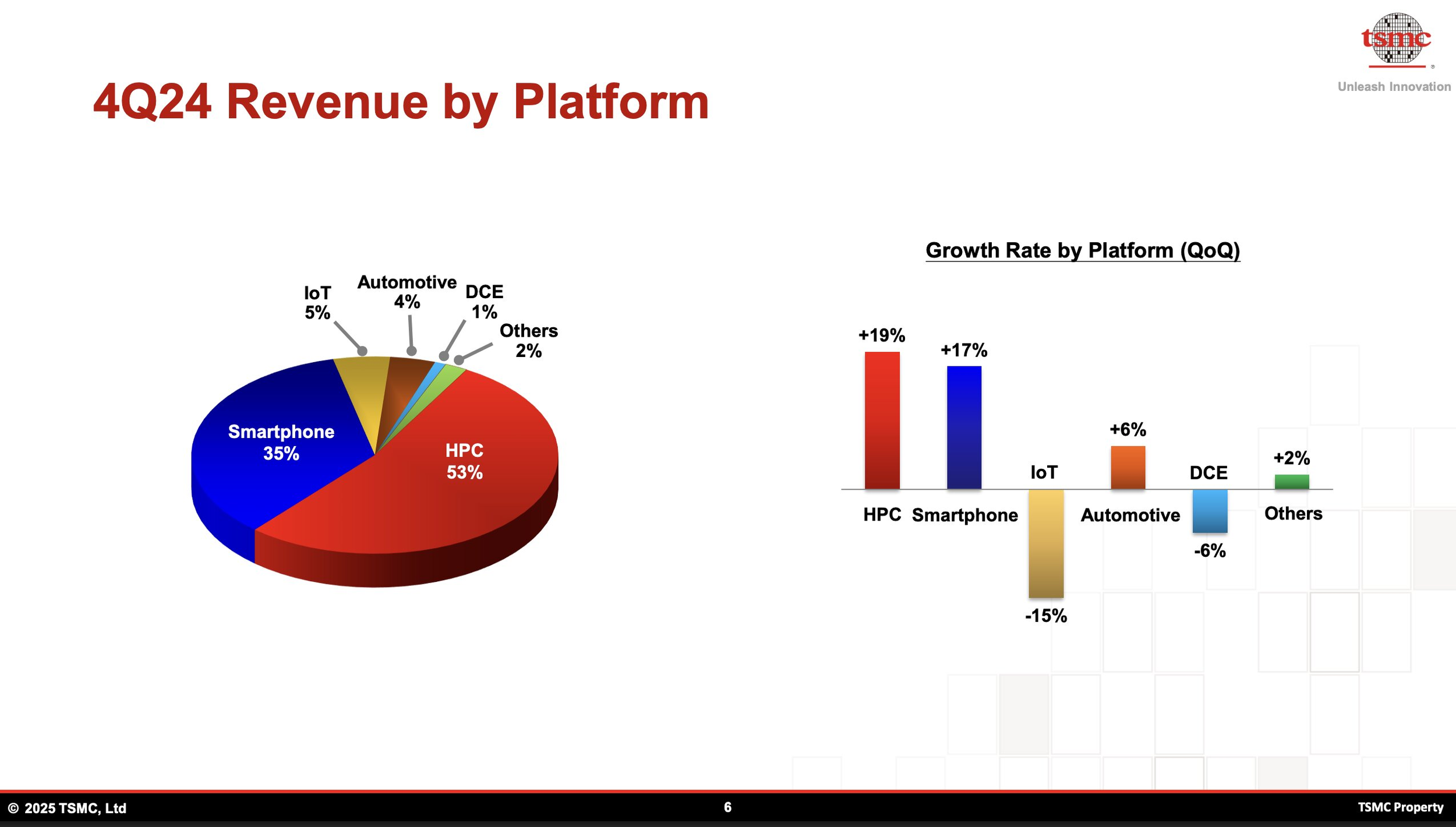
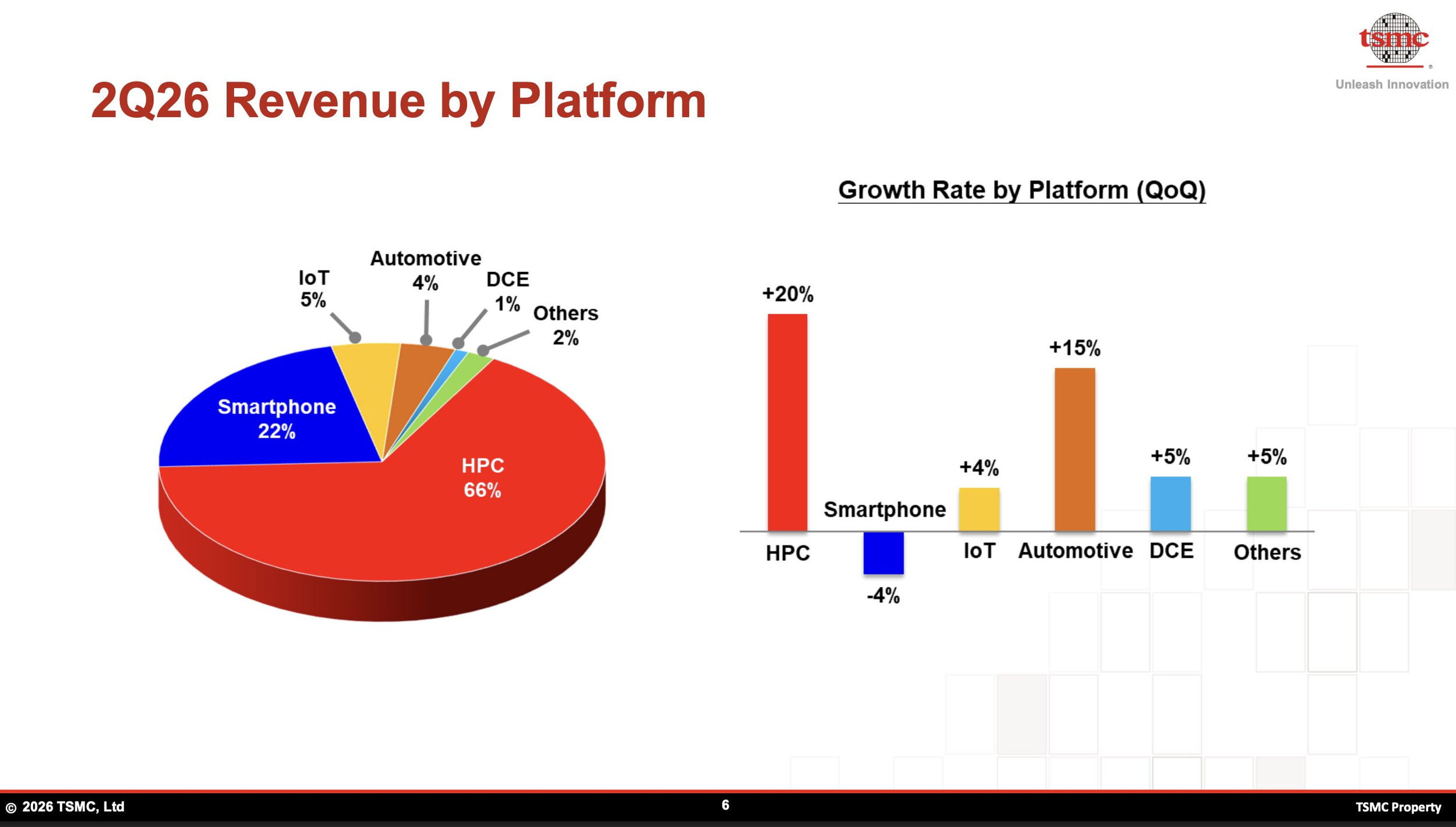
This gives TSMC significantly more exposure to AI accelerators, data center processors, and other high performance computing products than during previous smartphone dominated cycles. Liu told United Daily News that while memory shortages are outside TSMC's control and could affect delivery cycles and capital efficiency, the foundry can dynamically adjust production in coordination with customers and the broader semiconductor ecosystem. Capacity potentially affected by weaker consumer electronics production could therefore be redirected toward AI and high performance computing products where demand remains extremely strong.
The original concern centers on reports that TSMC could be holding approximately $1 billion of Apple's upcoming A20 Pro silicon because insufficient DRAM availability is preventing the processors from moving through later stages of the supply chain. Apple is expected to use its first generation 2 nm processors in upcoming devices, making synchronization between processor, memory, packaging, and final device assembly critical. The reported inventory figure remains unconfirmed, however, and Wccftech itself rated the original claim as only 50% plausible.
TF International Securities analyst Ming Chi Kuo has also challenged the idea that TSMC is sitting on $1 billion of stranded Apple processors. Kuo argues that Apple normally plans wafer requirements several months ahead and would align A20 Pro production with available memory supply rather than paying TSMC to manufacture large volumes of silicon that cannot progress through final production. He also noted that TSMC's increase in inventory days during Q2 2026 can be explained by the normal ramp of its new N2 technology. TSMC itself confirmed that inventory days increased from 80 to 87 primarily because of the N2 ramp.
Regardless of whether the reported Apple inventory reaches the claimed $1 billion figure, the broader supply imbalance is real. Memory manufacturers have increasingly prioritized higher value products serving AI infrastructure, particularly HBM, while demand across AI processors continues placing extraordinary pressure on leading edge foundry capacity. TSMC has consequently raised its 2026 capital expenditure budget to between $60 billion and $64 billion as it expands production for AI, high performance computing, and emerging agentic AI workloads.
The situation also reinforces why TSMC continues aggressively expanding 2 nm, 3 nm, and advanced packaging capacity. As previously covered in our report on TSMC capacity expansion, advanced processes and CoWoS packaging have become strategic bottlenecks as NVIDIA, AMD, Apple, and other major customers compete for manufacturing resources. AMD has already moved its EPYC Venice processors into volume production on TSMC 2 nm, demonstrating that Apple will increasingly share the newest process nodes with major data center customers rather than dominating early capacity alone.
The more important story may not be whether TSMC is actually holding $1 billion worth of Apple silicon, but how much its business has changed. With high performance computing now generating 66% of quarterly revenue, TSMC has considerably more flexibility to prioritize AI and data center customers when demand shifts elsewhere.
Apple remains one of the industry's most important semiconductor customers, but AI has fundamentally changed capacity economics. NVIDIA, AMD, hyperscalers, and custom accelerator developers are all competing for the same advanced nodes and packaging technologies. If smartphone production encounters a temporary bottleneck elsewhere in the supply chain, TSMC now has an enormous pool of AI demand capable of absorbing manufacturing resources that might otherwise sit underutilized.
Do you think AI demand gives TSMC enough flexibility to absorb a smartphone slowdown, or could memory shortages eventually disrupt both consumer electronics and AI hardware production?
