
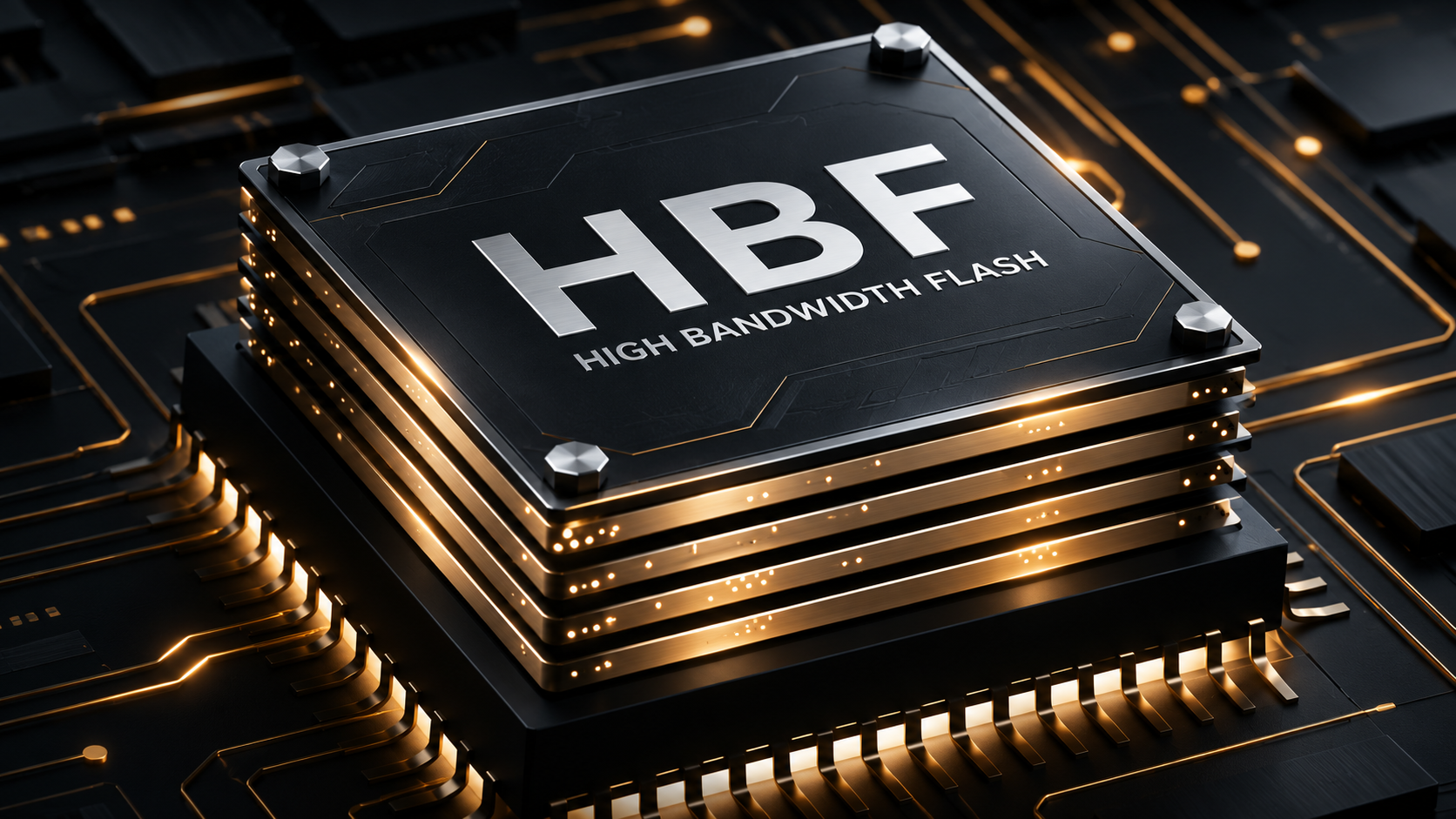
The growing demand for artificial intelligence infrastructure could create another major challenge for consumer SSD availability as semiconductor manufacturers prepare to introduce High Bandwidth Flash (HBF), a new memory technology designed to deliver substantially higher capacity at a fraction of the cost of conventional HBM. According to estimates attributed to Bernstein analysts, an 8 layer HBF stack could cost approximately $0.64 per GB, compared with $6.78 per GB for an equivalent HBM4 configuration. However, the same analysis suggests HBF could require approximately 6.5 times more wafer resources than conventional TLC NAND, potentially increasing pressure on the manufacturing capacity responsible for producing everyday consumer SSDs.
HBF is being developed by Sandisk and SK hynix as an additional memory layer positioned between conventional High Bandwidth Memory and enterprise SSD storage. Rather than relying on DRAM, the architecture vertically stacks NAND flash dies using advanced packaging and high speed interconnects. By accessing thousands of NAND cells in parallel, HBF aims to overcome some of the bandwidth limitations associated with conventional flash storage while retaining substantially greater capacity than typical HBM configurations.
The companies introduced their first open HBF specification through the Open Compute Project in August 2026, supporting capacities of up to 512GB per package and bandwidth ranging from approximately 0.4TB/s to 3.0TB/s. The standard also incorporates UCIe connectivity, allowing HBF to communicate with CPUs, GPUs, and specialized AI accelerators. As previously explained in the technical overview of HBF architecture and its performance characteristics, the technology is primarily designed for AI inference workloads that need rapid access to enormous quantities of model data.
HBF vs HBM4 vs Conventional TLC NAND
| Specification | HBF | HBM4 | TLC NAND |
|---|---|---|---|
| Memory Technology | Stacked NAND | Stacked DRAM | NAND flash |
| Primary Application | AI inference memory | AI accelerator memory | SSD storage |
| Estimated Cost per GB | $0.64 | $6.78 | Not specified |
| Bandwidth | 0.4 to 3.0 TB/s | Several TB/s per stack | Depends on SSD interface |
| Capacity per Package | Up to 512GB | Lower capacity than HBF | Varies |
| Relative Wafer Demand | Up to 6.5x in Bernstein comparison | Not specified | Reference baseline |
The $0.64 and $6.78 figures are Bernstein cost estimates, not retail prices. The wafer comparison reflects the analyst's manufacturing model and has not been independently validated in commercial HBF production.
The potential problem is that HBF and consumer SSDs depend on overlapping NAND manufacturing resources. If major cloud providers begin purchasing large quantities of HBF for AI accelerators, manufacturers could allocate more wafer capacity toward these specialized, higher value products, leaving less available for conventional SSD production. This could limit future price reductions even as NAND technology becomes more efficient.
Nevertheless, HBF is not expected to immediately transform the market. Sandisk has already reported progress on its first HBF silicon, with AI inference product samples targeted for 2027 and broader commercialization potentially following during 2028 or 2029. The technology also faces limitations related to NAND read latency, write performance, endurance, manufacturing yields, and thermal management. Consequently, HBF is more likely to complement HBM by storing large quantities of relatively static AI model data than replace DRAM for every accelerator workload.
The warning arrives as Phison has already raised concerns about prolonged NAND supply constraints driven by AI infrastructure investment. However, the latest TrendForce NAND market assessment also indicates that consumer demand remains relatively weak, with some NAND prices stabilizing at elevated levels. This means HBF could introduce additional long term supply pressure, but it does not guarantee that consumer SSD prices will continuously rise or remain expensive indefinitely.
HBF could become an important advancement for AI computing, offering the capacity required by increasingly large models without depending entirely on expensive HBM. However, the economics raise concerns about the direction of the storage industry.
We are already seeing AI infrastructure influence DRAM allocation, graphics card memory availability, and enterprise SSD production. If HBF becomes commercially successful and requires substantially more NAND manufacturing resources, consumers could face another situation where technological innovation benefits hyperscale customers while everyday hardware becomes less affordable.
For gamers, SSD capacity is increasingly important as modern games continue requiring larger installations. Developers, creators, and local AI enthusiasts also depend on affordable storage for projects, datasets, and applications. Maintaining access to reasonably priced 2TB, 4TB, and larger SSDs should remain an important industry priority.
The solution is not to restrict innovation but to encourage broader NAND manufacturing investment, improvements in production efficiency, and supply strategies that do not prioritize enterprise demand at the expense of consumer accessibility.
More efficient AI memory should not come at the cost of making personal computing increasingly expensive.
Would you consider upgrading your SSD storage now to avoid potential future price increases, or do you expect NAND manufacturers to eventually expand production enough to stabilize the market?
