
SMIC Revenue Jumps 20% as China Narrows the Foundry Gap With Samsung
China's Semiconductor Manufacturing International Corporation delivered the fastest revenue growth among the world's 10 largest foundries during Q2 2026, with sales climbing 20% from the previous quarter to more than $3 billion as stronger consumer electronics orders, AI peripheral chips and server networking demand pushed the company closer to Samsung Foundry.
According to TrendForce, combined revenue across the world's top 10 semiconductor foundries increased 11.5% sequentially to nearly $53.49 billion during Q2 2026, establishing another industry record. Demand remained particularly strong for advanced processes used by AI and high performance computing processors, while power management chips, power discrete components and other supporting silicon also contributed to growth. Consumer electronics manufacturers simultaneously increased procurement across PCs, notebooks and televisions as concerns over mature process capacity and future wafer pricing encouraged earlier orders.
TSMC remained overwhelmingly dominant with close to $40.2 billion in quarterly foundry revenue, representing 12.1% sequential growth and a 72.5% global market share. AI server GPUs and XPUs continued keeping its 5 nm, 4 nm and 3 nm production capacity heavily utilized, while Apple's product production cycle and the first revenue contribution from 2 nm manufacturing provided additional momentum. TSMC's scale remains dramatically larger than every competing pure foundry operation, even as smaller rivals experience stronger percentage growth.
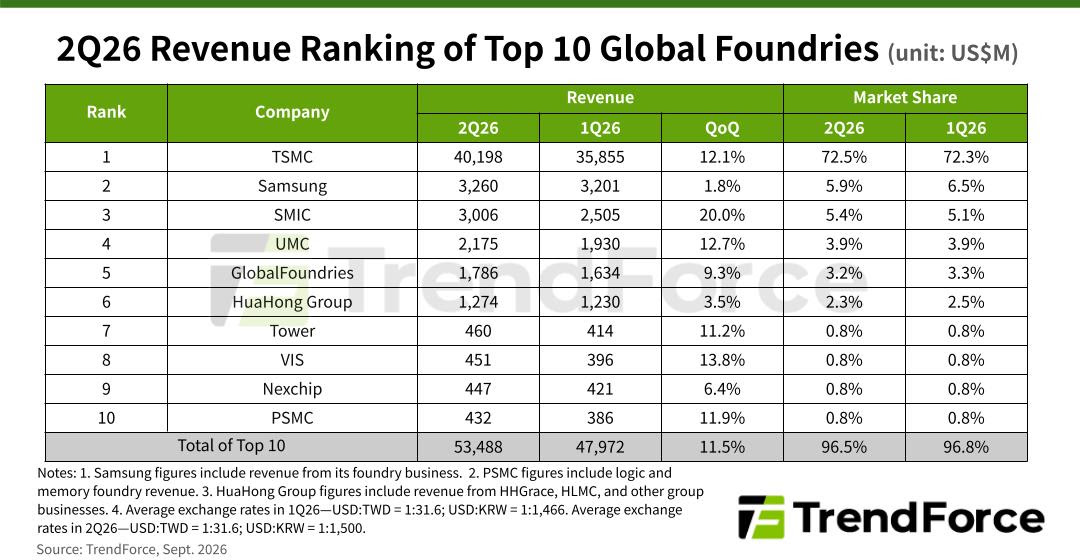
Samsung Foundry maintained second place with approximately $3.26 billion in revenue, but its quarterly growth was considerably slower at 1.8%. Its market share consequently declined to 5.9%. TrendForce attributed Samsung's growth to new advanced process orders, including HBM base dies, alongside higher foundry pricing across 5 nm, 4 nm and more advanced technologies. Samsung is also expanding its broader foundry strategy around AI customers, with its semiconductor partnership with Broadcom combining advanced foundry manufacturing, memory and packaging as it attempts to strengthen its position against TSMC.
SMIC remained in third place after revenue surged 20% to more than $3 billion, lifting its global foundry market share to 5.4%. That leaves only 0.5 percentage points between SMIC and Samsung, creating a significantly closer competition for second place than the enormous distance separating both companies from TSMC. Importantly, this was not the quarter in which SMIC newly overtook GlobalFoundries. TrendForce already ranked SMIC third during Q1 2026 with a 5.1% share, while GlobalFoundries held fifth place. Q2 therefore represents an acceleration of SMIC's existing third place position rather than a new ranking change.
SMIC's growth came primarily from stronger procurement across PC and notebook supply chains, increasing AI peripheral chip demand and additional server networking orders. Memory shortages also created stronger demand and improved pricing for NAND and NOR Flash foundry production, giving the Chinese manufacturer another source of revenue growth. These markets are particularly important for SMIC because the company remains restricted from accessing the most advanced EUV manufacturing equipment available to TSMC and Samsung, making mature and established process technologies central to its commercial expansion.
UMC remained fourth with nearly $2.18 billion in revenue and a 3.9% market share after growing 12.7% from the previous quarter. Its performance benefited from PC, notebook and consumer electronics procurement as well as stronger server related FPGA demand and improving utilization across 8 inch production capacity. GlobalFoundries followed in fifth place with approximately $1.79 billion in revenue, representing 9.3% sequential growth and a 3.2% share of the market.
The numbers highlight how differently the foundry market is developing at its 2 extremes. TSMC continues strengthening its control over leading edge manufacturing through 3 nm and 2 nm technology, with its 2 nm process moving deeper into commercial production, while SMIC is generating rapid growth through a wider combination of consumer, networking, storage and AI peripheral silicon manufactured on less advanced processes.
TrendForce expects global foundry revenue to continue expanding during Q3. Consumer semiconductor customers are maintaining wafer starts because mature process capacity could remain constrained, while flagship smartphone production and next generation AI and high performance computing platforms are expected to create additional demand at advanced nodes.
SMIC's 20% quarterly growth is significant, but the most important number is the shrinking distance between third and second place. Samsung controls 5.9% of global foundry revenue while SMIC has reached 5.4%, meaning the Chinese manufacturer is now much closer to Samsung than either company is to TSMC.
That does not mean SMIC has matched Samsung technologically. Samsung competes directly at advanced nodes including 2 nm and increasingly uses its combination of foundry, HBM and advanced packaging as a strategic advantage. SMIC remains much more dependent on mature technologies and faces equipment restrictions that make leading edge expansion considerably more difficult.
What SMIC is demonstrating is that advanced node leadership is not the only route toward scale. PC components, networking silicon, power management chips, Flash products and other mature process devices still represent enormous markets, particularly as AI infrastructure increases demand for the supporting chips surrounding CPUs, GPUs, networking equipment and storage.
For the semiconductor industry, the developing competition between Samsung and SMIC may become almost as interesting as TSMC's continued leadership. TSMC remains in a different category with 72.5% market share, but the fight for second place has become considerably tighter.
Can SMIC realistically overtake Samsung Foundry in revenue if its current growth continues, or will restrictions on advanced manufacturing technology eventually limit how far it can climb?
