
RTX 5090 Power Limit Reaches 800W With Custom VBIOS Editor Without Flashing
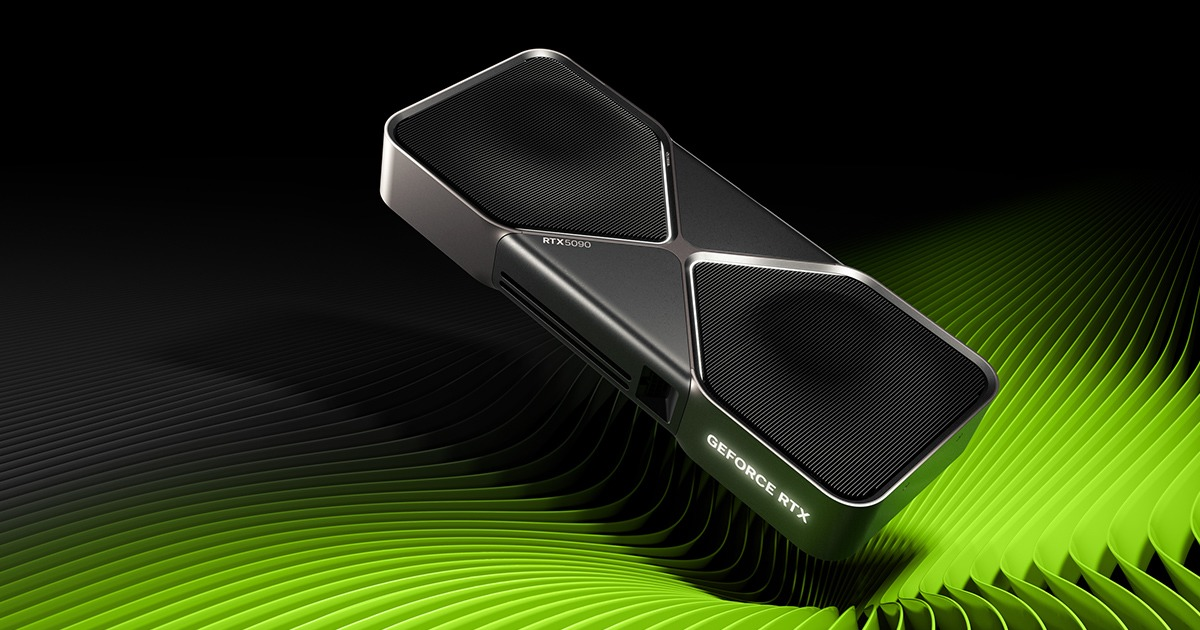
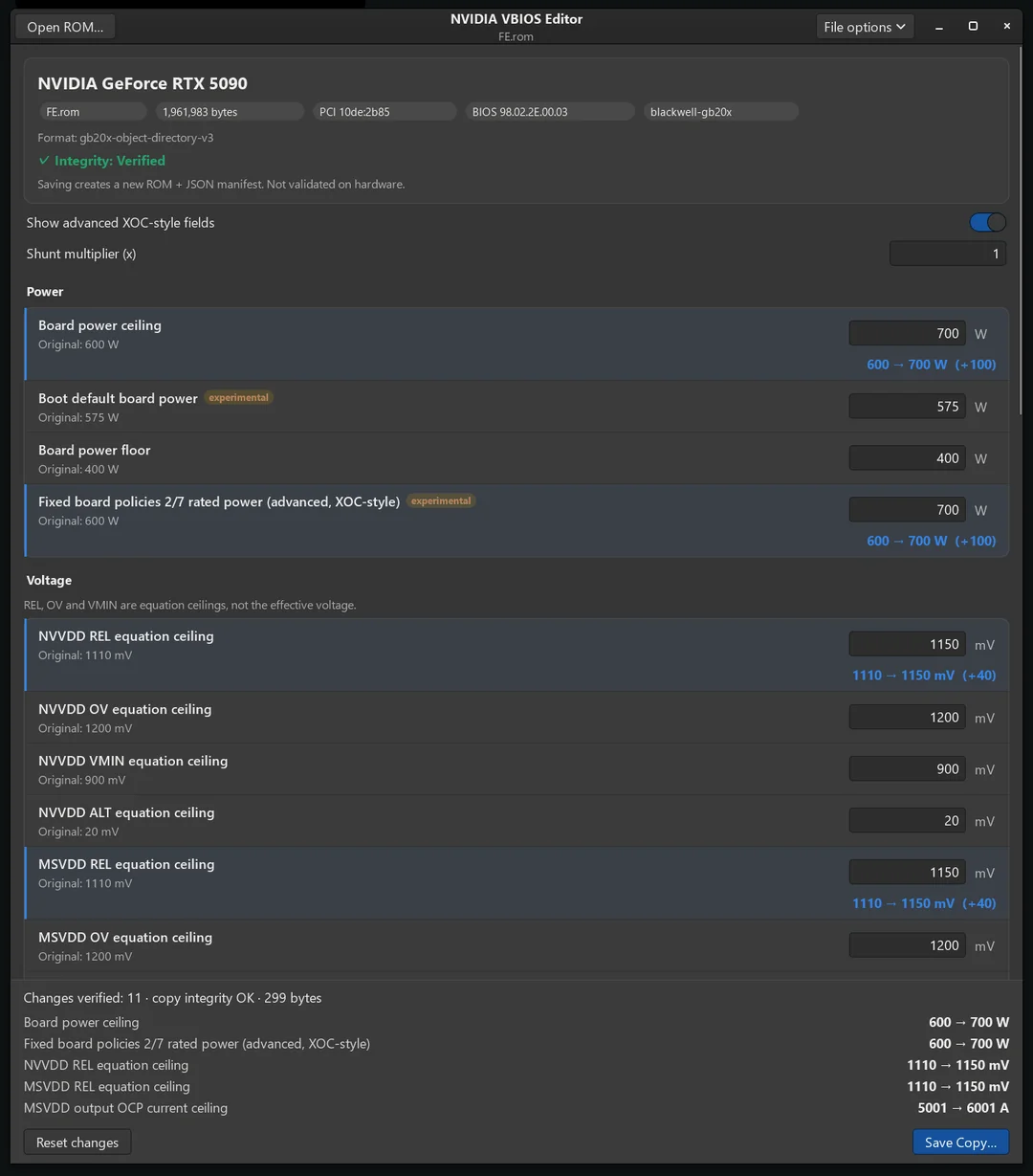
NVIDIA GeForce RTX 5090 owners can now unlock significantly higher GPU power limits through a new open source VBIOS modification tool, allowing a tested card's 600W power ceiling to increase to 800W without permanently flashing its firmware. Developed by modder Panchovix, the NVIDIA VBIOS Vix Editor supports multiple GPU generations and introduces extensive control over power, voltage, clock limits, and cooling settings.
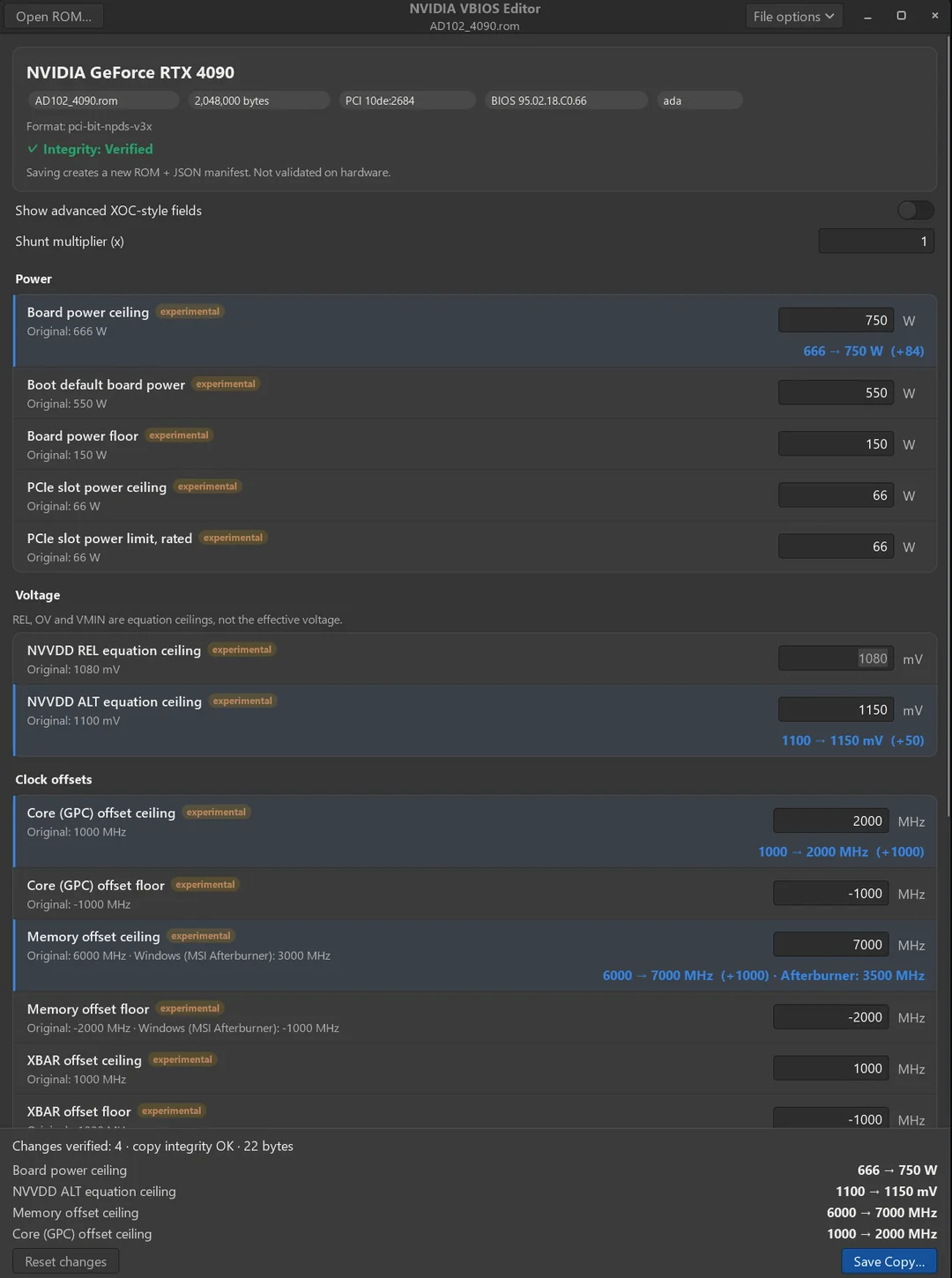
The NVIDIA VBIOS Vix Editor works by modifying a copy of the graphics card's original firmware rather than rewriting the physical BIOS chip. Separate loaders for Windows and Linux apply the modified configuration through software, leaving the factory firmware intact. As detailed in the developer's Reddit announcement, the tools support Blackwell, Ada Lovelace, and Ampere GPUs, with experimental support extending to Turing.
The editor provides access to settings normally restricted by GPU manufacturers, including maximum power consumption, voltage ceilings, minimum voltage, core and memory clock offset ranges, fan curves, and overcurrent protection thresholds. These options allow enthusiasts to experiment with higher overclocking limits or reduce power consumption beyond conventional software restrictions.
NVIDIA GPU Power Limits With VBIOS Vix Editor
| GPU | Original Tested Limit | Modified Limit | Increase |
|---|---|---|---|
| RTX 5090 | 600 W | 800 W | 33.3% |
| RTX 5080 | 360 W | 500 W | 38.9% |
| RTX 4090 | 550 W | 671 W | 22.0% |
| RTX 5070 | 250 W | 350 W | 40.0% |
Figures are based on the developer's reported configurations. They represent adjustable power ceilings, not measured consumption or verified gaming performance improvements. Original limits can vary between graphics card models.
The RTX 4090 demonstration is particularly notable because the developer successfully applied a 671W limit using NVIDIA's driver interface. A 700W configuration was also reported as supported, although the demonstrated 671W setting provides the clearest evidence of an operational override. Additional testing showed increased power limits on the RTX 5070 Ti, RTX 5060 Ti, and several professional NVIDIA GPUs.
On Windows, the companion VBIOS Vix Loader applies the modified firmware image through NVIDIA driver registry settings and restarts the GPU. The process does not require a complete system restart, and the override remains active across subsequent boots until removed. Windows 10 or 11 and compatible NVIDIA 616.x or 617.x drivers are required, starting with version 616.56. Linux support uses a separate loader that modifies the initialization process of NVIDIA's open GPU kernel modules.
The utilities also have significant limitations. Modified VBIOS images no longer possess valid original cryptographic signatures and must not be flashed directly using conventional firmware flashing tools. Future NVIDIA driver updates could also disable the override mechanism.
More importantly, unlocking an 800W power limit does not make a conventional RTX 5090 electrically capable of safely sustaining 800W. NVIDIA's reference RTX 5090 is rated at 575W, while the standard 12V 2x6 power connection is rated for up to 600W, with additional power available through the PCIe slot. Raising the firmware limit does not increase the physical capacity of the card's voltage regulation circuitry, cooling system, or connectors.
Specialized products such as MSI's RTX 5090 LIGHTNING Z are specifically engineered around substantially higher power targets. Applying similar limits to conventional graphics cards without appropriate hardware could cause instability, overheating, or permanent damage.
The VBIOS Vix Editor is available publicly through GitHub, but its developer emphasizes that all modifications are experimental and performed entirely at the user's own risk.
The VBIOS Vix Editor represents a significant development for NVIDIA GPU enthusiasts because it restores access to firmware parameters that have become increasingly restricted across recent graphics card generations.
Its ability to modify power limits without physically flashing the GPU reduces one particular risk associated with firmware experimentation, but it does not eliminate the possibility of hardware damage.
The RTX 5090's increase from 600W to 800W is technically impressive, although the additional 33.3% power headroom should not be confused with an equivalent performance improvement. Actual gains will depend on the GPU's existing power limitations, cooling capacity, operating voltage, and workload.
For experienced overclockers using specialized cooling and power delivery hardware, the project offers additional flexibility. For ordinary gaming systems, however, the electrical risks of extreme power configurations are likely to outweigh the potential performance benefits.
Would you experiment with an 800W RTX 5090 power limit for maximum performance, or would you rather undervolt your GPU for better efficiency and lower temperatures?
