
Four RTX 5090 GPUs Melt Wall Plug in AI Workstation, Raising Power Safety Concerns
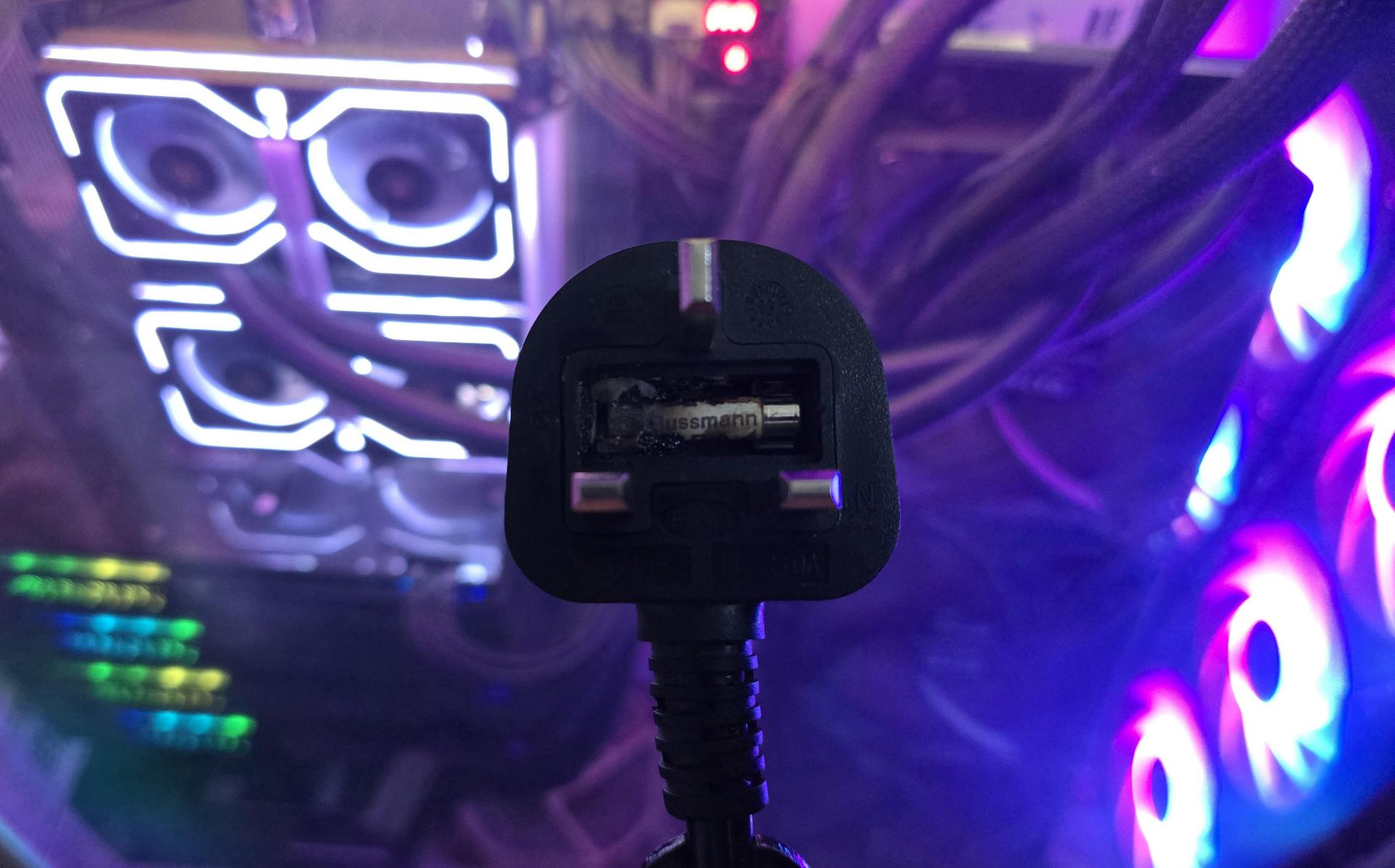
A powerful AI workstation equipped with 4 NVIDIA GeForce RTX 5090 graphics cards has suffered severe electrical damage, melting its main power plug and reportedly damaging the wall socket. The incident highlights an often overlooked risk of extreme computing systems, where electrical connections supplying the entire machine can become a critical point of failure even when the graphics cards themselves remain undamaged.
The incident was shared by Reddit user Zo0x78 in the LocalLLaMA community on October 18, 2026. According to the owner, the damage occurred while performance tuning a workstation equipped with 4 RTX 5090 GPUs and an ASUS Pro WS 3000W Platinum power supply. Photographs show significant melting around the mains plug and its 13A fuse, while the owner also reported damage to the electrical socket. Interestingly, none of the GPUs' 16 pin power connectors reportedly suffered similar damage.
The workstation uses an ASUS Pro WS 3000W Platinum, a power supply specifically designed to support up to 4 RTX 5090 graphics cards in demanding AI workloads. The owner confirmed using the power cable supplied with the PSU, which had reportedly operated without problems for several months before the incident. Although the owner initially suspected excessive power consumption, subsequent discussion raised the possibility of a defective plug, fuse holder, or electrical contact.
RTX 5090 Workstation Power Configuration
| Component | Specification |
|---|---|
| Graphics Cards | 4 × NVIDIA RTX 5090 |
| Total Graphics Memory | 128 GB GDDR7 across 4 GPUs |
| Rated GPU Power | 575 W per card |
| Combined GPU Rated Power | 2,300 W |
| Power Supply | ASUS Pro WS 3000W Platinum |
| PSU Rated Output | 3,000 W |
| Wall Plug Fuse | 13A |
| New GPU Power Limit | 400 W per card |
| Combined GPU Power Limit | 1,600 W |
The power figures are based on NVIDIA's reference specifications, ASUS's PSU rating, and the owner's updated settings. They are not measurements of the workstation's actual consumption when the failure occurred.
According to NVIDIA's official specifications, each RTX 5090 has a reference Total Graphics Power of 575 W, bringing the combined rated GPU consumption to 2,300 W before accounting for the processor, memory, storage, cooling, and power supply conversion losses. At a nominal 230 V, a 13A mains connection corresponds to approximately 3,000 W, leaving limited electrical headroom if the workstation approaches its maximum potential load.
However, the available evidence does not establish that exceeding the socket's power rating caused the failure. Several commenters observed that the most severe damage appeared concentrated near the fuse holder, suggesting excessive contact resistance as another possible explanation. A poor electrical connection can generate substantial localized heat without necessarily drawing enough current to trigger a protective fuse. No electrical measurements or professional inspection findings have been published to confirm the exact cause.
Following the incident, the owner replaced the damaged power cable, moved the workstation to another wall socket, and reduced each RTX 5090's power limit to 400 W. The owner also stated that an electrician would inspect the damaged socket and check for additional problems. Reducing GPU power consumption lowers the system's potential electrical demand, but it does not eliminate hazards caused by faulty wiring, damaged plugs, or poor contacts. For systems operating at this power level, the entire electrical installation must be appropriately rated and inspected rather than simply replacing a standard socket with a higher amperage connector.
The case differs from previous RTX 5090 incidents involving melted GPU power connectors. Instead of damage developing at the graphics card's 12V 2x6 interface, the affected connection was on the AC supply side of the workstation. It demonstrates that electrical reliability depends on the complete power delivery chain, including the building wiring, wall outlet, mains cable, PSU, and individual GPU connectors.
This incident illustrates an important challenge facing enthusiasts building local AI workstations with multiple high performance GPUs. While attention has largely focused on the RTX 5090's 16 pin power connector, supplying several kilowatts to a single workstation introduces additional electrical considerations that conventional gaming PCs rarely encounter.
The ASUS 3000 W power supply is designed for these demanding configurations, but its output rating does not guarantee that every household electrical connection can safely support the system at full load. Power supply efficiency, wiring conditions, connector quality, and sustained current all matter.
The distinction between electrical overload and contact resistance is especially important. A damaged connector can overheat even when total current remains within the expected operating range, meaning power limits and correctly rated fuses cannot substitute for sound electrical connections.
For users operating multi GPU AI systems, a professionally evaluated electrical supply and continuous awareness of actual wall power consumption are just as important as the workstation's internal cooling and power delivery.Would you trust a standard household outlet to power a workstation equipped with 4 RTX 5090 GPUs, or would you invest in a dedicated electrical circuit for a system this demanding?
