
Radeon RX 9070 XT Reportedly Reaches 75 FPS With DLSS 5 Neural Rendering in Cyberpunk 2077
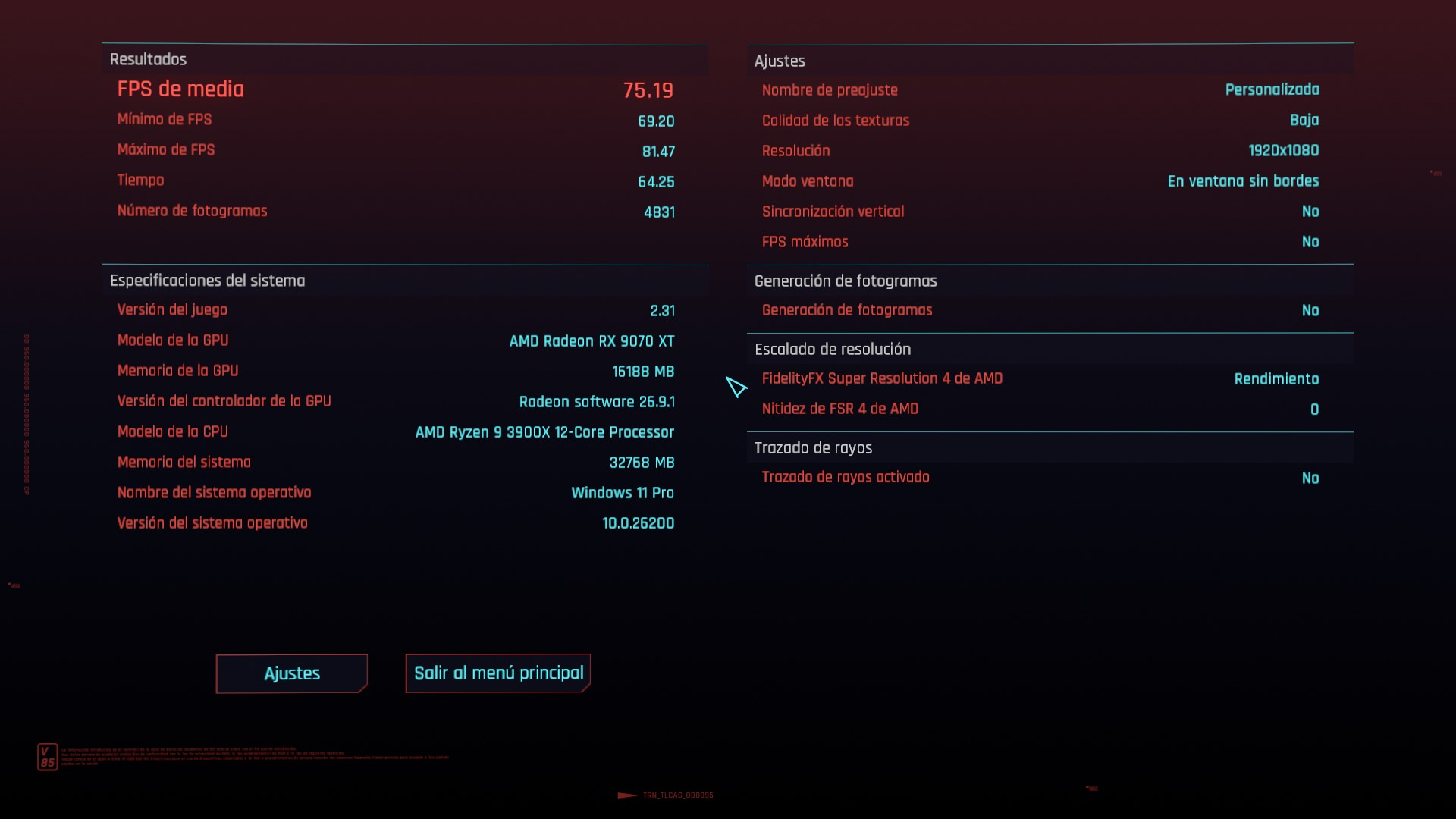
DLSS 5 Neural Rendering on AMD Radeon hardware is getting considerably faster. The experimental DLSS NR on AMD project has reportedly pushed a Radeon RX 9070 XT to around 75 FPS in Cyberpunk 2077 at 1080p, a major improvement over the roughly 30 FPS results seen only days earlier. The result does not mean AMD GPUs now officially support DLSS 5, nor does it represent NVIDIA’s complete DLSS feature stack. Developer Daniel Blanco is independently recreating the Neural Rendering runtime for Radeon hardware while using FSR for the game’s existing reconstruction path.
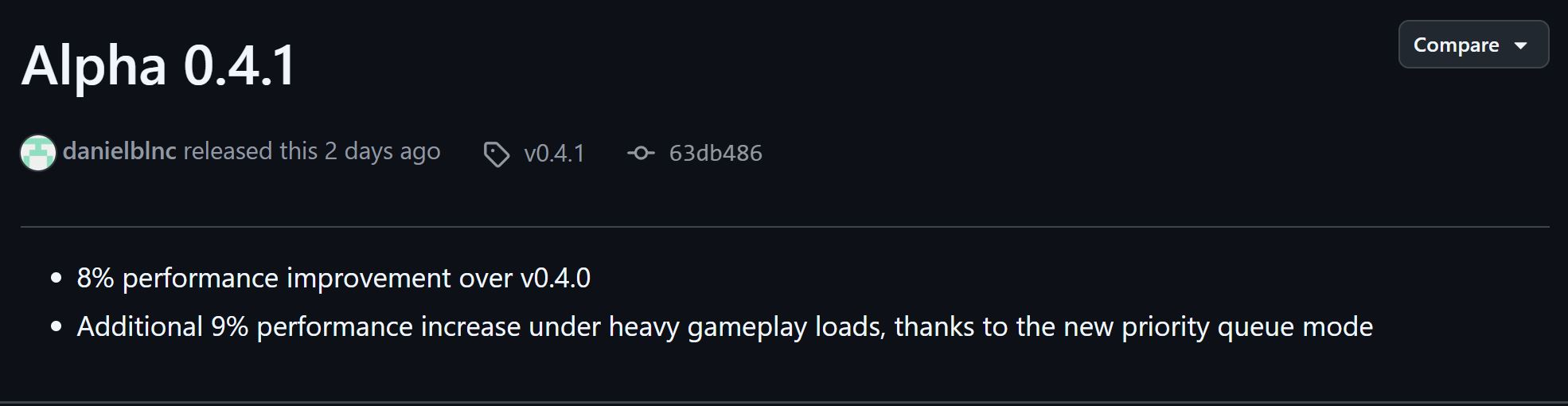
The project has improved quickly through a series of alpha releases. Version 0.4.0 brought a reported 42% performance increase over 0.3.3, followed by another 8% in 0.4.1 and an additional improvement under heavier gameplay loads through a new priority queue mode. Version 0.4.2 then added another 15% improvement for Radeon RX 9000 Series cards while introducing a new Fast quality mode that uses less expensive arithmetic than the Reference path. The developer says the visual difference is difficult to notice in normal use, although Reference mode remains available and RX 7000 Series hardware continues to use it by default.
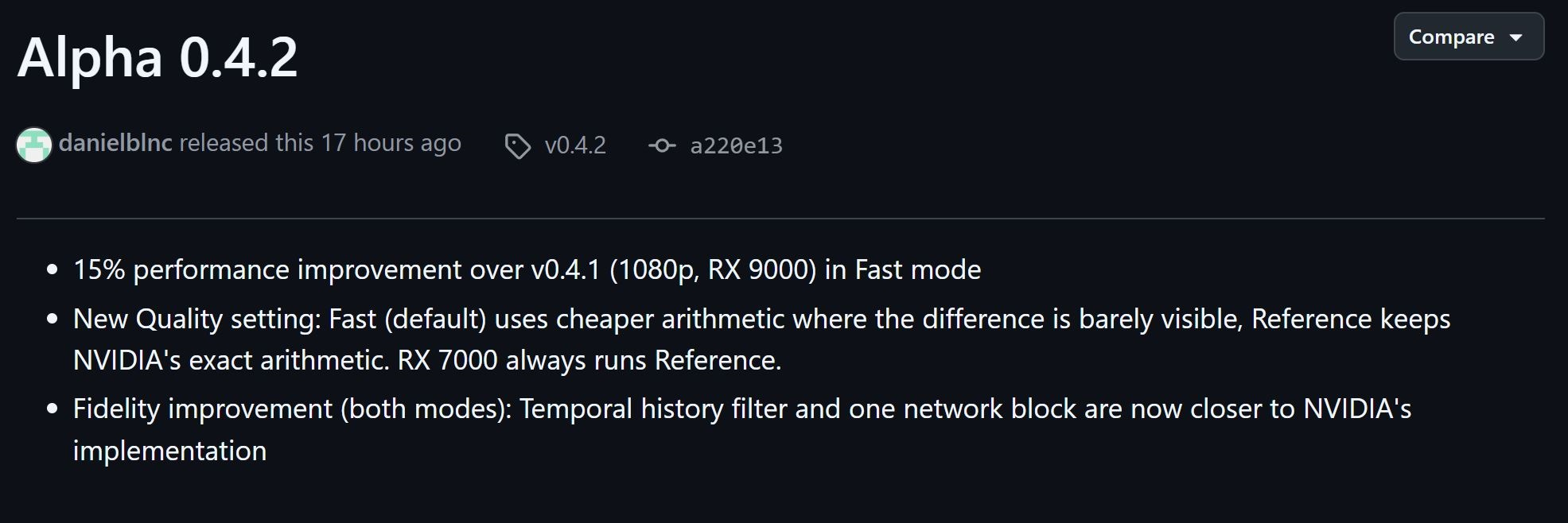
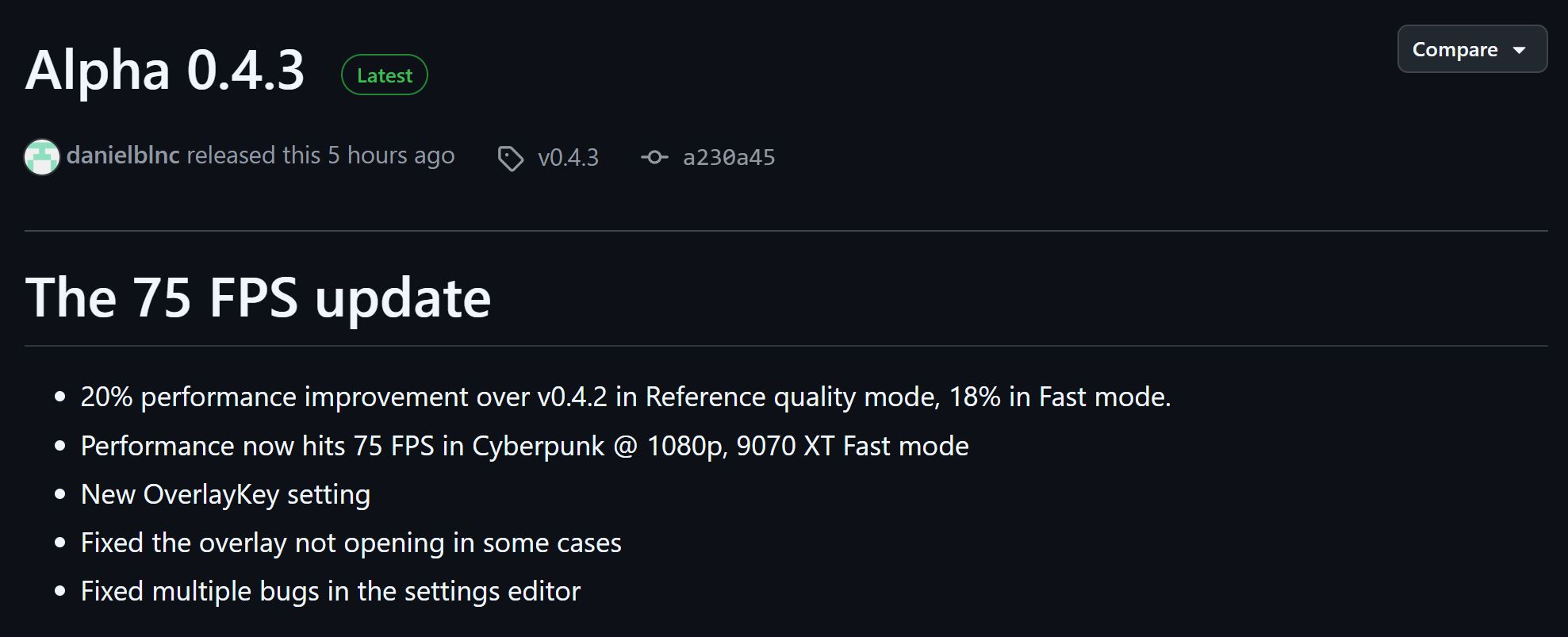
The reported 75 FPS Cyberpunk 2077 result goes a step beyond the performance currently documented on the project’s main page. Wccftech reports that a subsequent Alpha 0.4.3 build added roughly another 18% improvement in Fast mode, allowing the RX 9070 XT to reach approximately 75 FPS at 1080p. The public GitHub releases page indexed at the time of writing still lists Alpha 0.4.2 as the latest visible release, while the main README continues to describe performance at roughly 33 FPS at 1080p. The 75 FPS figure should therefore be treated as a result from the rapidly changing development builds rather than a fixed performance expectation for every installation.
That distinction is especially important because resolution and FSR settings have a major effect on the Neural Rendering workload. Earlier version 0.3.0 testing in Cyberpunk 2077 at 1080p Ultra showed 30 FPS with native resolution or FSRAA, 57 FPS with FSR Quality, 67 FPS with FSR Balanced, and 71 FPS with FSR Performance. With Path Tracing enabled, those figures dropped to 19 FPS native, 37 FPS with FSR Quality, 43 FPS with Balanced, and 50 FPS with Performance. The project’s pre upscaling mode improves performance by running the Neural Rendering pass before FSR performs the final upscale, reducing the amount of image data the neural network must process.
| Cyberpunk 2077 at 1080p, v0.3.0 | RX 9070 XT |
|---|---|
| Native or FSRAA | 30 FPS |
| FSR Quality | 57 FPS |
| FSR Balanced | 67 FPS |
| FSR Performance | 71 FPS |
| Native with Path Tracing | 19 FPS |
| FSR Quality with Path Tracing | 37 FPS |
| FSR Balanced with Path Tracing | 43 FPS |
| FSR Performance with Path Tracing | 50 FPS |
DLSS NR on AMD is not simply translating NVIDIA code at runtime. Blanco describes it as a ground up implementation built around AMD specific HIP kernels, memory layouts, and game integration. Users still need their own legitimate copy of NVIDIA’s nvngx_dlssnr.dll, while the project itself does not distribute NVIDIA code or model data. It currently targets Radeon RX 9000 and RX 7000 Series GPUs in Windows 11 DirectX 12 games that already support FSR, with Cyberpunk 2077 and GTA V Enhanced among the titles specifically tested by the developer.
We previously covered the project when DLSS 5 Neural Rendering first became functional on the Radeon RX 9070 XT, where early performance could fall into the low double digits once the neural pass was enabled. The recent optimizations show how much of that initial cost came from immature execution rather than an absolute hardware limit. We have since also seen OpenDLSS NR rebuild the same Neural Rendering workload through Vulkan, reinforcing that NVIDIA’s neural renderer can be mapped onto different execution environments even though the official DLSS product remains proprietary.
The 75 FPS headline is impressive, but the more important story is how quickly the Radeon implementation is improving. Going from barely practical frame rates to performance that can cross 60 FPS in selected 1080p configurations suggests the main barrier is increasingly software optimization rather than simply whether RDNA 4 can execute the workload at all.
It is still too early to treat this like native Radeon support for DLSS 5. Fast mode changes the arithmetic used by the neural network, different FSR settings alter how much work it processes, and the project remains experimental. But the gap between “it technically runs” and “it can be used while gaming” has narrowed dramatically in only a few releases.
If community developers can make DLSS 5 Neural Rendering practical on Radeon hardware, should neural graphics technologies become less dependent on individual GPU brands?
