
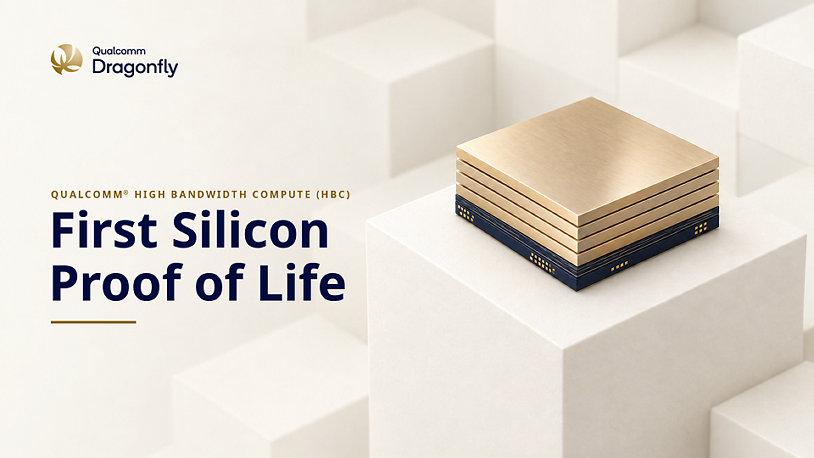
Qualcomm has successfully validated its first generation High Bandwidth Compute (HBC) silicon, marking a significant milestone in its effort to overcome one of the biggest limitations affecting modern artificial intelligence infrastructure: memory bandwidth. According to Qualcomm's official announcement, engineers at its San Diego laboratory successfully tested complete memory read and write operations alongside near memory computations using physical silicon. The company also confirmed that a data center product has completed tapeout, bringing its next generation AI inference architecture closer to commercial deployment.
Unlike conventional AI accelerators that rely on external High Bandwidth Memory (HBM) stacks, Qualcomm's HBC architecture places LPDDR memory directly above an active computing die through advanced wafer bonding technology. This configuration dramatically reduces the distance data must travel between memory and processing components, moving information across micrometers rather than millimeters. The objective is to address the memory wall, a growing performance bottleneck where AI processors spend considerable time waiting for data rather than performing calculations.
This limitation is particularly significant during large language model inference. Every generated token requires access to model parameters stored in memory, making bandwidth and energy efficiency critical factors in determining response speed and operational costs. By performing more computations close to where data is stored, HBC aims to reduce unnecessary transfers while improving effective bandwidth.
Qualcomm's initial silicon validation demonstrates the architecture's functionality under production representative conditions. Engineers tested the complete data path using standardized automated testing equipment and randomized model weights and activations. The company estimates that its first generation HBC implementation can provide 18x greater effective memory bandwidth compared with its LPDDR5X based Dragonfly AI200 platform, alongside more than 5x the bandwidth efficiency of projected HBM4 implementations.
These figures require some context. The 18x comparison measures effective bandwidth between Qualcomm's own accelerator generations rather than a universal improvement over every LPDDR5X memory system. Likewise, the HBM4 efficiency comparison is based on measurements normalized to target operating conditions and published competing specifications, not independent testing of finished commercial accelerators.
Qualcomm HBC and Dragonfly AI250 Specifications
| Feature | Announced Details |
|---|---|
| Architecture | High Bandwidth Compute Gen 1 |
| Memory Technology | Vertically stacked LPDDR |
| Integration | Wafer bonding with active compute silicon |
| Effective Bandwidth Improvement | 18x versus Dragonfly AI200 |
| HBM Efficiency Comparison | More than 5x bandwidth per watt, estimated |
| Dragonfly AI250 Bandwidth | Up to 133 TB/s effective per card |
| Memory Capacity | Up to 768GB per card |
| Rack Memory Capacity | Up to 43TB |
| Rack Effective Bandwidth | Approximately 7.4 PB/s |
| Expected AI250 Sampling | First half of 2027 |
Performance and capacity figures are Qualcomm's announced platform targets and should not be interpreted as independently verified commercial benchmarks.
The technology is being developed for Qualcomm's Dragonfly AI250 accelerator, which is expected to begin sampling during the first half of 2027. The platform will integrate HBC into a broader AI inference system designed for hyperscale data centers, supporting large language models, reasoning workloads, and autonomous AI agents. Qualcomm has also incorporated redundancy and memory remapping mechanisms into its architecture to manage defects within vertically stacked memory, an important requirement for maintaining manufacturing yields and reliability.
The company is already preparing its next generation roadmap, with Dragonfly AI300 expected to introduce HBC Gen 2 in 2028. Its broader data center strategy also includes the Dragonfly C1000 server CPU, positioning Qualcomm as a potential competitor to NVIDIA, AMD, and other manufacturers developing specialized AI infrastructure.
The announcement comes as memory manufacturers face growing demand from AI infrastructure developers. While NVIDIA has explored alternative memory architectures for AI inference, Qualcomm is approaching the problem by bringing processing capabilities directly into the memory stack. Both strategies reflect an industry increasingly focused on data movement efficiency rather than simply increasing raw computational power.
Qualcomm's achievement demonstrates that its HBC architecture can function in physical silicon, but commercial success will depend on manufacturing yields, software compatibility, pricing, and performance across real AI workloads. Independent benchmarks will be necessary to determine whether the technology can deliver its projected advantages against established HBM based accelerators.
Qualcomm's HBC architecture represents an interesting direction for semiconductor development because it challenges the assumption that increasing memory bandwidth always requires faster and more expensive conventional memory systems. Moving computation closer to data could provide meaningful efficiency improvements, particularly for AI inference workloads where memory transfers consume substantial energy.
The potential impact extends beyond performance. If architectures such as HBC eventually reduce dependence on conventional HBM configurations for certain AI workloads, they could encourage greater competition in a market increasingly dominated by expensive accelerator platforms. However, it would be premature to suggest that HBC will directly resolve today's DRAM shortages or lower consumer memory prices.
Innovations that improve efficiency without continuously increasing memory consumption deserve attention. AI infrastructure should become more efficient and sustainable instead of relying exclusively on acquiring larger quantities of memory that could otherwise support PCs, gaming hardware, workstations, and independent developers.
The real test will come when Dragonfly AI250 reaches customers and independent performance evaluations demonstrate whether Qualcomm's architectural advantages translate into lower operating costs and better real world performance.
Could Qualcomm's HBC technology challenge NVIDIA's dominance in AI inference, or will established HBM based accelerators continue leading the data center market?
