
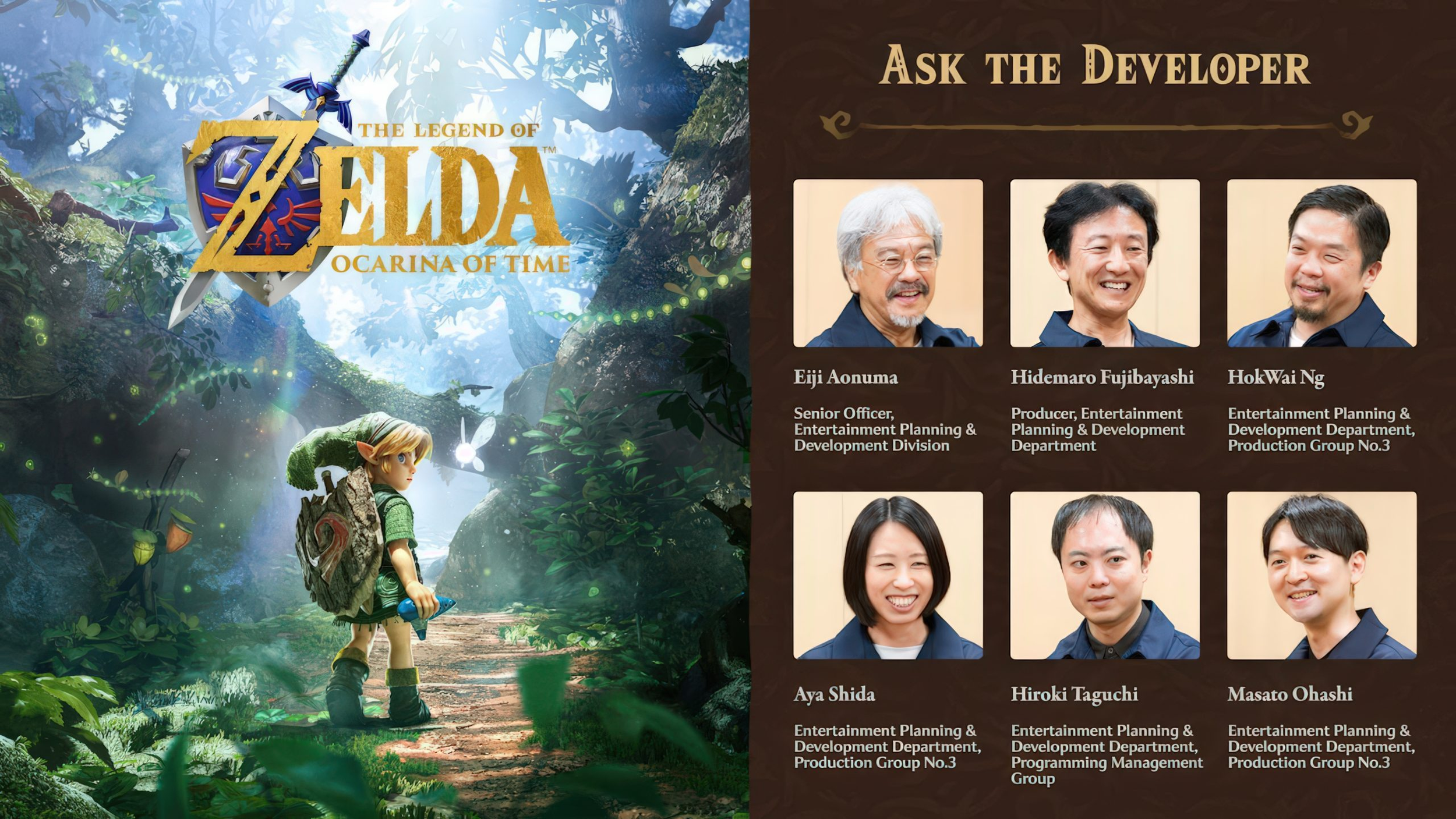
Nintendo has confirmed that The Legend of Zelda: Ocarina of Time remake will retain the original game's interconnected map structure rather than adopting the seamless open world design introduced in Breath of the Wild and Tears of the Kingdom. Speaking in Nintendo's latest Ask the Developer interview, game director HokWai Ng explained that the decision was intentional, with the development team prioritizing the original adventure's pacing, exploration, and sense of discovery over modern open world conventions.
The remake, scheduled to launch November 5, 2026, exclusively on Nintendo Switch 2, has been developed internally by Nintendo's Entertainment Planning and Development team under the supervision of series producers Eiji Aonuma and Hidemaro Fujibayashi. According to Ng, the project's guiding philosophy was to modernize its presentation without changing the fundamental experience that made the 1998 Nintendo 64 classic so memorable.
"The visuals may change, but the experience does not."
— Quote by: HokWai Ng, Game Director
Rather than connecting every region into one continuous environment, the remake preserves separate maps for locations such as Kokiri Forest, Hyrule Field, and the surrounding areas. Ng explained that transitioning between these regions was an essential part of the original game's identity, creating moments of anticipation whenever players entered unfamiliar territory. The team even commissioned the artist responsible for the original Nintendo 64 map illustrations to create a new world map for the remake.
The decision also influenced the game's visual design. Art director Aya Shida revealed that the team deliberately adjusted environmental detail and landmark proportions to guide exploration. Areas players can visit feature greater visual complexity, while inaccessible scenery receives less detail to preserve a sense of distance. Important landmarks, including Hyrule Castle and the windmill, were also enlarged to reinforce their presence within the environment.
Shida described the new artistic direction as combining the handcrafted appearance of puppet shows with the physical authenticity of practical movie effects. Rather than pursuing photorealism, Nintendo wanted to preserve the slightly mysterious atmosphere of the original while introducing more detailed environments, character models, lighting, and animation.
Interestingly, Aonuma also revealed in another part of the interview that he initially requested additional fast travel points inspired by Breath of the Wild. However, testing demonstrated that these shortcuts reduced opportunities for unexpected discoveries during exploration, leading the team to remove them.
The remake therefore represents a different approach from Nintendo's recent Zelda titles, emphasizing a carefully structured adventure rather than unrestricted exploration. Although the Switch 2 offers considerably more processing power than the original Nintendo 64, the decision to retain separate regions reflects creative direction rather than a stated hardware limitation.
Nintendo's decision to preserve Ocarina of Time's original world structure demonstrates that technological improvements do not always require fundamentally changing how a game is designed. Breath of the Wild and Tears of the Kingdom successfully expanded the possibilities of open world exploration, but Ocarina of Time was built around a more deliberate progression system where each region, dungeon, and discovery contributed to the overall adventure.
For longtime Zelda fans, maintaining that structure could be more important than introducing seamless travel simply because modern hardware makes it possible. A successful remake should improve visuals, responsiveness, and accessibility while preserving the mechanics that defined the original experience. Sometimes, respecting the original design is a more meaningful improvement than making a game bigger.
Should Nintendo preserve Ocarina of Time's original map structure, or would you prefer a fully seamless Hyrule similar to Breath of the Wild?
