
Intel Previews 18A-P as a Stronger Foundry Pitch With More Than 9% Higher Performance or More Than 18% Lower Power Than 18A
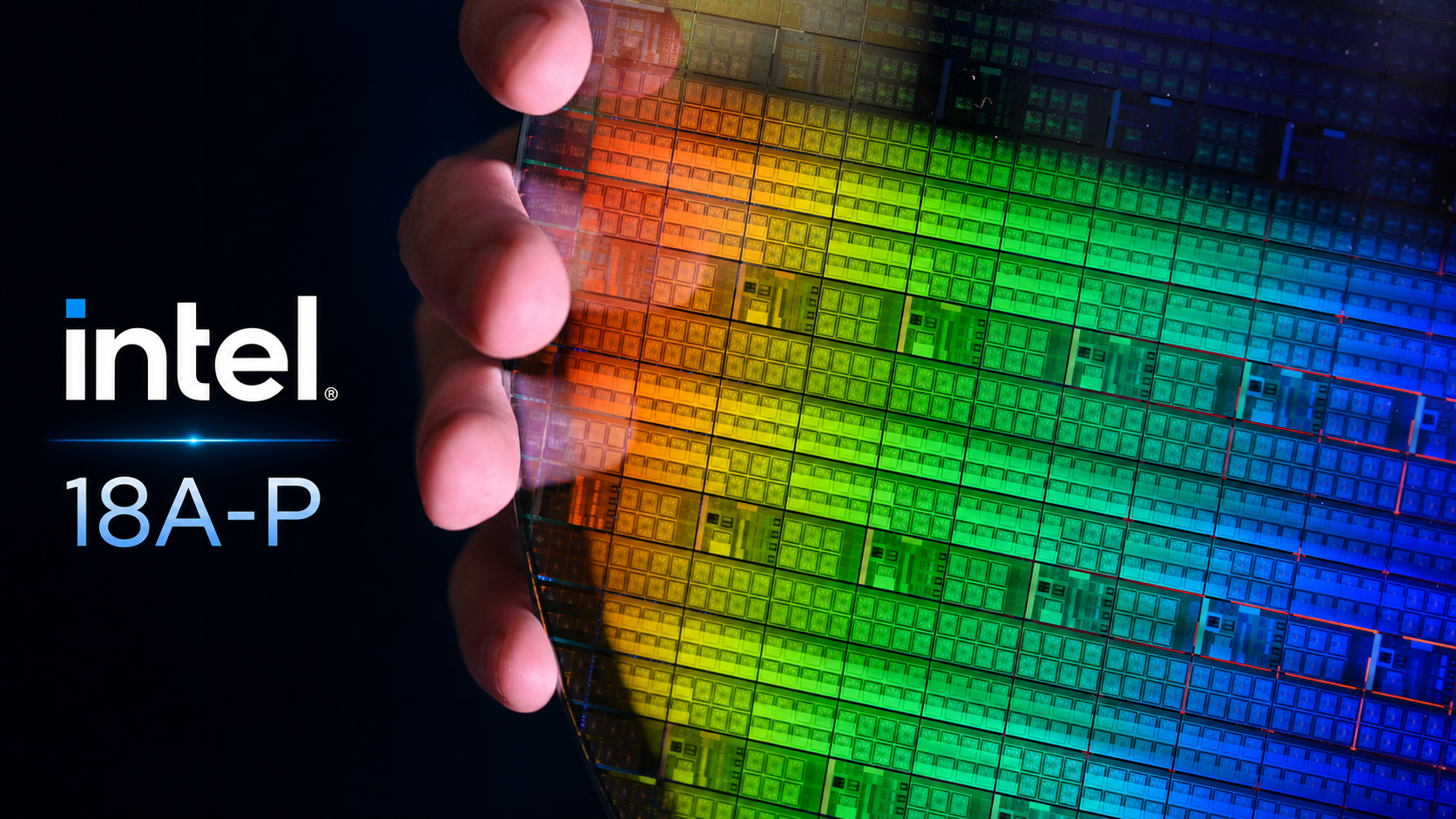
Intel has started previewing its enhanced 18A P process ahead of the June VLSI symposium, and the early message is clear. This is not being positioned as a brand new node, but as a sharper, customer facing refinement of 18A that is meant to improve Intel Foundry’s appeal to external chip designers. According to Intel’s VLSI session abstract, 18A P offers more than 18% lower power at iso performance, or more than 9% higher performance at iso power versus standard 18A. Intel also said the gains come from added technology features, transistor enhancements, interconnect improvements, and design technology co optimization.
That matters because Intel has already said 18A P is aimed at a broader set of foundry customers. At Intel Foundry Direct Connect 2025, the company described 18A P as a new 18A variant built to deliver enhanced performance for more external customers, added that early wafers were already in the fab, and said the node is design compatible with 18A so IP and EDA partners can transition more smoothly.
News about @Intel 18AP from @VLSI_2026
— 𝐷𝑟. 𝐼𝑎𝑛 𝐶𝑢𝑡𝑟𝑒𝑠𝑠 (@IanCutress) April 29, 2026
Paper T1.2
Intel 18AP will offer 9% perf or 18% power over 18A
➡️ New VT pairs, low and high power devices
➡️ Numbers based on Arm core sub-block
➡️ 30% skew corner tightening
➡️ Matched SRAM Vmin
Conference is June 14-18 in Honolulu. pic.twitter.com/MnUwxYiEIi
Intel’s own 18A platform brief adds another useful layer to the positioning. The company says 18A P builds on the 3rd implementation of RibbonFET and PowerVia, includes optimizations for multiple voltage types, and improves performance per watt over 18A. Intel also ties those gains to better SRAM Vmin behavior and improved thermal management, which suggests 18A P is not just about peak speed bins, but also about making the node more flexible and more attractive across different chip classes.
| Category | Feature | 18A | 18A-P |
|---|---|---|---|
| Performance | Performance @ Iso-Power | 1x | 9% Iso-Power Performance Gain |
| Design Rules | Contacted Poly Pitch (nm) | 50 | 50 |
| Library Height (nm) | — | 180 / 160 | 180 / 160 |
| Transistor | Available Devices | Z2, Z3 Z1, Z2, Z3 | Z2, Z3 Z1, Z2, Z3 Z1 (Low Power) Z1.5 (Low Power) Z3P (HP contact) |
| VT Options | Logic VT Pairs | 4 pairs of Logic VTs | 5+ pairs of Logic VTs (New Logic VT between ULVT and LVT) Lower ULVT |
| Skew Corners | — | — | ~30% tightening in skew corners |
| Interconnect RC | — | Intel 18A Base Process | V0-V2 R reduction M2-M4 jogs |
| Thermals | — | — | Improved thermal conductivity by 50% |
The most important strategic takeaway is that Intel is trying to make 18A P feel like a low friction upgrade rather than a risky detour. If customers can reuse much of their 18A design work while gaining a measurable power and performance uplift, then 18A P becomes a more compelling on ramp for foundry business. That is especially relevant as Intel continues trying to prove it can pair process recovery with a credible external manufacturing roadmap.
It is also worth noting what Intel has and has not publicly confirmed here. The company has officially published the power and performance uplift, design compatibility, and the broad feature additions in the VLSI abstract. However, many of the more granular comparisons now circulating online go beyond the level of detail Intel has publicly posted in the sources above. So the cleanest reading for now is that 18A P is a meaningful enhancement of 18A, but the full depth of the node’s tuning will likely become clearer once the VLSI presentation itself is delivered in June.
For Intel Foundry, this is exactly the kind of message it needs in 2026. 18A established the architectural foundation with RibbonFET and PowerVia. 18A P now looks like the version designed to make that foundation easier to sell. If Intel executes well, this node could become one of its most practical bridge offerings between internal product use and broader external foundry adoption.
Do you think 18A P is the kind of refinement that can win real foundry customers, or will Intel still need a major external design win before confidence truly shifts?
