
NVIDIA RTX PRO 5500 Blackwell Arrives With 84 GB GDDR7 and RTX 5090 Core Count
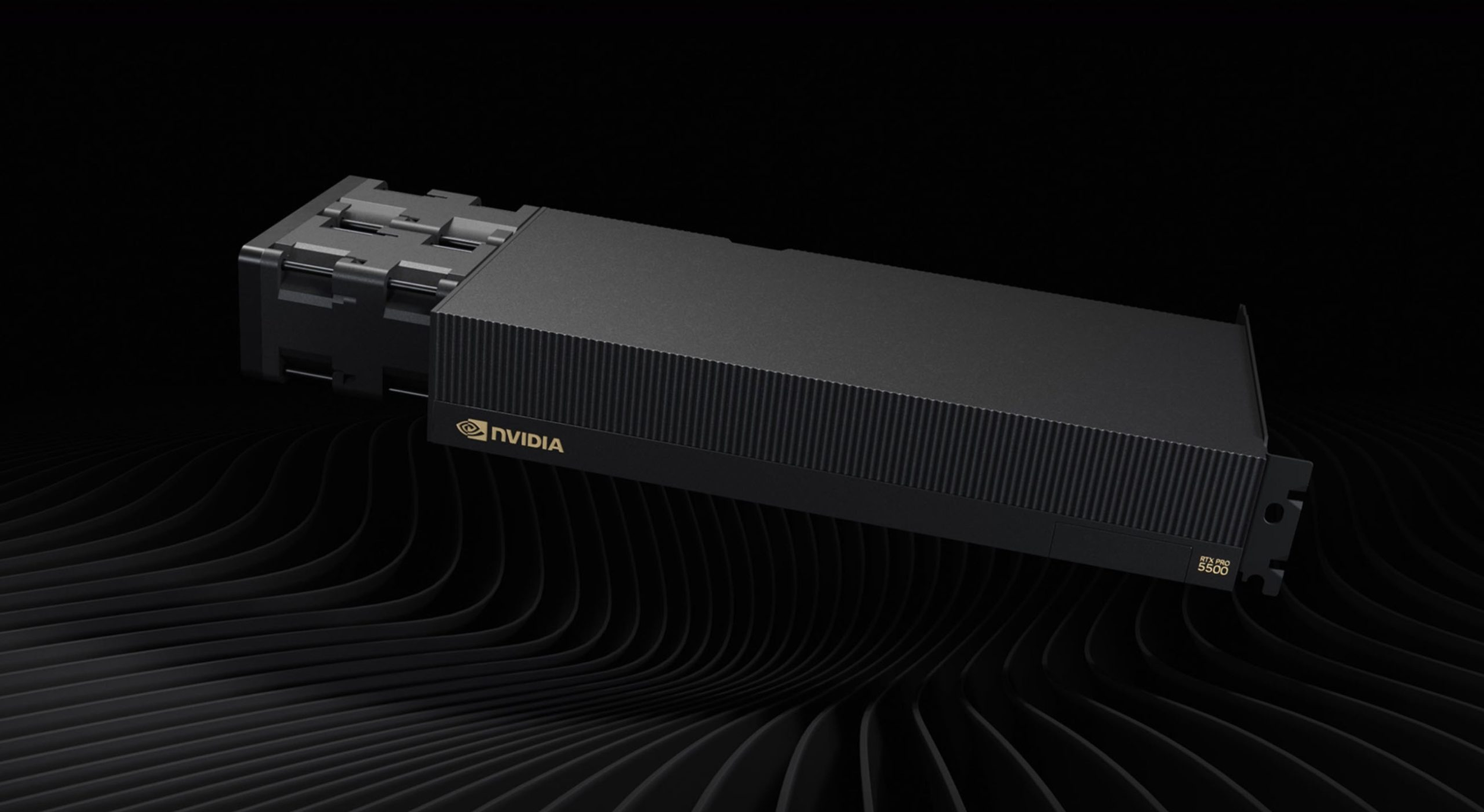
NVIDIA has expanded its professional Blackwell graphics lineup with the RTX PRO 5500 Workstation Edition, positioning the new GPU directly below the flagship RTX PRO 6000 while equipping it with 84 GB of GDDR7 ECC memory and up to 600 W of power. The card is aimed at agentic AI, generative AI, simulation, professional graphics, scientific computing, and large workstation deployments where memory capacity and enterprise features are more important than gaming performance.
The official NVIDIA RTX PRO 5500 specifications confirm 84 GB of GDDR7 memory with ECC and 1,398 GB/s of memory bandwidth. The card uses PCIe Gen 5 x16, offers up to 4 DisplayPort 2.1b connections, and includes 3 ninth generation NVENC engines alongside 3 sixth generation NVDEC engines for professional video workflows. NVIDIA currently lists the product as coming soon and has not announced pricing or a specific retail availability date.
Board partner PNY provides additional specifications, listing 21,760 CUDA cores based on a 750 mm² Blackwell GPU containing 92.2 billion transistors. That is the same CUDA core count found on the GeForce RTX 5090, although the 2 cards target fundamentally different markets and should not be treated as equivalent products simply because their core counts match. PNY also lists fifth generation Tensor Cores, fourth generation RT Cores, a dual slot design, one PCIe CEM5 16 pin power connector, and a maximum power consumption of 600 W.
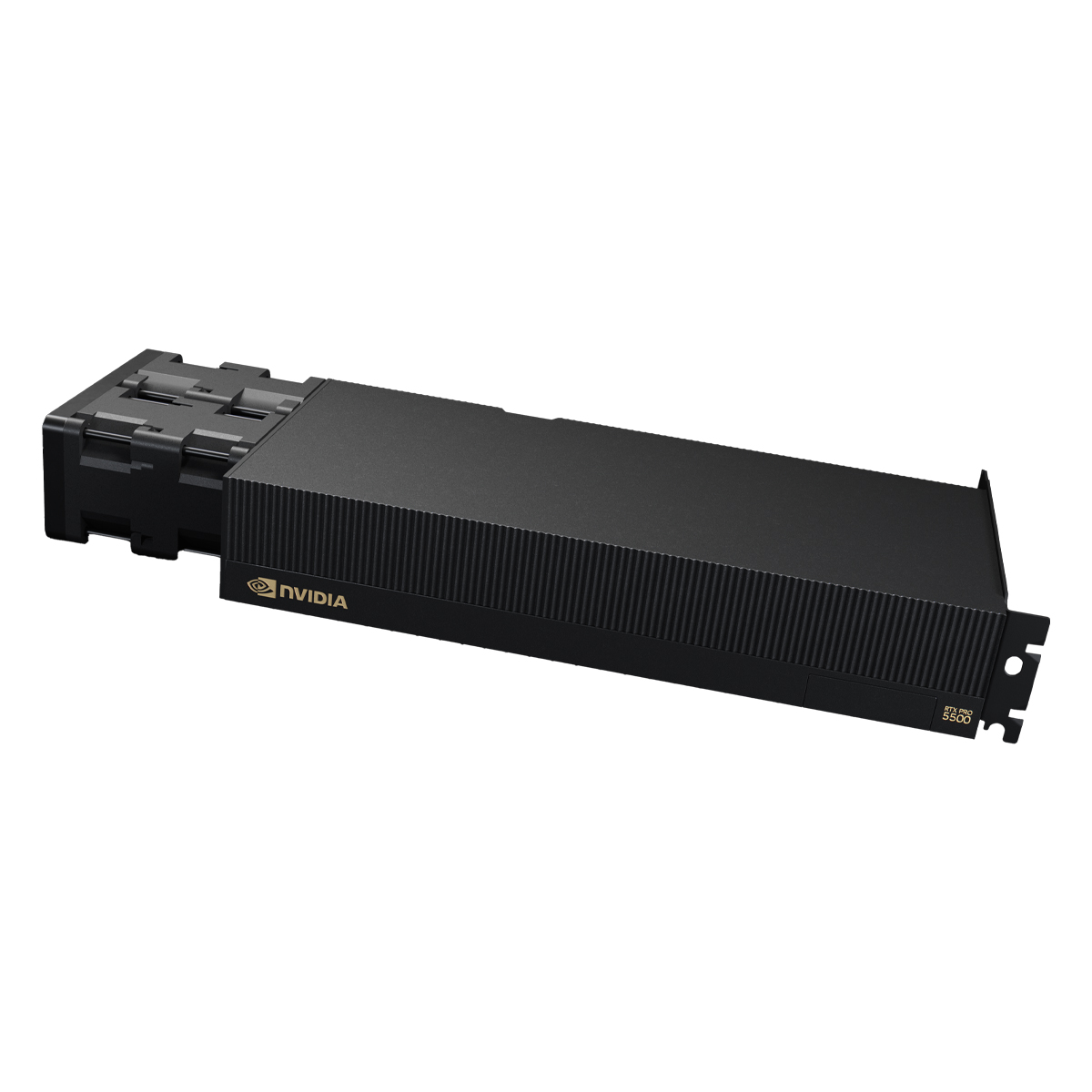
Memory is where the difference becomes far more significant. The GeForce RTX 5090 carries 32 GB of GDDR7, while the RTX PRO 5500 increases that capacity to 84 GB, giving professional users more than 2.6 times as much local GPU memory. The RTX PRO 5500 also sits between the updated RTX PRO 5000, which is available with 48 GB or 72 GB, and the RTX PRO 6000 with 96 GB. NVIDIA is therefore creating a much denser professional product stack for workloads where available VRAM can determine whether an AI model, large simulation, or complex 3D scene fits on a single GPU.
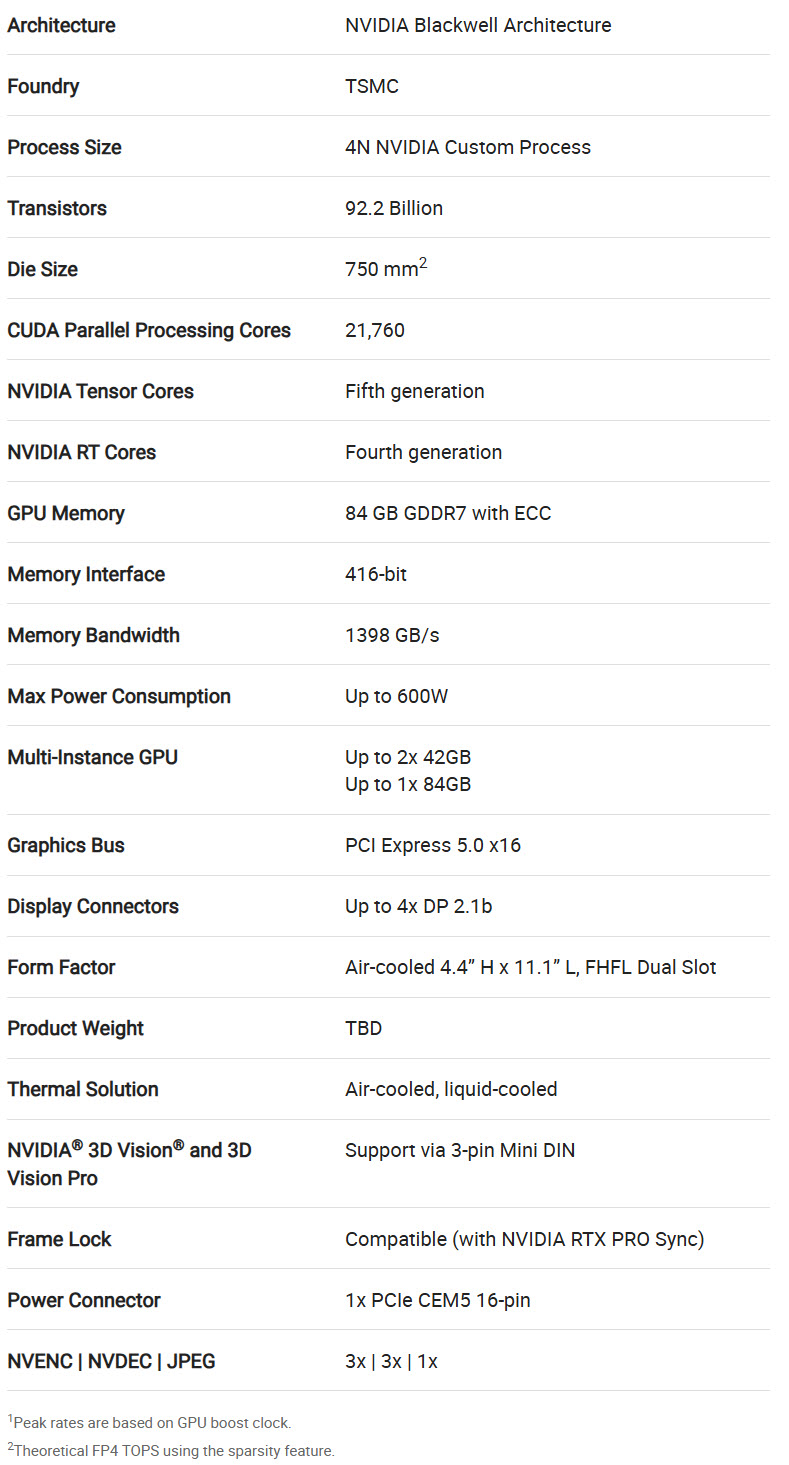
The 84 GB capacity also enables Multi Instance GPU support. NVIDIA says the RTX PRO 5500 can operate as one 84 GB instance or be divided into 2 isolated instances with up to 42 GB each. Every instance receives dedicated memory, cache, and compute resources with guaranteed quality of service, allowing organizations to share one physical GPU between multiple users or workloads. This is one of the clearest distinctions between the RTX PRO 5500 and a consumer card such as the RTX 5090.
NVIDIA is specifically designing the card around rack mounted workstation deployments rather than only conventional desktop towers. Air cooled versions use a dual slot form factor measuring approximately 11.1 inches long, while NVIDIA also confirms that liquid cooled solutions will be available through an RXM form factor. The company sees the RTX PRO 5500 being centralized inside managed workstation infrastructure where teams can share GPU resources instead of requiring a high end graphics card inside every individual desktop.
Professional video workloads receive another substantial upgrade through the 3 NVENC and 3 NVDEC engines. The ninth generation encoders add support for 4:2:2 H.264 and HEVC encoding while improving HEVC and AV1 quality, while the sixth generation decoders provide up to twice the H.264 decoding throughput of the previous generation and support 4:2:2 H.264 and HEVC decoding. That makes the GPU particularly relevant for high resolution production, virtual production, live media, and AI assisted video pipelines.
NVIDIA is also positioning the RTX PRO 5500 heavily toward local AI. Its 84 GB memory pool allows larger language models, longer context windows, computer vision workloads, and multiple models to remain resident on the GPU instead of being partially moved into system memory. Fifth generation Tensor Cores add FP4 support and are designed around the increasingly important low precision workloads used by modern generative and agentic AI applications.
The card arrives as high memory professional GPUs are becoming increasingly valuable. NVIDIA's flagship RTX PRO 6000 Blackwell recently climbed to approximately 16,000$, making the positioning of the RTX PRO 5500 particularly important. If NVIDIA can place the new 84 GB model meaningfully below the 96 GB flagship, it could become a more practical option for AI developers and professional teams that need substantially more memory than the RTX 5090 but do not require the full RTX PRO 6000 configuration.
The 600 W power rating is equally notable. It places the RTX PRO 5500 at the same maximum power level as the RTX PRO 6000 Workstation Edition and above the GeForce RTX 5090. With that amount of power moving through a single high current connector, system integration, cooling, and power delivery will remain important considerations, particularly in dense workstation environments. Recent RTX PRO 6000 connector incidents have already highlighted the importance of properly engineered power delivery around 600 W professional Blackwell hardware.
NVIDIA has not yet published performance figures, final pricing, or a confirmed launch date for the RTX PRO 5500, and the current specifications are marked as preliminary. The card is nevertheless already listed across NVIDIA's international workstation pages and through PNY, confirming that it is intended as a global professional product rather than a limited regional model.
The RTX PRO 5500 may end up being one of the more strategically important cards in NVIDIA's professional Blackwell lineup. Matching the RTX 5090 at 21,760 CUDA cores is attention grabbing, but the real story is the 84 GB of ECC memory.
AI development is increasingly becoming a memory capacity problem. A model that does not fit inside 32 GB cannot take advantage of an RTX 5090's performance without some form of memory offloading, quantization, or multi GPU configuration. Moving to 84 GB dramatically changes what can remain entirely resident on one GPU.
The biggest unknown is price. With the RTX PRO 6000 reaching extremely high workstation pricing, NVIDIA has plenty of room to position the RTX PRO 5500 below it while still charging a substantial premium over GeForce hardware. If that gap is reasonable, 84 GB could make the RTX PRO 5500 a particularly attractive local AI and professional workstation option.
Would 84 GB of VRAM make the RTX PRO 5500 a better local AI option than multiple GeForce RTX 5090 cards, or would you still prioritize raw performance and lower cost?
