
NVIDIA DLSS 5 Debuts in NBA 2K27 With Pixel Accurate Neural Rendering and 5x Faster Performance
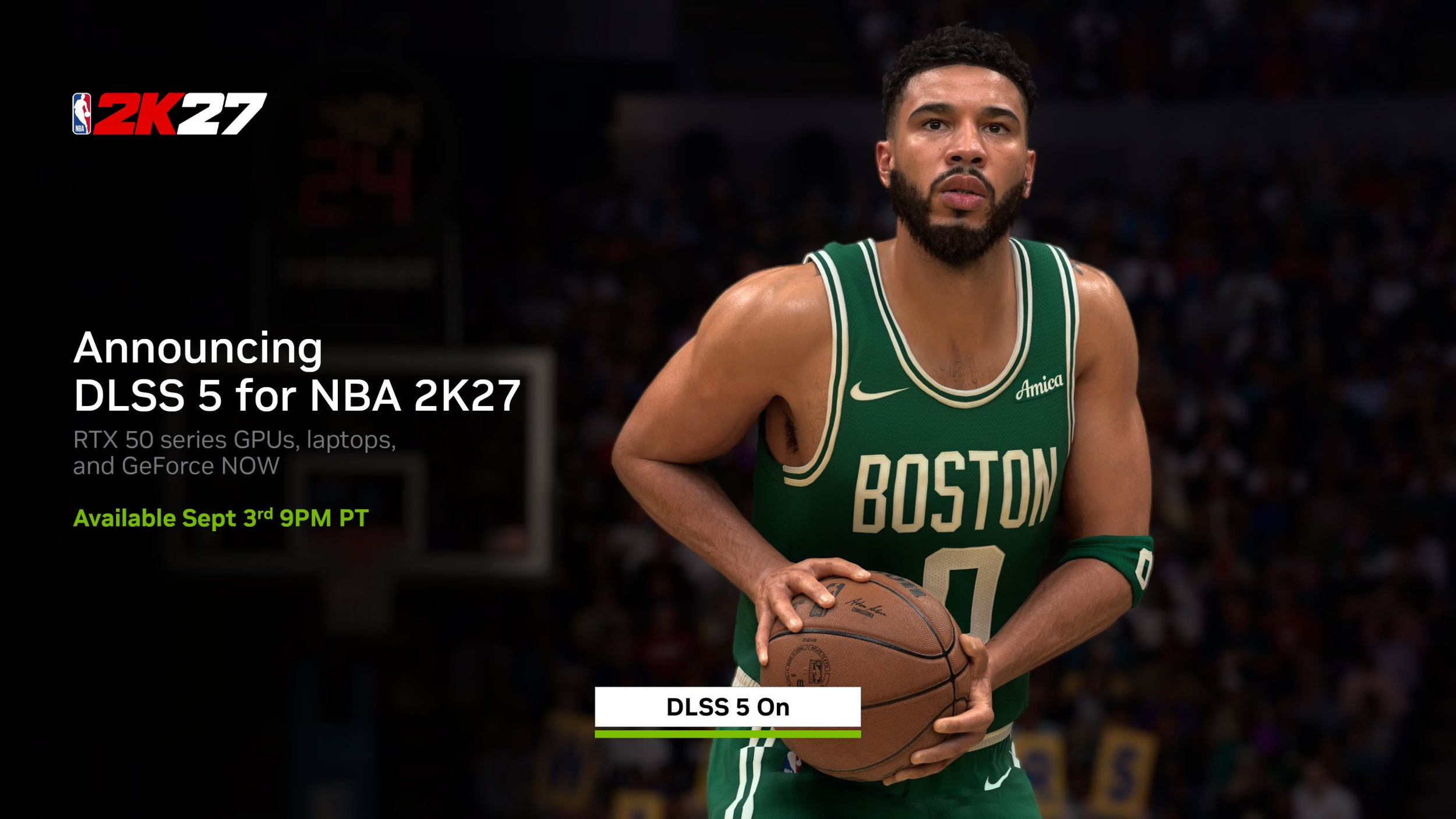
NVIDIA is officially launching DLSS 5 on September 3 at 9 PM PT, with NBA 2K27 becoming the first commercial game to support its new 3D Guided Neural Rendering technology. After months of controversy surrounding the original GTC 2026 presentation and the recent leaked runtime, the finished implementation provides a much clearer picture of what NVIDIA is actually trying to achieve. The production model is designed to remain pixel accurate to the underlying game, gives developers significantly more control over how AI modifies lighting and materials, and now runs approximately 5x faster than the original March demonstration.

Unlike DLSS Super Resolution or Frame Generation, DLSS 5 is primarily designed to improve visual fidelity rather than simply reconstruct resolution or increase frame rates. The new model receives the rendered color frame and motion vectors from the game while using information learned from surface albedo, normals, lighting and other rendering data to understand what objects and materials are supposed to represent. NVIDIA says the process remains deterministic and temporally stable, meaning identical inputs generate consistent results rather than the unpredictable variations normally associated with generative image models.
NVIDIA is also emphasizing that the original rendered frame remains the foundation of the image. The model does not receive text prompts and is not intended to redesign geometry, faces or character silhouettes. Instead, it attempts to reproduce expensive lighting interactions that conventional real time rendering often simplifies, including skin subsurface scattering, light passing through hair and foliage, ambient occlusion, reflections and detailed contact shadows. According to NVIDIA, even pixelation already present in the original image remains anchored in the output rather than being arbitrarily repositioned or regenerated.
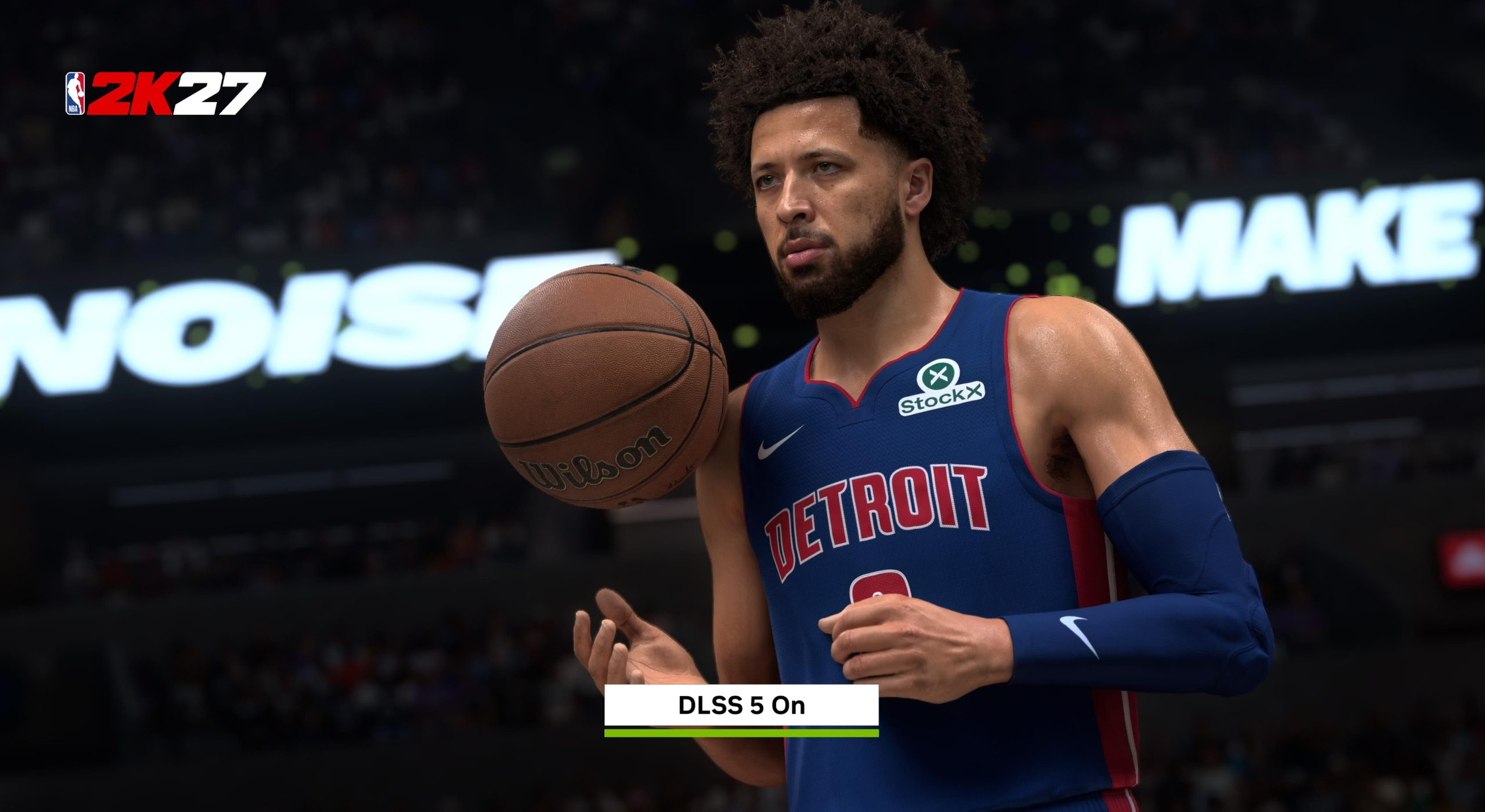
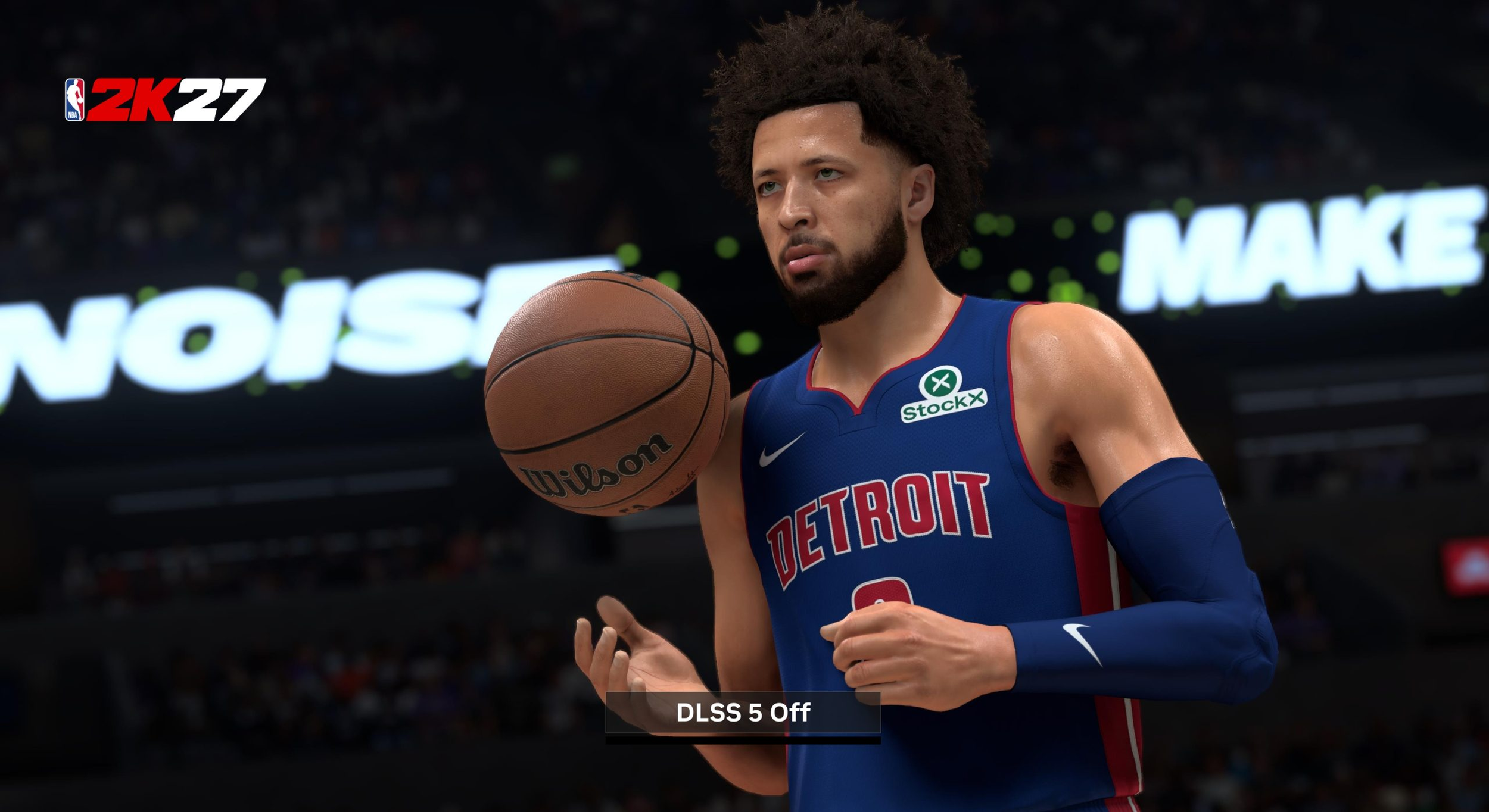
That pixel accuracy is particularly important in NBA 2K27, where the technology is dealing with digital recreations of real athletes whose appearances are immediately recognizable. Hands on testing at Gamescom showed DLSS 5 improving skin response, hair lighting, clothing materials and contact shadows without noticeably changing the underlying identity of the players. NVIDIA demonstrated examples involving Cade Cunningham, Tyrese Haliburton and Jayson Tatum, with more natural light transmission through skin and hair alongside stronger shadows around jerseys, faces and the basketball itself. Courtside spectators and staff receive similar enhancements.
Visual Concepts has also tuned the system rather than simply enabling Neural Rendering globally at maximum strength. Developers can choose between different neural models while independently adjusting Structure Intensity and Tone Intensity. Structure controls finer details such as ambient occlusion, reflections and subsurface scattering, while Tone controls broader lighting and color response. Engine level masks can restrict Neural Rendering to specific characters, materials or objects, giving artists much more control than the unofficial implementations currently spreading through the modding community.
"DLSS 3D guided neural rendering helped boost the visual quality of our materials and lighting, bringing a real jump to photorealism across the game."
— Quote by: Peter Kavic, Senior Producer at Visual Concepts.
NVIDIA has also addressed one of the largest controversies surrounding the original reveal. The widely circulated Resident Evil Requiem comparison showing protagonist Grace with an apparently different facial expression was reportedly created from 2 frames captured at different points in the character animation. NVIDIA maintains that the earlier research model was still geometrically pixel accurate, although it acknowledges that the model was slower, less realistic and lacked the granular developer controls available in the version shipping with NBA 2K27. Independent Gamescom demonstrations similarly found that the newer model looks significantly more controlled than the version shown in March.
The other major breakthrough is performance. When NVIDIA first demonstrated DLSS 5 during GTC 2026, Neural Rendering required 2 GeForce RTX 5090 GPUs. After 6 months of optimization across its rendering pipeline and neural model, NVIDIA says the technology has achieved a 5x performance improvement and can now operate on a single RTX 50 Series GPU. That improvement is large enough for NVIDIA to officially support every desktop and laptop GPU across the GeForce RTX 50 Series when DLSS 5 launches.
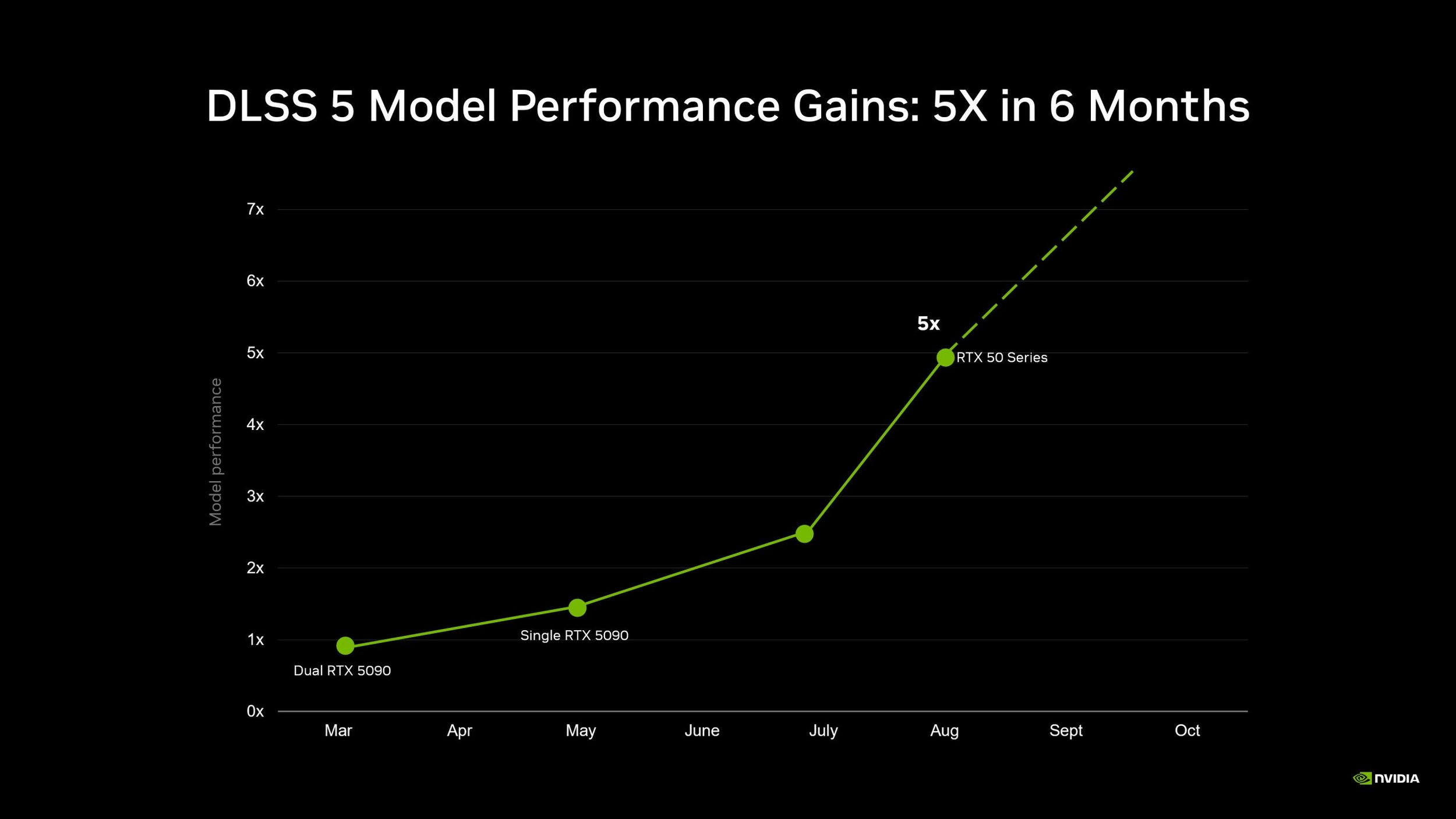
The 5x figure should not be interpreted as games suddenly delivering 5x higher frame rates when DLSS 5 is enabled. NVIDIA is describing the improvement in the execution performance of the Neural Rendering model itself compared with its March research implementation. DLSS 5 remains a demanding graphics workload, and the extremely high NBA 2K27 frame rates NVIDIA is advertising rely on the broader DLSS suite, including Super Resolution and Multi Frame Generation, rather than Neural Rendering alone. NVIDIA says further model optimizations are already in development for fall 2026.
In NBA 2K27, NVIDIA tested the full DLSS configuration using the Ultra preset, ray tracing, Super Resolution Quality mode and Multi Frame Generation. At 2560 × 1440, the RTX 5070 reaches up to 260 FPS, the RTX 5070 Ti reaches 350 FPS, the RTX 5080 reaches 410 FPS, and the RTX 5090 reaches as much as 590 FPS. At 4K, NVIDIA reports approximately 233 FPS on the RTX 5080 and up to 370 FPS on the RTX 5090. NVIDIA recommends the RTX 5070 or higher for 1440p and the RTX 5080 or RTX 5090 for the highest 4K configuration.
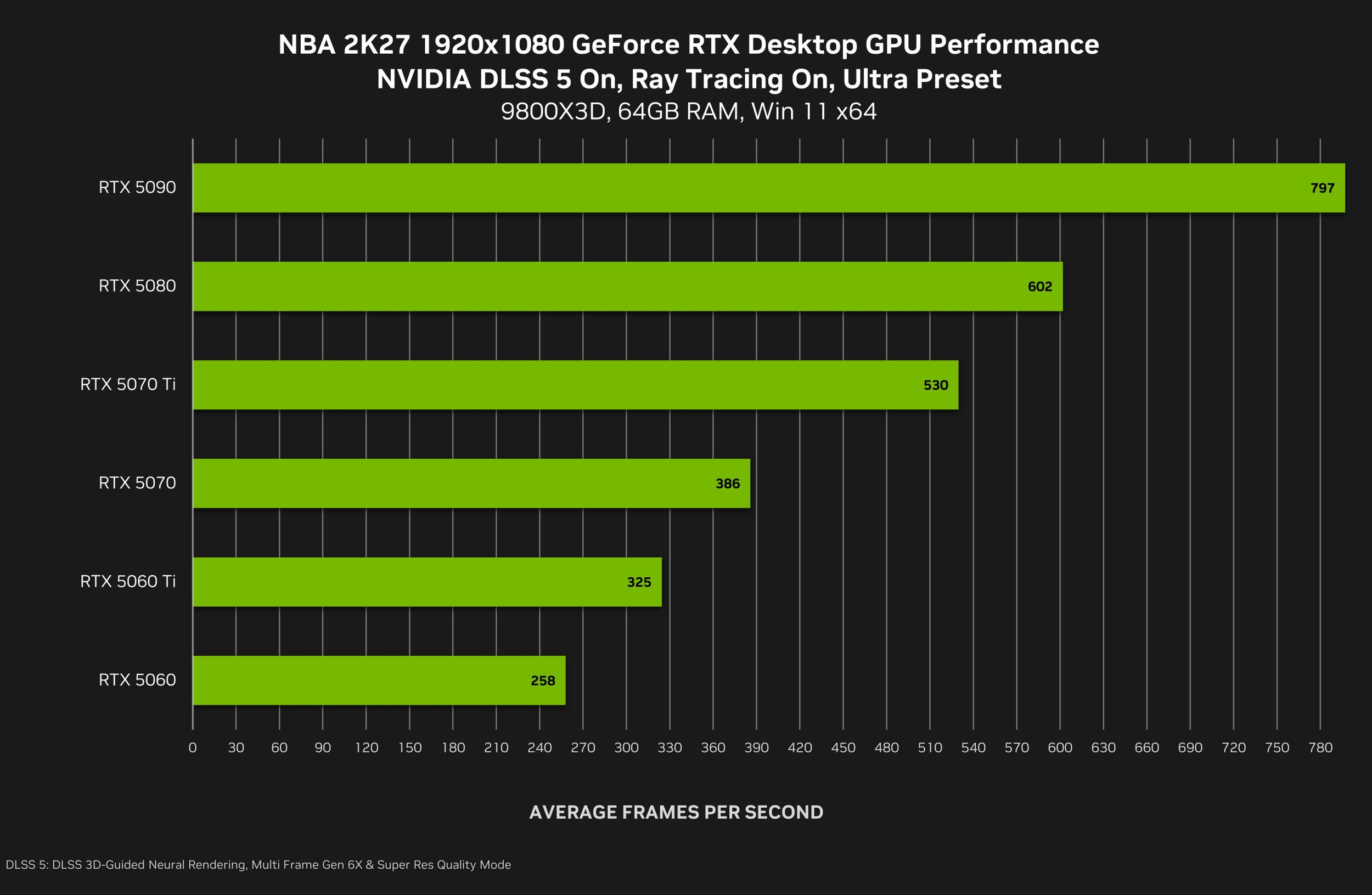
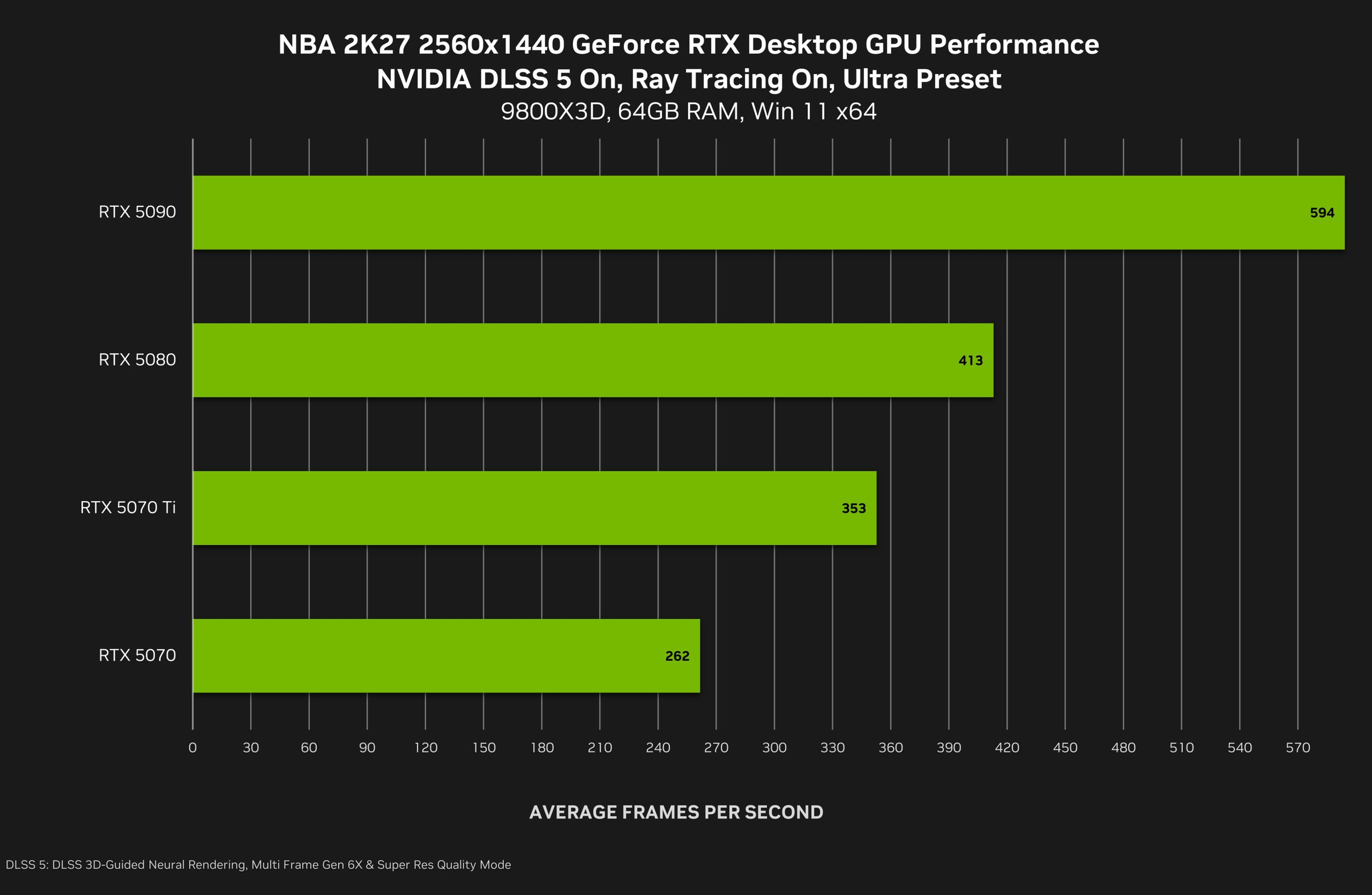
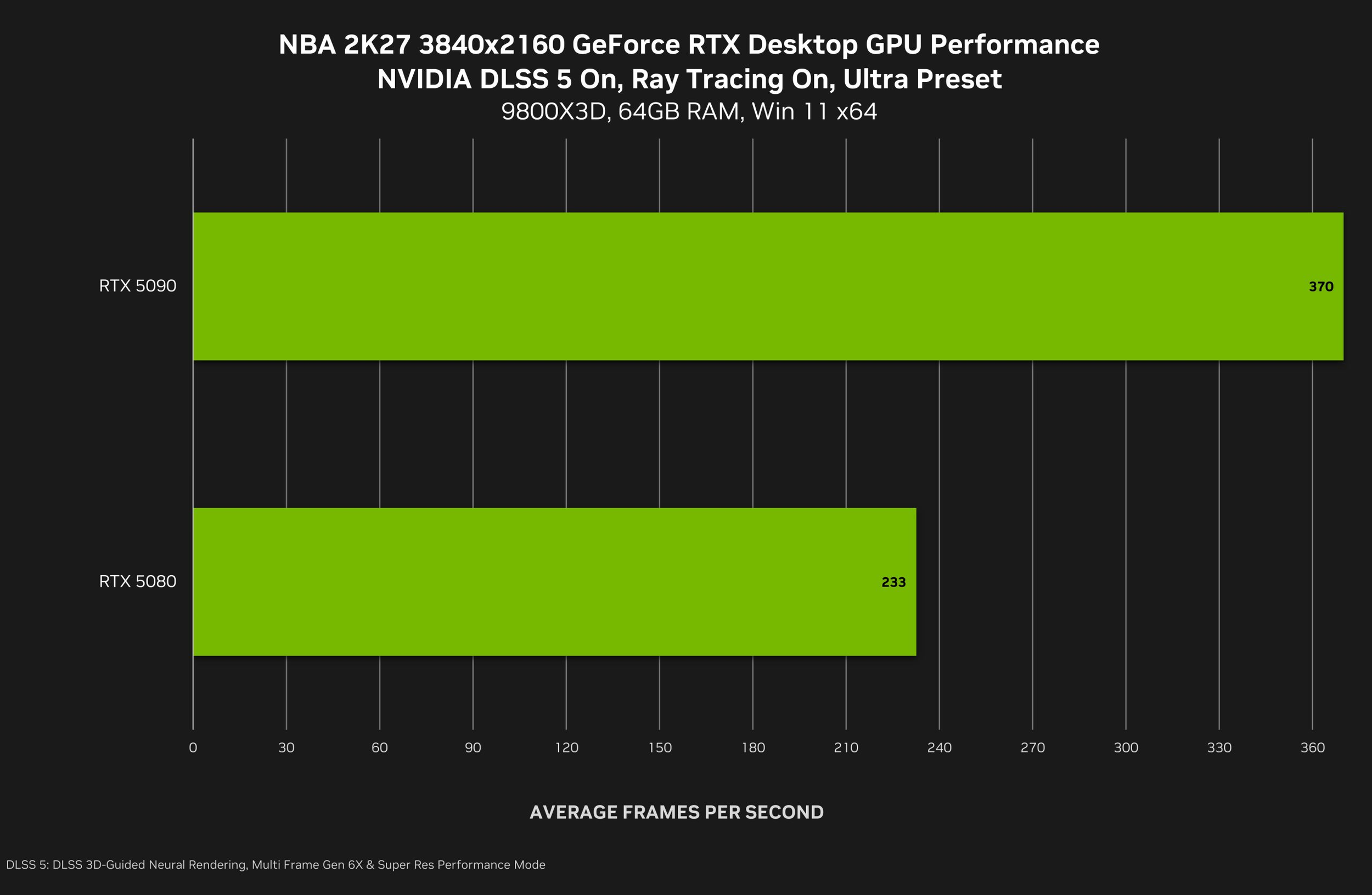
Those numbers need to be understood in context because Multi Frame Generation contributes heavily to the final displayed FPS. They do demonstrate, however, that NVIDIA has moved DLSS 5 from a research model requiring dual flagship GPUs into a system capable of running alongside ray tracing and the rest of the DLSS pipeline on mainstream Blackwell hardware. At 1080p, NVIDIA says virtually the entire RTX 50 Series can run NBA 2K27 with Ultra settings, ray tracing and Neural Rendering enabled.
The official implementation is also substantially different from the leaked DLSS 5 runtime that modders recently forced into games such as Control, Cyberpunk 2077 and The Witcher 3. Those experiments often applied Neural Rendering much more aggressively and produced significant performance losses because they lacked game specific optimization, accurate developer masks and official artistic tuning. Modders have since expanded that leaked runtime across RTX 30 Series hardware, older graphics APIs and even emulators, demonstrating the flexibility of the underlying technology without representing NVIDIA's intended production experience.
Official hardware support is currently much narrower. NVIDIA confirms DLSS 5 Neural Rendering for GeForce RTX 50 Series desktop GPUs, RTX 50 Series Laptop GPUs and GeForce NOW Ultimate systems using RTX 5080 class hardware. Despite community demonstrations running modified versions on RTX 20, RTX 30 and RTX 40 Series hardware, NVIDIA has not announced official Neural Rendering support for those generations.
NBA 2K27 launches worldwide on September 4 for PlayStation 5, Xbox Series X and S, Nintendo Switch 2 and PC, although Deluxe and Ultra Edition customers already have early access. The DLSS 5 update becomes available on September 3 at 9 PM PT through a new NVIDIA Game Ready Driver, after which RTX 50 users can activate DLSS Neural Rendering through the game's Video Settings. Players can also toggle the effect during gameplay and replays using F9.
NBA 2K27 may be the demonstration DLSS 5 needed after the controversy surrounding its original reveal. Using real NBA players creates very little room for Neural Rendering to casually reinterpret character identity, and the finished implementation looks considerably more disciplined than the leaked versions currently being pushed into unsupported games.
The 5x performance improvement is equally important, but it needs to be understood correctly. NVIDIA has made the Neural Rendering model itself approximately 5x faster compared with March. It has not magically made NBA 2K27 run 5x faster simply by turning DLSS 5 on. The enormous 260 FPS to 590 FPS results come from combining Neural Rendering with Super Resolution and Multi Frame Generation.
What is becoming clearer is that DLSS 5 should be judged less like another upscaler and more like a new stage of the rendering pipeline. If developers maintain control over where and how strongly it operates, Neural Rendering could genuinely recover lighting and material details that remain too expensive to simulate conventionally in real time. The next challenge will be proving that this level of control and image consistency survives once DLSS 5 moves beyond NBA 2K27 into very different visual styles and game engines.
After seeing the official NBA 2K27 implementation and NVIDIA's 5x improvement since March, does DLSS 5 look more convincing to you than it did during the original reveal?
