
NVIDIA DLSS 5 Arrives in Portal With RTX and Half Life 2 RTX With 6X Frame Generation
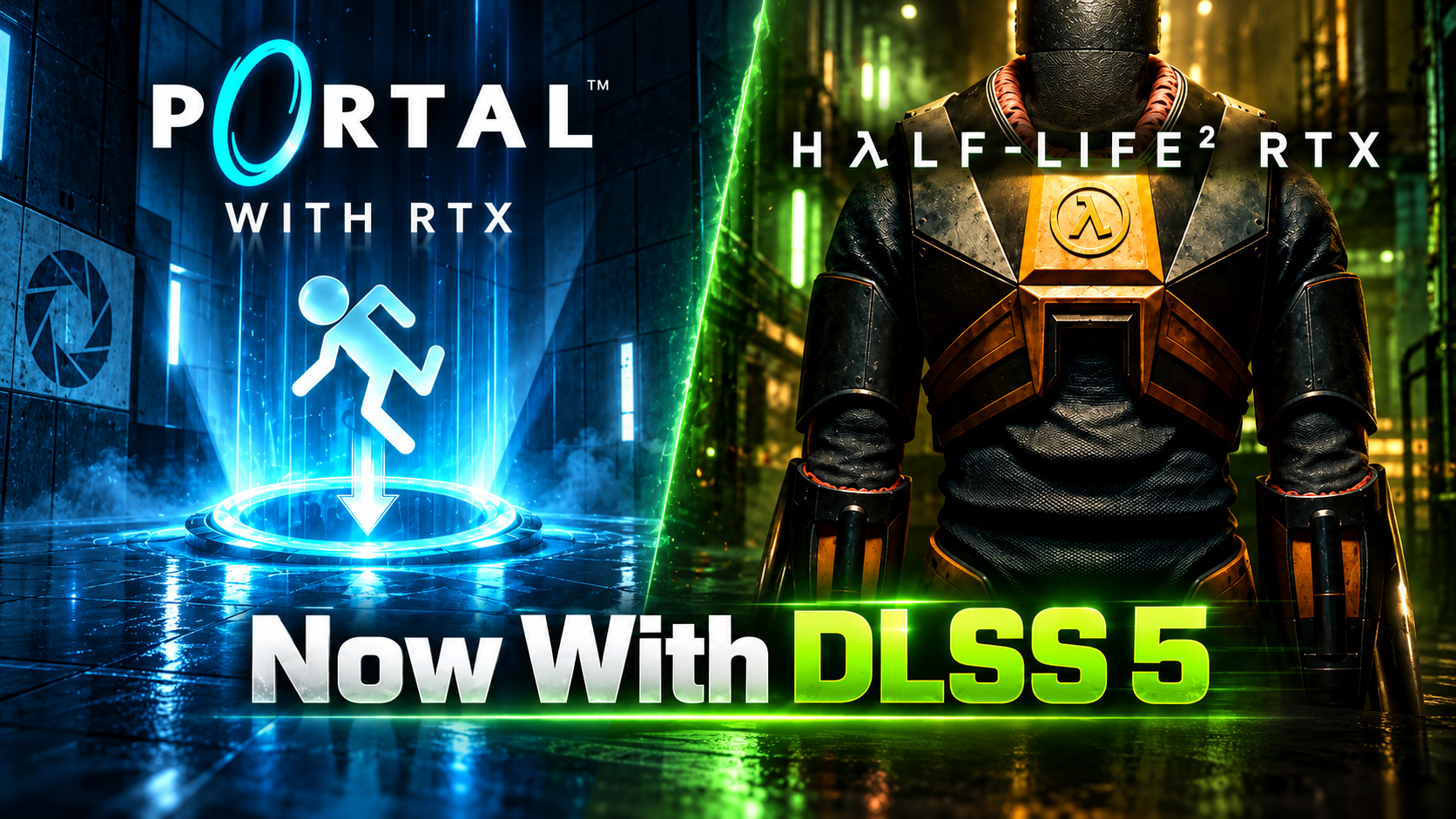
NVIDIA has officially introduced DLSS 5 with 3D Guided Neural Rendering to Portal with RTX and the Half Life 2 RTX demo, bringing advanced AI powered lighting and material enhancements to 2 of Valve's most recognizable classics. The updates, released on October 21 and October 23, 2026, also introduce up to 6X Multi Frame Generation, improved rendering techniques and expanded compatibility through NVIDIA RTX Remix 1.6.
Unlike traditional DLSS Super Resolution, which reconstructs images at higher resolutions, DLSS 5 uses a neural rendering model to enhance lighting, reflections and material details while preserving the underlying geometry and artistic direction of the original scene. According to NVIDIA's technical documentation, the technology processes rendered frames and motion vectors to generate more realistic visual details without replacing the game's original rendering pipeline.
Players can now experience these improvements in Portal with RTX and the Half Life 2 RTX demo, with both updates allowing Neural Rendering to be enabled through the RTX Remix overlay using Alt + X. The feature remains optional, giving players the ability to compare traditional path tracing with NVIDIA's AI enhanced rendering.
NVIDIA RTX Remix 1.6 Technology Updates
| Technology | Function | Compatibility |
|---|---|---|
| DLSS 5 Neural Rendering | AI enhanced lighting and materials | RTX 50 Series |
| 6X Multi Frame Generation | Up to 5 generated frames per rendered frame | RTX 50 Series |
| Frame Generation Preset C | Optimized generation performance | RTX 40 and 50 Series |
| DLSS 4.5 Super Resolution | Improved image reconstruction | Compatible RTX GPUs |
| Sparse Rendering | Reduces lighting samples using Ray Reconstruction | Supported RTX Remix titles |
| Windows on ARM | Native runtime support | Compatible ARM systems |
Feature availability depends on GPU architecture, drivers and game integration. DLSS 5 Neural Rendering also supports NVIDIA RTX Spark hardware.
The Portal with RTX update additionally introduces Sparse Rendering, which reduces the number of lighting samples required while relying on DLSS Ray Reconstruction to recover image detail. NVIDIA has also implemented Spatially Hashed Radiance Cache (SHaRC) for indirect lighting and improvements designed to reduce unwanted shadow artifacts on curved surfaces.
Meanwhile, Half Life 2 RTX receives DLSS 4.5 Super Resolution with Preset F alongside the new Frame Generation options. These improvements currently apply to the playable demo, while the complete remaster remains under development at Orbifold Studios.
Both games benefit from NVIDIA's recently optimized DLSS 5 model, which delivers 2X faster neural rendering execution with approximately 118 million parameters and 20% lower VRAM consumption at 4K compared with its September implementation. However, those efficiency gains do not translate directly into doubled gaming frame rates.
The updates are part of the broader RTX Remix 1.6 release, which introduces additional creative controls for modders, including Neural Rendering intensity adjustments, model selection and the ability to exclude individual objects or materials from AI enhancements. Combined with previously introduced path traced particle improvements, these additions continue expanding the possibilities for visually modernizing classic PC games.
Bringing DLSS 5 to Portal and Half Life 2 demonstrates how neural rendering could transform older games without rebuilding their underlying engines. RTX Remix already provides advanced path tracing and high resolution materials, but AI enhanced lighting introduces another level of visual customization.
The addition of 6X Multi Frame Generation is particularly interesting for demanding path traced environments, although generated frames should not be confused with additional simulation frames or equivalent improvements in input responsiveness. The greatest opportunity lies in combining these technologies with effective developer and modder controls, allowing classic games to benefit from modern graphics without losing their original visual identity.
Would you prefer playing classic games with DLSS 5 Neural Rendering and 6X Multi Frame Generation, or do you believe AI enhanced graphics risk changing too much of the original artistic experience?
