

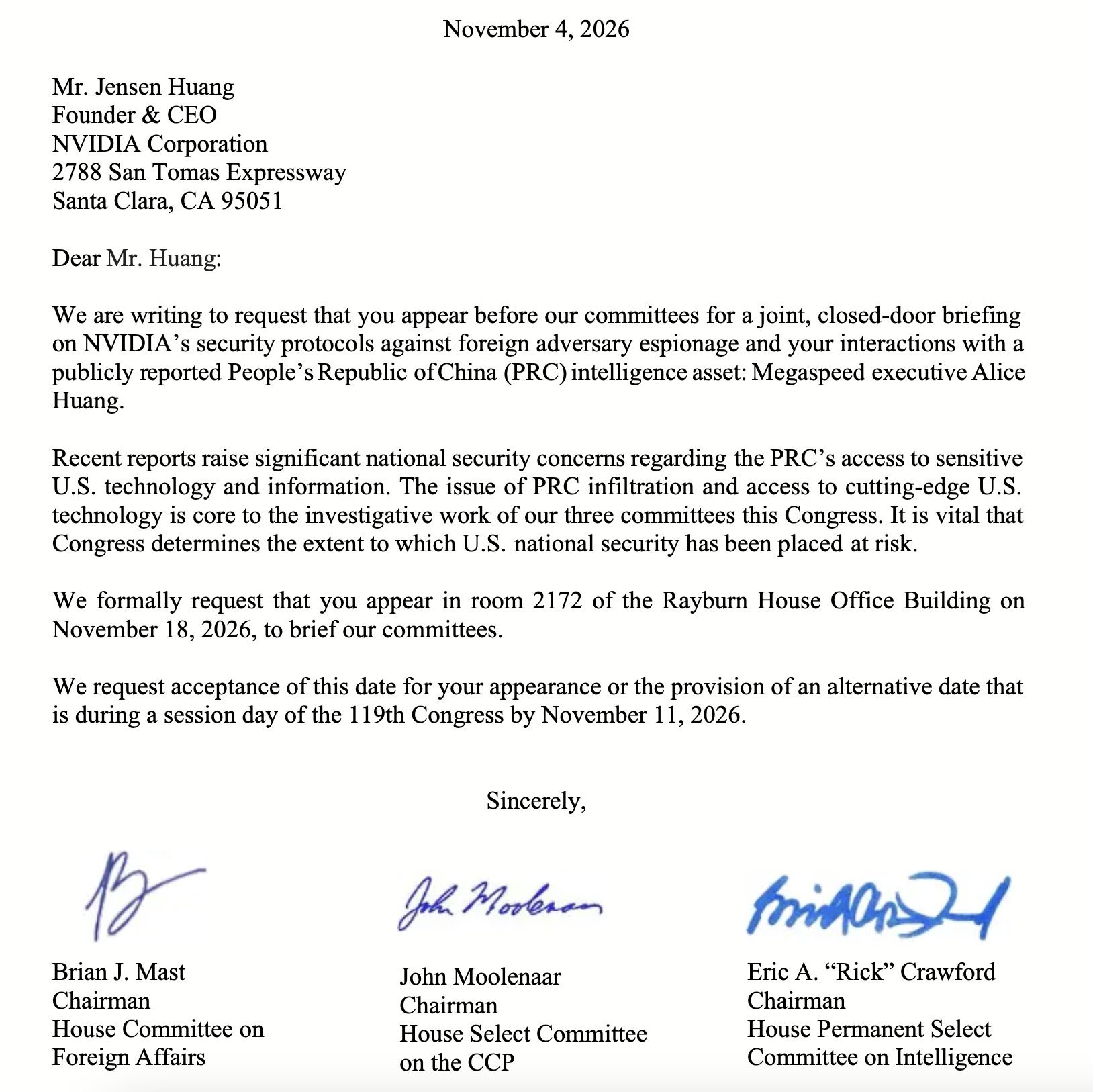
NVIDIA CEO Jensen Huang has been requested to attend a closed door congressional briefing following allegations involving a former executive at one of the company's Asian customers who is suspected of sharing information with Chinese intelligence. The request, issued on November 4, 2026, by 3 senior Republican lawmakers, raises concerns about potential national security vulnerabilities involving NVIDIA's business relationships and the protection of sensitive American semiconductor technology. The briefing has been requested for November 18, 2026, although Huang's attendance has not yet been confirmed.
According to the official congressional announcement, House Foreign Affairs Committee Chairman Brian Mast, House Select Committee on China Chairman John Moolenaar, and House Intelligence Committee Chairman Rick Crawford have requested information about Huang's interactions with Alice Huang, a former executive at Singapore based cloud computing company Megaspeed. The lawmakers are also seeking details about NVIDIA's internal security procedures for preventing foreign intelligence operations and unauthorized access to sensitive technologies.
The investigation follows an October 29 report from The New York Times, which alleged that American intelligence agencies had identified Alice Huang, also known as Huang Le, as a potential Chinese intelligence asset. According to the report, investigators monitored her activities after concerns emerged that Megaspeed could have helped Chinese companies obtain advanced NVIDIA AI accelerators despite United States export restrictions. Surveillance reportedly revealed a close business relationship between Alice Huang and Jensen Huang, raising concerns that information about NVIDIA's operations or American semiconductor policies could have reached Beijing.
However, the allegations remain unproven publicly, and there is no established evidence that Jensen Huang knowingly shared classified information, participated in espionage, or violated export regulations. NVIDIA has rejected suggestions that the executive's interactions were unusual, explaining that Huang regularly meets thousands of customers and business representatives worldwide. The company also maintains that its Asian cloud customers receive ordinary commercial information rather than confidential trade secrets or sensitive national security material. Megaspeed has separately stated that it is investigating the allegations and cooperating with American authorities.
The controversy arrives amid increasing scrutiny of NVIDIA's semiconductor supply chain and the effectiveness of export restrictions targeting China. Recent investigations have identified 32 NVIDIA B300 Blackwell Ultra GPUs operating on infrastructure associated with China Telecom, raising questions about how restricted AI hardware reaches Chinese networks. Those findings have not been linked to the allegations involving Alice Huang or Megaspeed.
Congressional lawmakers have requested that Jensen Huang confirm his attendance or propose an alternative date by November 11. The upcoming briefing could provide additional clarity about NVIDIA's customer verification procedures, internal security protections, and compliance with United States export restrictions. For now, no criminal wrongdoing by Jensen Huang has been established, and the congressional request should not be interpreted as a formal accusation against the NVIDIA CEO.
NVIDIA's position as a leading supplier of AI computing hardware places the company at the center of increasingly complicated commercial and national security interests. As its technology becomes essential to global AI infrastructure, maintaining transparent customer verification and strong security procedures is critical.
However, allegations involving a business relationship should not automatically be treated as evidence of wrongdoing. Congressional oversight is important, but conclusions must be supported by verified findings rather than speculation.
The broader concern is the effectiveness of semiconductor export restrictions and whether legitimate manufacturers can realistically monitor where their products and computing capabilities ultimately operate. Addressing those challenges should not result in unnecessary restrictions that undermine competition, consumer hardware availability, or legitimate technological development.
Should NVIDIA face stricter oversight of its international AI chip customers, or are existing semiconductor export restrictions already creating excessive challenges for the technology industry?
