
NVIDIA Becomes No. 1 in Data Center Ethernet Switching as Market Reaches $15.4 Billion
NVIDIA has become the world’s largest data center Ethernet switch supplier by revenue for the first time, demonstrating that its influence over artificial intelligence infrastructure now extends far beyond GPUs. According to the latest IDC Ethernet switch market report, NVIDIA generated $2.1 billion in data center Ethernet switching revenue during Q1 2026, representing growth of 192.7% compared with the same period last year.
The complete worldwide Ethernet switch market reached a record $15.4 billion during the quarter, increasing 39.8% from Q1 2025. The data center portion grew considerably faster, rising 61% to $10 billion as hyperscalers, cloud providers, and large enterprises continued building infrastructure for AI training and inference. NVIDIA captured 21.5% of this data center segment, narrowly surpassing Arista Networks, which held 20.7%.
This distinction is important because NVIDIA does not control 21.5% of the entire $15.4 billion Ethernet market. Its share applies specifically to the $10 billion data center segment. Cisco remains the largest supplier across the complete Ethernet market, generating $4.5 billion and controlling 29.3% when campus, branch, and data center equipment are combined. NVIDIA’s accomplishment is focused on the part of the market growing most rapidly because of AI infrastructure investment.
"NVIDIA’s rise to #1 in datacenter Ethernet switching in a single year is one of the most significant vendor landscape shifts IDC has tracked."
— Paul Nicholson, IDC
The growth was primarily driven by NVIDIA’s Spectrum X Ethernet platform, which combines Spectrum switches with ConnectX SuperNICs, BlueField data processing units, LinkX cables, and software designed to manage large AI networks. These components connect thousands of GPUs while reducing congestion, maintaining consistent bandwidth, and preventing network bottlenecks from leaving expensive accelerators waiting for data.
This integrated approach gives NVIDIA an important advantage. Customers purchasing large GPU clusters can also obtain networking hardware, software, management tools, and reference designs from the same supplier. Instead of treating the network as a separate infrastructure layer, NVIDIA develops its GPUs and Ethernet platform together around the requirements of large scale AI factories. IDC believes this combination has helped the company secure major deployments with hyperscalers and AI focused cloud providers.
Demand is also moving rapidly toward faster networking standards. IDC reports that 800G switches represented 35.8% of data center Ethernet revenue during Q1 2026, while 200G and 400G products contributed another 34.1%. Together, these high speed categories generated almost 70% of data center switch spending. The Americas recorded the strongest regional growth at 49.7%, followed by Europe, the Middle East, and Africa at 32.2%, while Asia Pacific increased 25.9%.
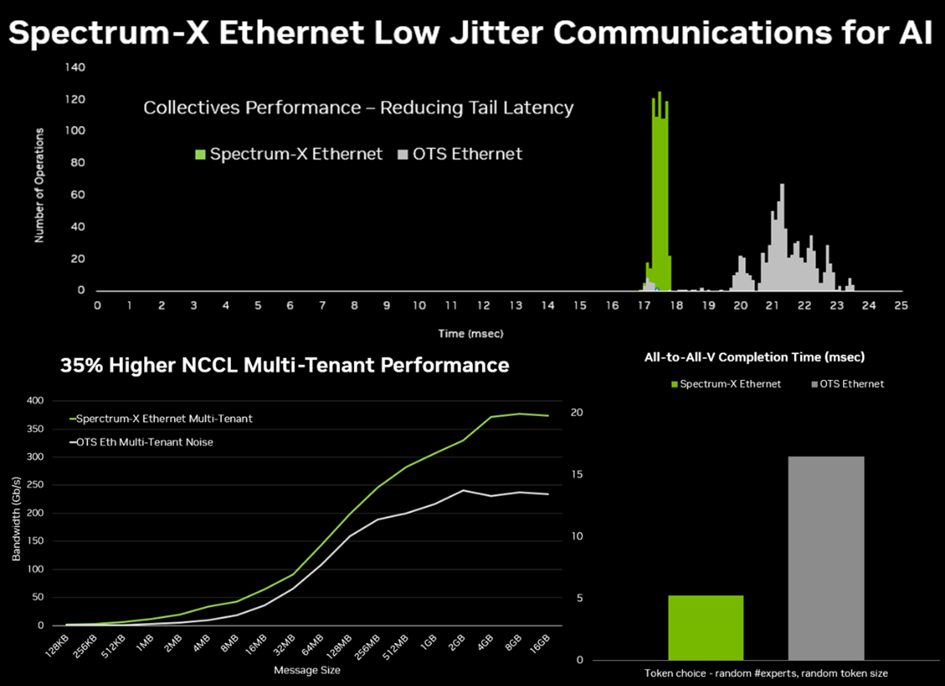
NVIDIA’s networking expansion connects directly with its wider AI factory strategy. CoreWeave and Oracle began validating Vera Rubin NVL72 systems, where Spectrum X handles scale out communication between rack systems while BlueField manages infrastructure services and tenant isolation. This shows why networking is becoming as strategically important as the GPU itself. Large AI systems cannot reach their expected performance if communication between accelerators becomes the bottleneck.
The company is already preparing the next stage through Spectrum 6 and Spectrum X Ethernet Photonics. These platforms introduce co packaged optical technology intended to lower power consumption and improve reliability as AI clusters expand toward hundreds of thousands or potentially millions of accelerators.
NVIDIA’s new leadership position will not remain uncontested. Arista, Cisco, Broadcom ecosystem partners, and other networking companies are expanding their own 800G and future 1.6T products. Open standards and multivendor Ethernet platforms may also appeal to cloud operators that do not want one supplier controlling GPUs, networking, software, and system design. However, the Q1 2026 results show that many customers currently value the performance and deployment simplicity provided by NVIDIA’s integrated ecosystem.
NVIDIA becoming the largest data center Ethernet switching supplier is one of the clearest signs that the AI infrastructure competition is no longer only about accelerator performance. A powerful GPU has limited value if the network cannot move training data, model states, and inference traffic quickly enough to keep it operating efficiently.
The company’s real advantage is its ability to sell an increasingly complete AI factory. GPUs provide compute, Vera CPUs handle host workloads, BlueField manages infrastructure services, NVLink connects accelerators inside a system, and Spectrum X connects systems across the data center. Every additional layer gives NVIDIA more control over performance, customer relationships, and infrastructure spending.
That strength also creates a risk for customers. Depending on one company across most of the AI stack may simplify deployment, but it can increase costs and reduce flexibility. NVIDIA has taken the lead, but the next phase will determine whether Spectrum X becomes the standard network for AI factories or encourages competitors to build stronger open alternatives.
Will NVIDIA’s complete AI infrastructure ecosystem make Spectrum X the default choice for future data centers, or will customers push toward more open networking alternatives?
