
NVIDIA and LG Expand Physical AI Push With Humanoid Robot and Vera Rubin AI Factories
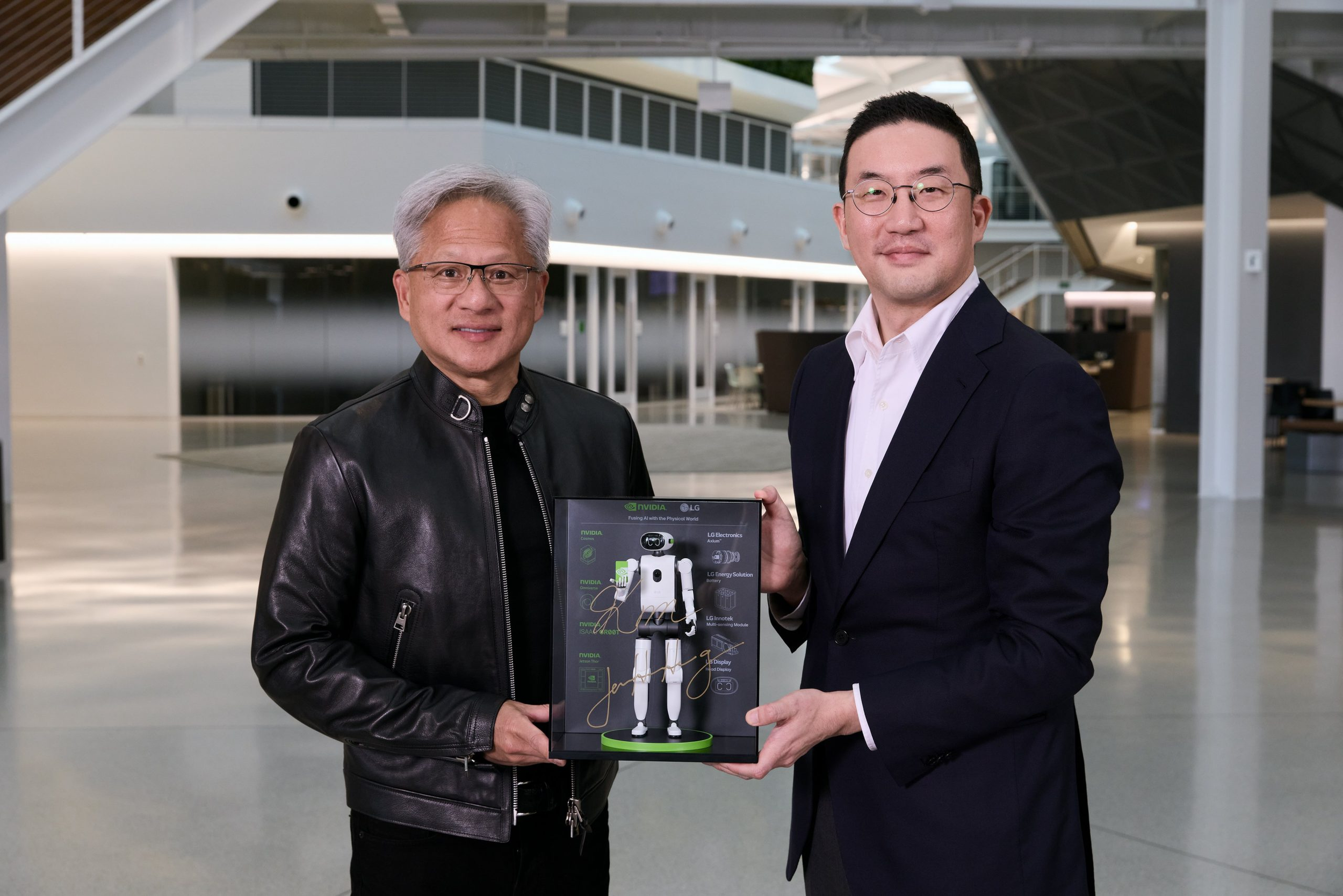
LG Group and NVIDIA are expanding their partnership across humanoid robotics, AI infrastructure, and autonomous vehicles, moving from earlier development plans toward commercial deployment. LG is developing a next generation bipedal humanoid robot built around NVIDIA Isaac GR00T, Jetson Thor, and Halos for Robotics, with its first public unveiling planned for Q1 2027. The agreement follows an August 13 meeting at NVIDIA headquarters between LG Group Chairman Koo Kwang mo and NVIDIA CEO Jensen Huang.
"The defining opportunity of physical AI is to give every machine the ability to understand the real world, reason and act safely alongside people."
— Quote by: Jensen Huang
Jetson Thor will provide the humanoid's onboard AI computing, while Isaac GR00T supplies the foundation model technology needed for reasoning, perception, and robotic control. NVIDIA already positions Jetson Thor as its Blackwell based computing platform for humanoids and physical AI, with the family delivering up to 2,070 FP4 TFLOPS and supporting GR00T based robotic workloads.
Great to welcome @LGE_Global Group Chairman Kwang-mo Koo and LG leaders to NVIDIA as we enter the next chapter of our collaboration.
— NVIDIA (@nvidia) August 14, 2026
Together, we’re expanding our work across AI infrastructure, physical AI and robotics.
We’re excited about what our teams can build together. pic.twitter.com/75yVaxSdIT
LG will also begin validating its wheel based CLOiD robot on an LG Electronics washing machine production line in Tennessee during 2026. The companies plan to use real manufacturing environments to collect data, train robotic systems, validate behaviors, and improve physical AI models before expanding deployment into additional factories and potentially other environments. NVIDIA had already confirmed earlier in 2026 that LG was adopting Isaac GR00T models as part of its humanoid robotics strategy.
The partnership extends far beyond robots. LG plans to establish a reference AI factory based on NVIDIA DSX and Vera Rubin during H1 2027, followed by an approximately 80 MW AI factory in Cheonan, South Korea, during H1 2028. The infrastructure will support physical AI and robot foundation model development while combining NVIDIA computing with LG technologies covering cooling, batteries, power, IT infrastructure, and operations. The project follows the same broader strategy visible in NVIDIA's 27,500 Rubin GPU physical AI factory planned for Japan.
LG and NVIDIA are also expanding into mobility through NVIDIA DRIVE Hyperion, with LG developing a high performance computing platform for future AI defined vehicles that combines its automotive software and infotainment expertise with NVIDIA autonomous driving technology.
This partnership demonstrates how NVIDIA's Physical AI strategy is evolving beyond selling robotics processors. LG brings manufacturing, batteries, sensors, electronics, automotive technology, cooling, and real production environments, while NVIDIA provides the computing, simulation, foundation models, and AI infrastructure. The most important milestone will be the 2027 humanoid demonstration, where we should finally see whether this full stack approach can move beyond impressive prototypes into reliable industrial machines.
Could NVIDIA and LG become major competitors in humanoid robotics, or will companies already dedicated entirely to robotics maintain the advantage?
