
NVIDIA Expands Jetson Thor With T3000 and T2000 for Mainstream Robotics and Edge AI
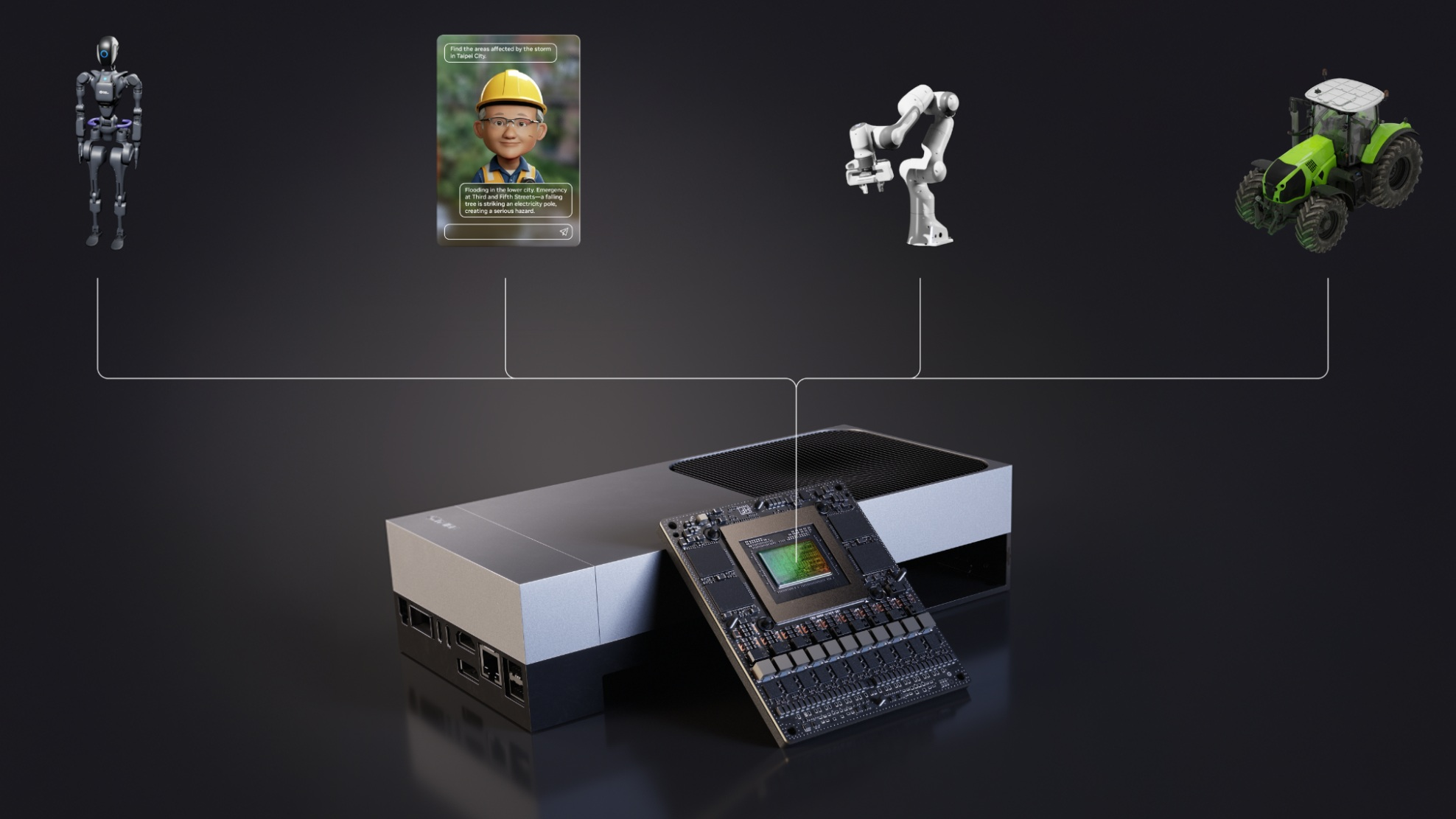
NVIDIA has expanded its Jetson Thor platform with the new T3000 and T2000 modules, bringing Blackwell based artificial intelligence performance to more compact and power efficient systems designed for humanoid robots, autonomous machines, visual AI agents, and industrial edge computing.
According to the official NVIDIA Jetson Thor announcement, the new modules are intended to move physical AI beyond research laboratories and into larger commercial deployments. Companies including 1X, Agile Robots, Amazon Robotics, Boston Dynamics, FANUC, Hitachi, and Techman Robot are already developing robotic systems around the wider Jetson AGX Thor platform.
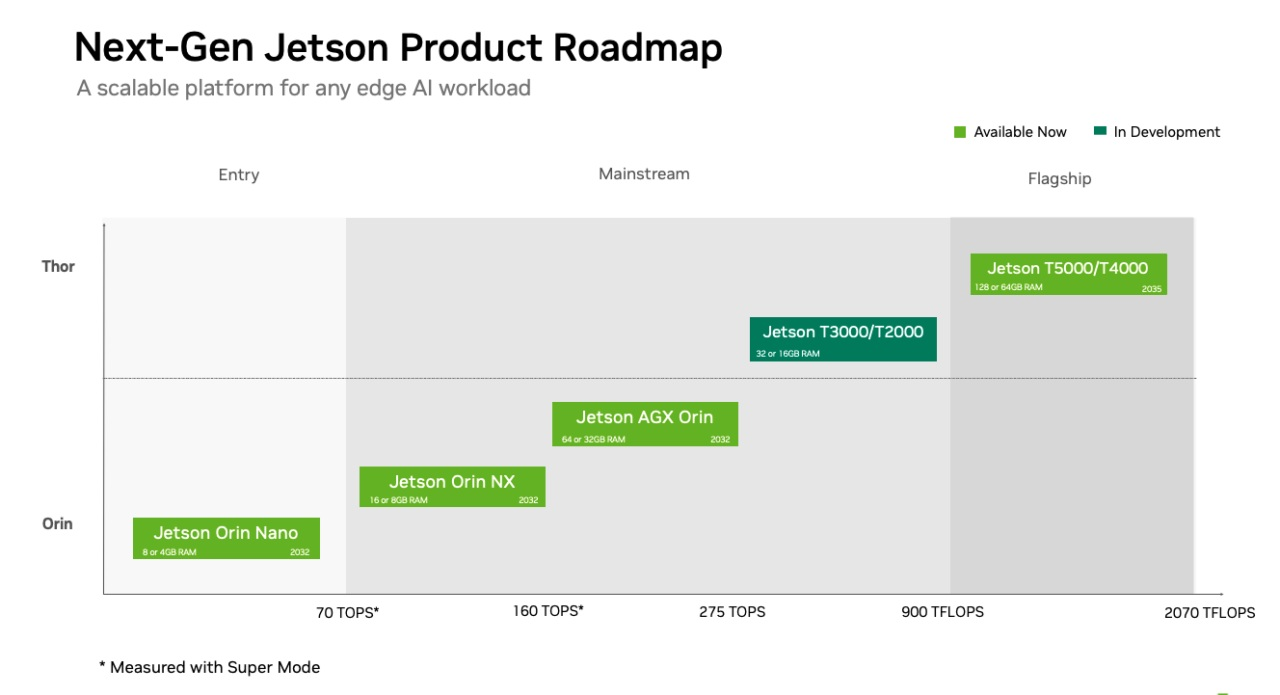
The Jetson T3000 is positioned as a smaller alternative to the flagship T5000. It delivers 865 TFLOPS of FP4 artificial intelligence compute through an NVIDIA Blackwell GPU, supported by an 8 core Arm Neoverse CPU, 32 GB of LPDDR5X memory, 273 GB/s of memory bandwidth, and 25 GbE connectivity.
NVIDIA says the T3000 occupies roughly half the physical space and consumes approximately half the power of the T5000 while providing similar inference performance in selected multimodal workloads. These include large language models, vision language models, vision language action models, and world foundation models. The comparison refers to NVIDIA’s internal workload testing and should not be interpreted as equal performance across every robotics or edge application.
Ecosystem partner specifications list the T3000 with a 70 W power target. NVIDIA is also offering an IGX T3000 version with integrated functional safety support for machines operating near people. The IGX model can run the NVIDIA Halos for Robotics safety platform while maintaining the same core compute performance. Final specifications remain subject to change before commercial availability.
The Jetson T2000 extends the Thor architecture into lower cost edge systems with 400 TFLOPS of FP4 compute and 16 GB of memory. It targets visual AI agents, autonomous mobile robots, industrial manipulators, intelligent cameras, and other applications that require local inference without the capacity or power requirements of the larger Thor modules.
Partner documentation places the T2000 at a 40 W power target, giving developers a more accessible route into Blackwell based edge computing. NVIDIA says the expanded Jetson portfolio now covers systems ranging from 70 TOPS to more than 2000 TFLOPS, allowing developers to select hardware according to model size, sensor requirements, energy limits, and deployment cost.
The launch also introduces new Jetson agent skills designed to automate memory optimization, system configuration, and deployment tasks. NVIDIA says these tools can help developers reduce memory consumption and move applications onto less expensive modules without reducing their intended functionality.
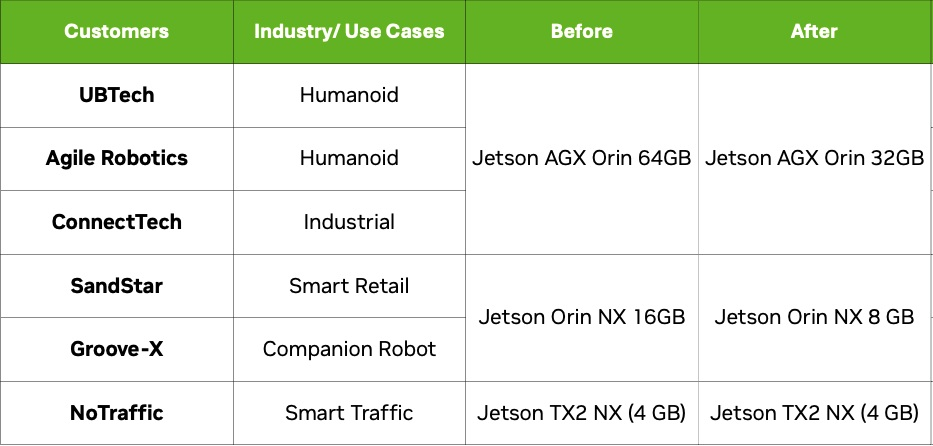
UBTech, Agile Robots, and Connect Tech reportedly reduced memory usage by as much as 15 GB, allowing selected workloads to move from Jetson AGX Orin 64 GB modules to 32 GB configurations. SandStar reduced memory usage by as much as 4 GB and moved from a 16 GB Jetson Orin NX module to an 8 GB version, while NoTraffic reported a 30% memory reduction on Jetson TX2 NX. These results are company supplied examples and may vary according to workload and software configuration.
NVIDIA is also bringing Cosmos 3 Edge to the Thor family. The 4 billion parameter world foundation model is designed to help embodied systems interpret their surroundings, reason locally, and generate actions directly on the device. Developers can adapt the model for specific robots and sensor configurations before deploying it through Jetson Thor for local vision analysis and robotic control.
The broader rollout coincides with NVIDIA’s expansion across Japan’s healthcare and robotics industries. Kawasaki Heavy Industries plans to use NVIDIA Holoscan IGX, Isaac for Healthcare, Isaac GR00T, and Cosmos to develop surgical assistance, nursing support, and hospital transportation robots. Direava is separately developing a surgical vision language model capable of interpreting live operating room video and supporting natural language interaction with surgical scenes through the NVIDIA Japan AI ecosystem.
This growth reflects NVIDIA’s wider effort to connect robotics, autonomous vehicles, industrial systems, local inference, and consumer computing under a unified edge strategy. Developers will be able to emulate the T3000 through existing Jetson AGX Thor developer kits with JetPack 7.2.1 later in July 2026. T2000 emulation support will follow in a future software release, while both production modules are scheduled to become available during Q1 2027.
Hardware partners preparing Thor based solutions include ADLINK, Advantech, AAEON, Aetina, Auvidea, AVerMedia, Connect Tech, ForeCR, JWIPC, NEXCOM Robotic Solutions, Realtimes, Seeed Studio, Twowin, TZTEK, and YUAN. Antmicro, Neurealm, REBOTNIX, and RidgeRun will provide software migration and emulation support.
The T3000 and T2000 are strategically important because they make Thor architecture more practical for commercial robotics rather than limiting it to premium humanoid prototypes and heavily funded research programs.
The T3000 appears particularly well balanced. It retains the T5000’s 273 GB/s memory bandwidth while reducing memory capacity, processor resources, module size, and power consumption. That configuration could be attractive for robots that require advanced multimodal reasoning but do not need the full 128 GB memory capacity of the flagship platform.
The T2000 may have the larger market opportunity. A 40 W Blackwell module with 400 FP4 TFLOPS could fit autonomous mobile robots, smart retail systems, industrial cameras, transportation infrastructure, and compact robotic arms where power, cooling, and production cost are more restrictive than maximum performance.
NVIDIA’s strongest advantage remains its complete development environment. Hardware alone will not determine which platform dominates physical AI. Isaac, GR00T, Cosmos, Holoscan, JetPack, simulation tools, and a large partner network reduce the amount of custom software required to move a robot from development into deployment.
The major question will be pricing. NVIDIA has not announced commercial prices for either module, and the value proposition will depend on whether the T2000 and T3000 can deliver meaningful cost reductions compared with current Jetson AGX Orin and higher capacity Thor configurations.
Could the lower power Jetson T2000 become the platform that finally pushes physical AI and autonomous robots into mainstream commercial deployment?
