
NVIDIA Moves Gaming Under Edge Computing As Blackwell Workstations Drive 29% Growth While Consumer GPUs Slow Down
NVIDIA is changing how it reports its business, moving its Gaming segment under a broader Edge Computing category as the company continues shifting from a traditional GPU manufacturer into a wider AI ecosystem provider. The change appeared alongside NVIDIA’s latest earnings, where the company reported record revenue of $81.6 billion for Q1 FY2027, led primarily by its Data Center business.
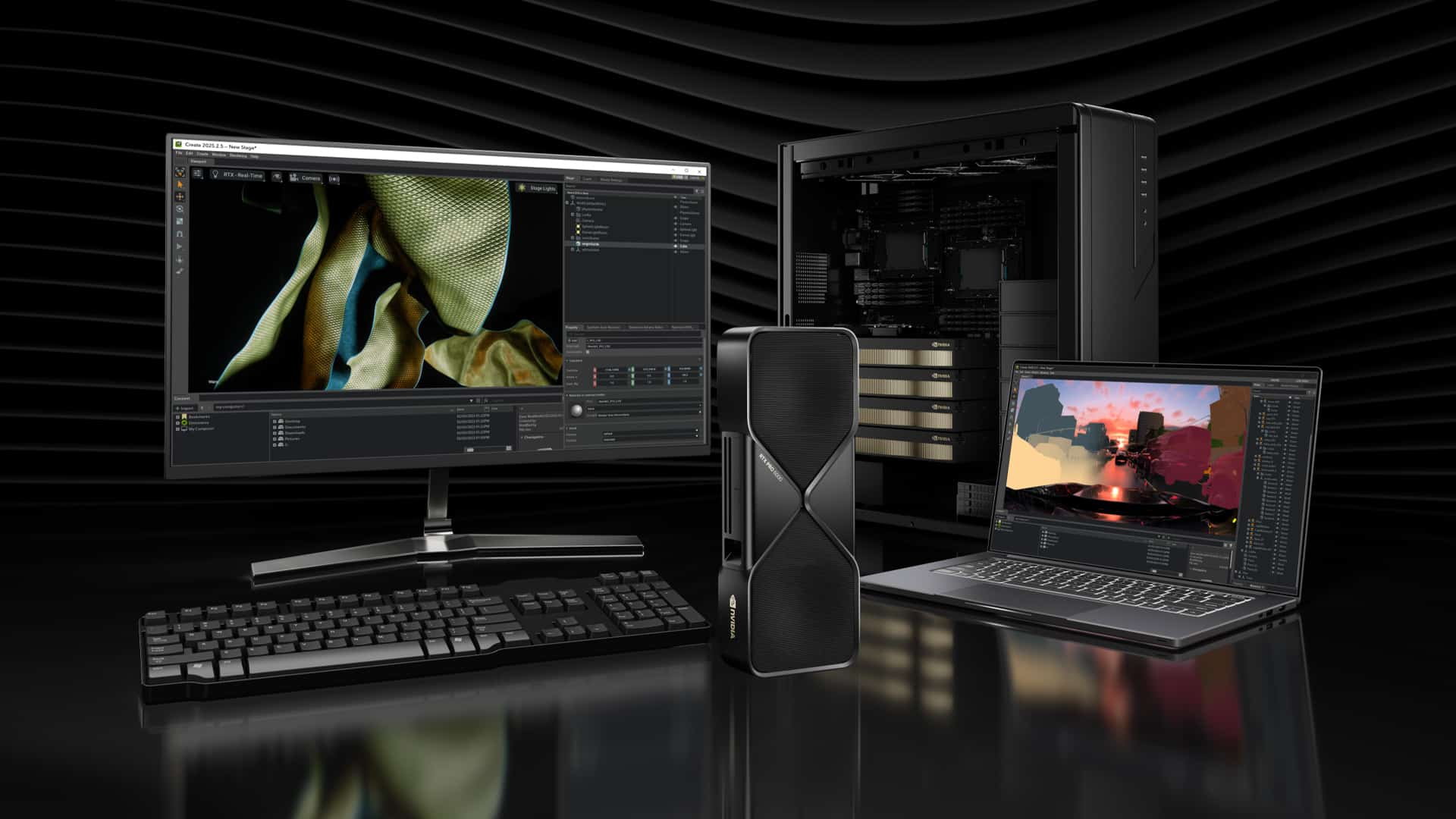
The move means NVIDIA will no longer report Gaming as a standalone category in the same way it has in previous financial updates. Instead, gaming related revenue from GeForce GPUs and console SoCs will now be grouped together with other client focused markets under Edge Computing. These include PCs, game consoles, workstations, AI RAN base stations, robotics, and automotive platforms.
This is a meaningful reporting shift because it reduces visibility into how NVIDIA’s GeForce gaming GPUs and console related business are performing independently. Previously, NVIDIA separated Gaming, Professional Visualization, Automotive, and OEM or Other segments. Starting in FY2027, those client side businesses will now fall into the larger Edge Computing umbrella. By comparison, AMD still reports Gaming revenue separately, including Radeon graphics and console semi custom business.
NVIDIA’s new structure divides its business more clearly between massive cloud scale infrastructure and client side AI enabled devices. Data Center is split into Hyperscale and ACIE, which includes AI Clouds, Industrial, and Enterprise. Edge Computing, meanwhile, becomes the category for devices and systems closer to end users, physical environments, vehicles, telecom networks, and local AI workloads.
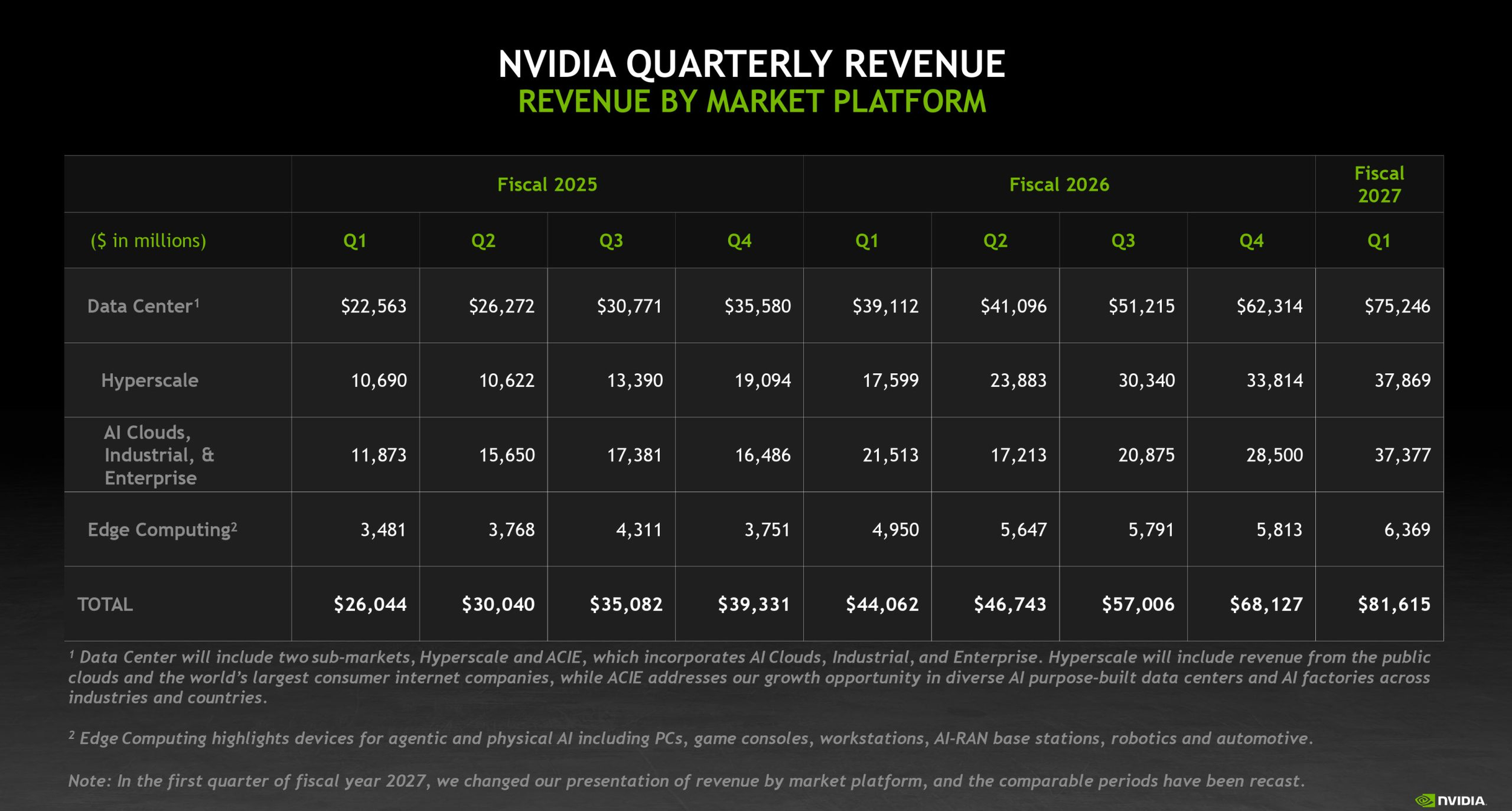
For Q1 FY2027, NVIDIA reported $6.4 billion in Edge Computing revenue. That represents a 29% increase from the same period last year and a 10% increase sequentially. NVIDIA said growth was driven by strong Blackwell workstation demand, although this was partially offset by weaker consumer PC demand caused by elevated memory and system prices.
“Edge Computing revenue for the first quarter was $6.4 billion, up 29% from a year ago and up 10% sequentially. The increases were driven by robust Blackwell workstation demand, partially offset by slower consumer PC demand that was tempered by elevated memory and systems prices.” Quote by: NVIDIA
That comment gives a useful but limited view of the gaming market. NVIDIA is still seeing strength in professional Blackwell workstation demand, but the consumer PC side is facing pressure. The company specifically pointed to elevated memory and system prices, which have become a growing issue as AI infrastructure demand continues absorbing large portions of global DRAM supply. As memory prices rise, gaming PCs, prebuilt systems, and graphics card upgrade cycles can all become more expensive for consumers.
For gamers, this matters because higher component costs can slow demand even when GPU technology continues advancing. If memory and broader system prices remain elevated, buyers may delay upgrades, hold onto existing GPUs longer, or shift toward lower priced hardware. This could affect the broader PC gaming ecosystem, especially as high end graphics cards already sit at premium price points.
At the same time, NVIDIA’s decision to fold Gaming into Edge Computing reflects how the company now sees client hardware. GeForce GPUs are no longer positioned only as gaming products. They are increasingly part of a larger RTX ecosystem that includes local AI models, creator tools, workstation workloads, robotics development, neural rendering, and edge AI applications. This gives NVIDIA more flexibility in how it frames client hardware growth, but it also makes it harder for the market to measure gaming performance by itself.
During the quarter, NVIDIA highlighted several Edge Computing developments. The company released DLSS 4.5 Dynamic Multi Frame Generation and previewed DLSS 5, which it described as the next generation of its 3D guided neural rendering model and its most significant graphics breakthrough since ray tracing in 2018. This keeps NVIDIA’s graphics roadmap closely tied to AI based rendering, not only traditional raster performance.
NVIDIA also accelerated and optimized local agentic models such as Gemma 4, Qwen, Mistral, and NVIDIA Nemotron for RTX and edge devices. This reinforces the company’s push to make RTX platforms useful for local AI workloads, not just gaming and content creation.
The Edge Computing category also includes NVIDIA’s automotive, robotics, industrial, and telecom initiatives. During the quarter, NVIDIA announced the Alpamayo 1.5 open model and Omniverse NuRec technologies for autonomous driving systems. It also expanded partnerships with Hyundai Motor Company and Kia for next generation autonomous driving on the NVIDIA DRIVE Hyperion platform, while working with Uber on autonomous vehicles powered by NVIDIA DRIVE AV software.
NVIDIA also said BYD, Geely, Isuzu, and Nissan are building level 4 ready vehicles on NVIDIA DRIVE Hyperion. The company introduced NVIDIA Halos OS, a unified safety architecture for AI powered vehicles, and announced new NVIDIA Cosmos and NVIDIA Isaac GR00T N models alongside Isaac simulation frameworks and the general availability of NVIDIA IGX Thor.
The company’s telecom and industrial AI strategy is also becoming part of the same picture. NVIDIA announced collaboration with T Mobile and Nokia to integrate physical AI applications on AI RAN ready infrastructure, while also working with global telecom leaders on future 6G wireless networks built around AI native, open, and secure platforms. Industrial software partnerships around CUDA X, Omniverse, and accelerated computing further show how wide the Edge Computing category has become.
For NVIDIA, this reporting change supports a broader strategic message. The company is no longer only selling gaming GPUs, professional GPUs, automotive chips, or data center accelerators as separate stories. It is presenting itself as a full stack AI platform company where cloud AI, local AI, physical AI, neural rendering, robotics, autonomous vehicles, and gaming all connect through its hardware and software ecosystem.
For investors, the new Edge Computing category may make NVIDIA’s client side business look more unified. For gamers and industry analysts, however, it removes some useful transparency. Without separate Gaming revenue, it will become more difficult to track GeForce demand, console related contributions, and consumer GPU market cycles directly from NVIDIA’s financial reports.
The key takeaway is that NVIDIA’s Gaming business is not disappearing. It is being reframed. Gaming now sits inside a larger client and edge AI strategy where RTX hardware is expected to power not only games, but also local models, creator workflows, AI enhanced rendering, robotics, vehicles, and industrial applications.
As AI continues reshaping hardware demand, NVIDIA’s new reporting structure signals where the company believes the market is going. Gaming remains important, but it is now one part of a much larger Edge Computing ecosystem.
Do you think NVIDIA’s decision to move Gaming under Edge Computing makes strategic sense, or does it reduce too much transparency around GeForce GPU performance?
