
Colorful Introduces Memory Tuning Mode for Intel 800 Series Motherboards
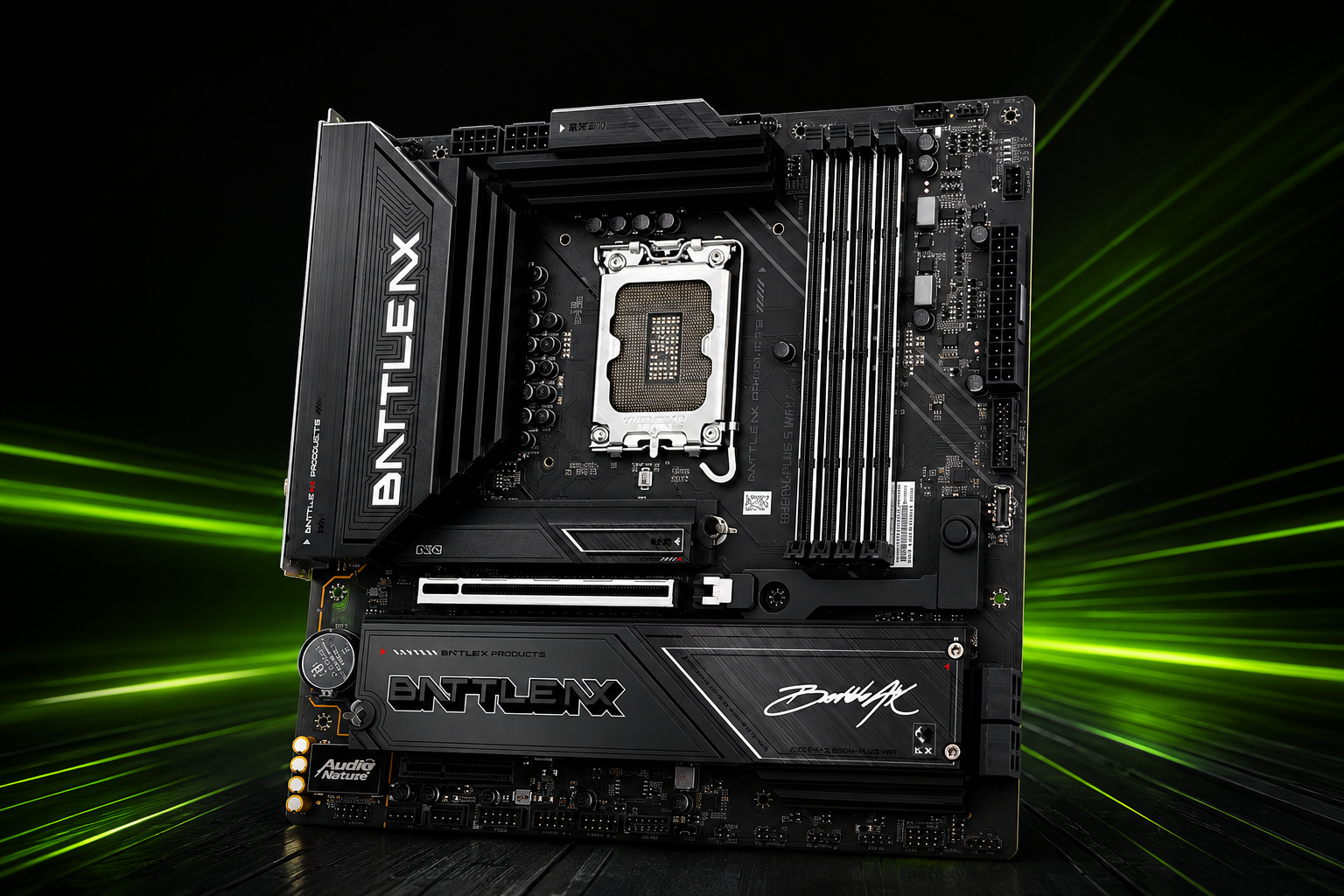
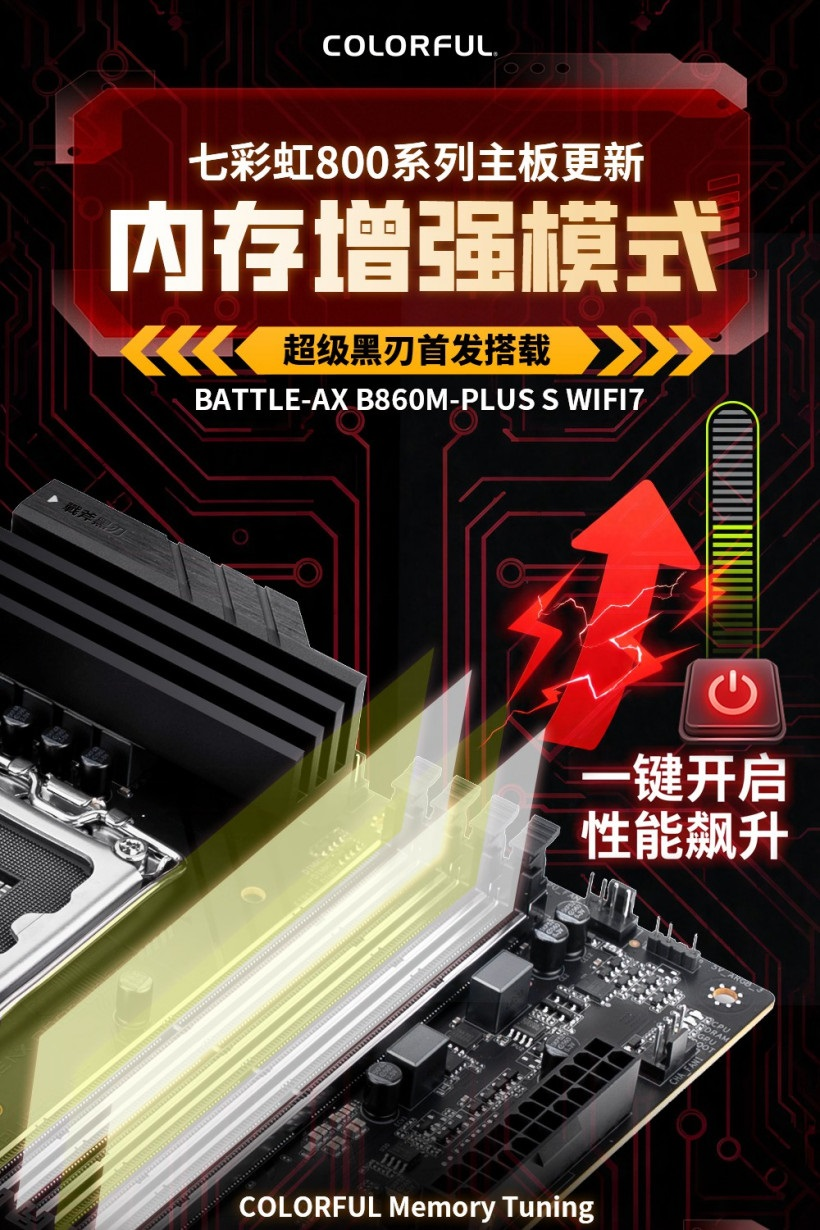
Colorful has introduced Memory Tuning Mode, a new BIOS optimization feature for selected Intel 800 series motherboards that promises higher DDR5 bandwidth, lower latency, and improved gaming performance without requiring users to manually adjust advanced memory settings. The feature debuts on the BATTLE AX B860M PLUS S WIFI7 V20 and will expand to additional Z890 and B860 motherboards through future BIOS updates.
According to IT Home, Memory Tuning Mode can be activated directly inside the motherboard BIOS with a single setting. Colorful provides several optimization levels, allowing users to apply validated memory presets instead of manually configuring primary timings, secondary timings, voltages, and memory controller parameters. The company has not yet explained every technical adjustment performed by the feature, but it appears designed to optimize the relationship between the processor, motherboard firmware, and installed DDR5 memory.
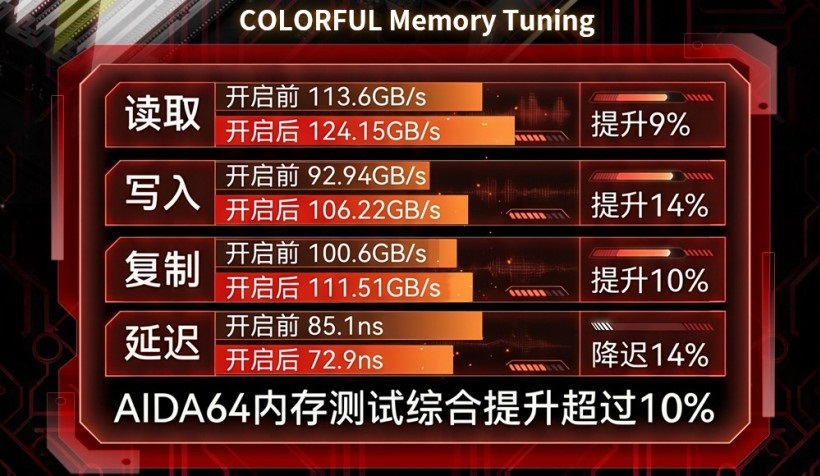
Colorful’s internal AIDA64 testing showed memory read bandwidth increasing by 9%, write bandwidth improving by 14%, and copy bandwidth rising by 10%. Memory latency was reduced by 14%, resulting in a claimed overall memory performance improvement above 10%. These results indicate that the largest benefits may appear in workloads that frequently depend on system memory access rather than applications limited primarily by graphics or storage performance.
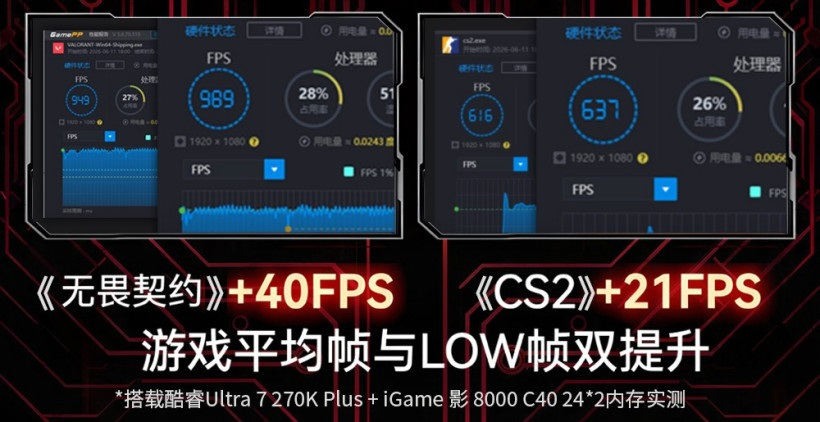
Gaming gains were smaller but still measurable in Colorful’s testing. The company paired an Intel Core Ultra 7 270K Plus processor with a 48 GB iGame Shadow DDR5 8000 CL40 memory kit and tested both Valorant and Counter Strike 2 at 1080p. Valorant gained 40 FPS, representing a 4.2% average performance increase, while Counter Strike 2 improved by 21 FPS, or approximately 3.4%. Colorful also reported stronger 1% low frame rates, which may reduce sudden performance drops and improve perceived smoothness during competitive gameplay.
The test conditions are particularly favorable to memory tuning because both games operate at extremely high frame rates and can become limited by processor and memory performance. The improvements may be considerably smaller in graphically demanding games running at 1440p or 4K, where the graphics card becomes the primary performance limitation. Results will also vary according to the processor, memory kit, motherboard, BIOS version, memory controller quality, and selected tuning preset.
The feature initially appears on the BATTLE AX B860M PLUS S WIFI7 V20, a mainstream Micro ATX motherboard featuring a 10+1+1+1 phase 60A power design, WiFi 7, 5 GbE networking, and support for high frequency DDR5 memory. Colorful’s broader Intel XMP motherboard compatibility page shows that selected Z890 and B860 models already support memory speeds ranging from 7600 MT/s to 9200 MT/s, depending on the board and configuration.
-
iGame Z890 VULCAN W V20
iGame Z890 VULCAN X V20
iGame Z890 ULTRA S W V20
iGame Z890 FLOW V20
iGame Z890 ULTRA V20
iGame B860M ULTRA V20
CVN Z890 ARK FROZEN V20
CVN Z890M GAMING FROZEN V20
CVN B860I GAMING FROZEN V20
CVN B860M GAMING FROZEN V20
BATTLE AX Z890M PLUS V20
Colorful has not announced when every motherboard will receive the required BIOS update. Owners will need to monitor the support page for their specific model and confirm memory stability after enabling the feature, especially when using high frequency kits or modules that are not listed on the motherboard qualification list.
The launch also complements Intel’s renewed focus on memory performance for the Core Ultra 200S Plus platform, which introduced official DDR5 7200 support, faster internal communication, and support for Intel’s warranty backed 8000 MT/s memory profile on selected 800 series motherboards.
Memory Tuning Mode gives Colorful users a convenient way to access some of the benefits normally associated with manual DDR5 optimization. Tightening memory timings can improve latency and CPU limited gaming performance, but the process is complicated and can easily create instability when settings are applied without sufficient testing.
A motherboard validated preset removes much of that complexity, although Colorful’s performance claims still need independent verification. The 3% to 4% gaming gains are believable in competitive games running at very high frame rates, but buyers should not expect the same improvement across every title.
The feature also shows how motherboard vendors are increasingly using firmware optimization to differentiate products built around the same Intel chipset. Raw hardware specifications remain important, but BIOS quality, memory training, validated presets, and long term firmware support are becoming equally significant parts of the platform experience.
Would you use an automatic Memory Tuning Mode for additional gaming performance, or do you prefer manually adjusting DDR5 timings and voltages?
