
GIGABYTE Quietly Launches B850 AORUS ELITE X3D With X3D Turbo Mode 2.0
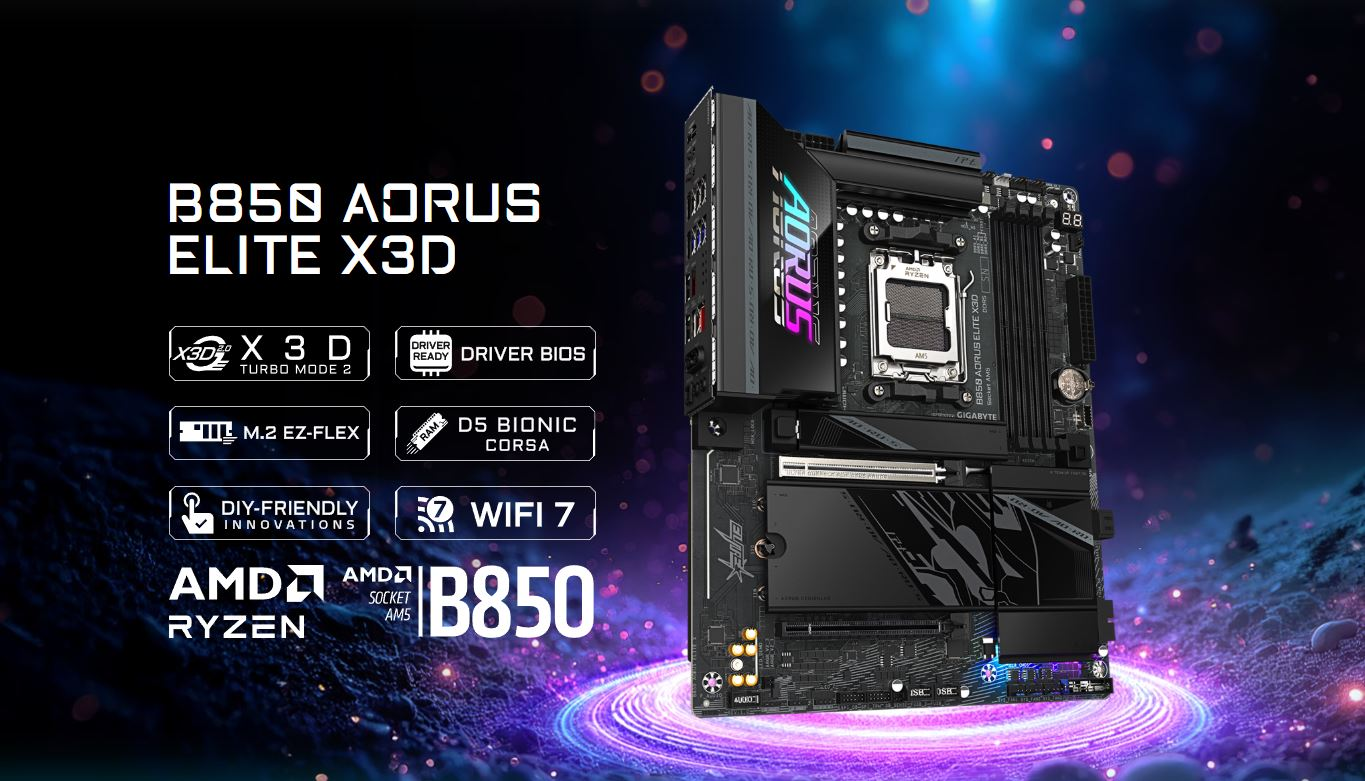
GIGABYTE has quietly expanded its AMD AM5 motherboard lineup with the B850 AORUS ELITE X3D, a new gaming focused model designed around Ryzen X3D processors and the company’s latest X3D Turbo Mode 2.0 technology. While it shares its general positioning with the existing B850 AORUS ELITE WIFI7, the new board introduces stronger power delivery, faster networking, additional storage connectivity, and dedicated hardware designed to optimize the behavior of AMD processors equipped with 3D V Cache.
According to the official B850 AORUS ELITE X3D product page, the motherboard uses a 20 phase digital power layout divided into 16 Vcore phases, 2 SoC phases, and 2 miscellaneous phases. Each stage is rated at 60A, while the processor receives power through dual 8 pin CPU connectors. The board also uses a 6 layer PCB with 2 ounce copper construction, premium chokes, and enlarged VRM heatsinks connected through a heat pipe.
The specification represents a meaningful upgrade over the standard B850 AORUS ELITE WIFI7, which uses a 14 plus 2 plus 2 power configuration. The X3D model also expands storage from 3 to 4 M.2 slots, including 2 PCIe 5.0 connections and 2 PCIe 4.0 connections. Its main graphics slot supports PCIe 5.0 x16 with Ryzen 9000 and Ryzen 7000 processors, while a second full length slot operates at PCIe 4.0 x4. That secondary slot shares bandwidth with one of the chipset connected M.2 slots.
Memory support reaches DDR5 8200 MT/s through overclocking, with 4 DIMM slots providing up to 256 GB of total capacity. Both AMD EXPO and Intel XMP profiles are supported, although achievable memory speed will depend on the processor, memory kit, and number of installed modules. GIGABYTE also includes its D5 Bionic Corsa and AORUS AI SNATCH technologies for automatic processor and memory tuning.
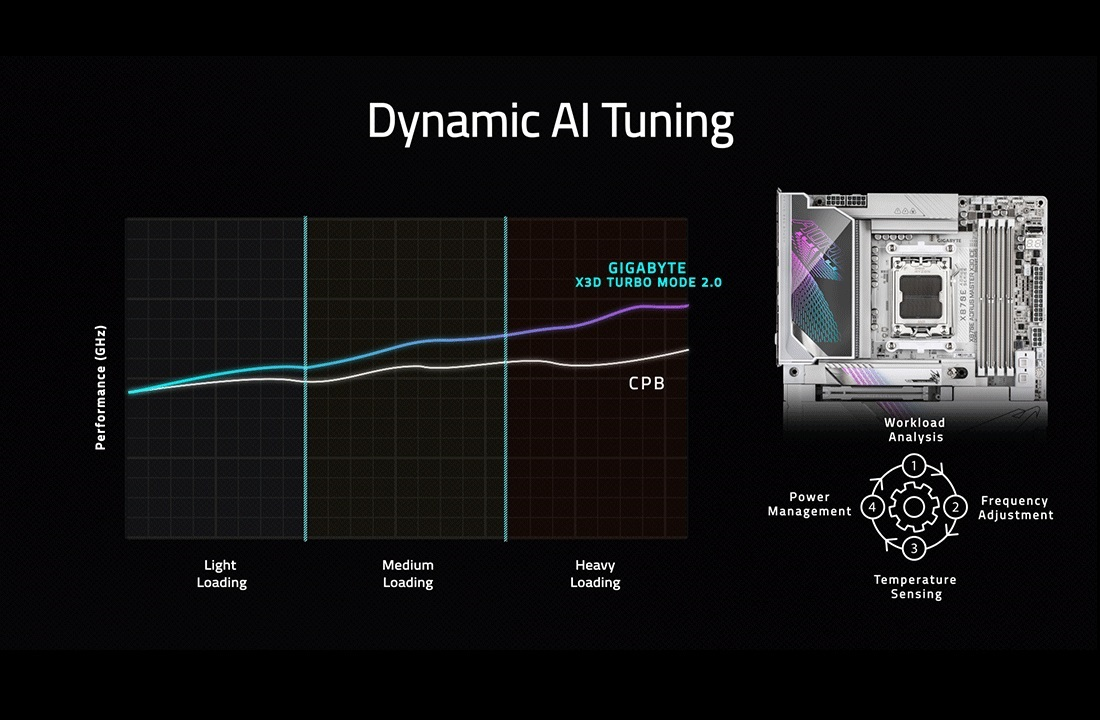
The main feature is X3D Turbo Mode 2.0, which GIGABYTE describes as a platform level optimization system rather than traditional overclocking. A dedicated controller monitors2.0, workload behavior and adjusts power delivery, memory behavior, and system response through the company’s Dynamic OC Engine. Users can retain standard operation or choose between Max Performance and Extreme Gaming profiles.
Max Performance is designed to balance gaming with heavy multicore workloads such as rendering and content creation. Extreme Gaming instead prioritizes higher frame rates and stronger frame time consistency. GIGABYTE claims gains of up to 25% in selected games compared with standard configurations, although the actual improvement will vary considerably depending on the processor, game, memory, and graphics card.
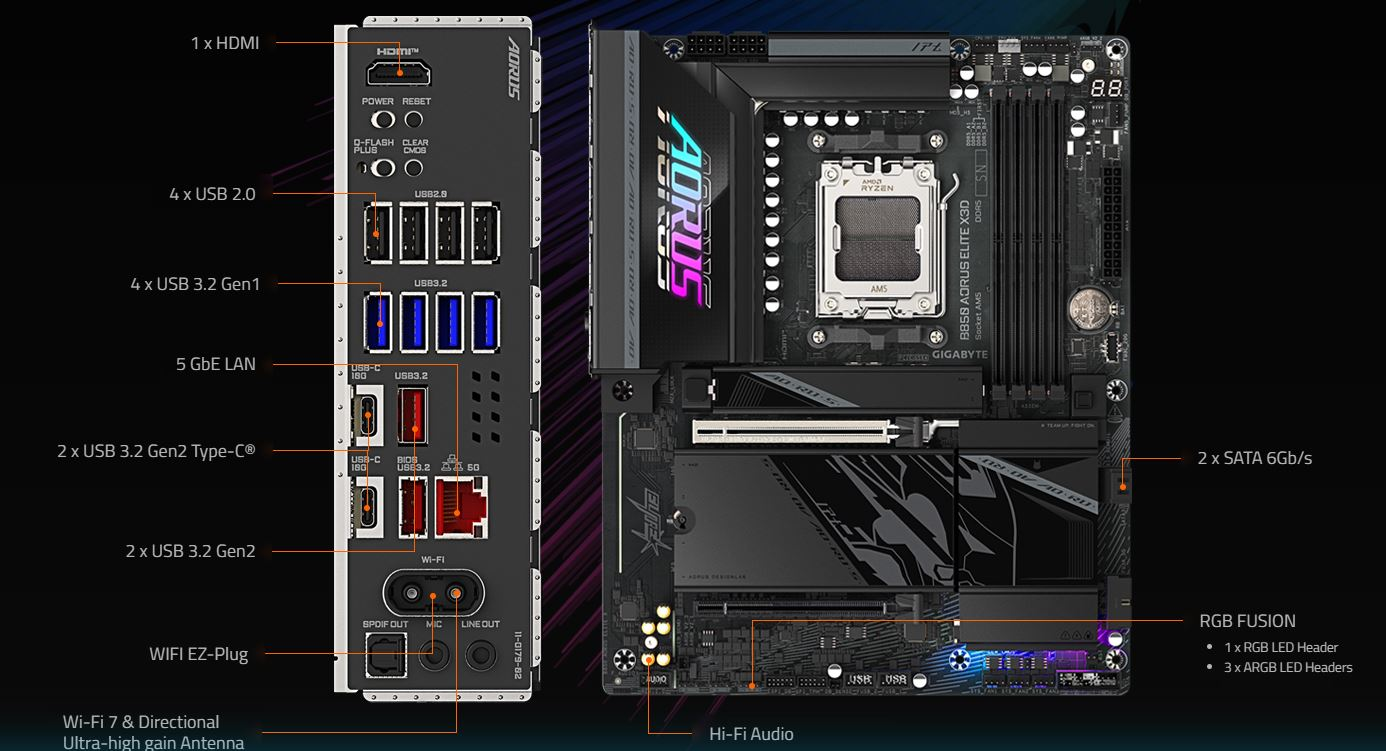
Connectivity is another major strength. The rear panel includes 4 USB 2.0 ports, 4 USB 3.2 Gen 1 ports, 2 USB 3.2 Gen 2 Type A ports, and 2 USB 3.2 Gen 2 Type C ports. Networking is handled by Realtek 5 GbE and Wi Fi 7 with Bluetooth 5.4. The board also provides HDMI 2.1, optical audio output, Realtek ALC1220 audio, and dedicated power, reset, Clear CMOS, and Q Flash Plus buttons.
GIGABYTE has included several builder focused features, including quick release mechanisms for the graphics and M.2 slots, diagnostic LEDs, an 80 port diagnostic display, 8 fan and pump headers, temperature sensor connections, and large M.2 heatsinks. A full coverage metal rear plate is also included to improve rigidity and assist with thermal management.
GIGABYTE has not announced official pricing or detailed regional availability. Its final value will depend on how closely it approaches premium X870 models, particularly because the B850 chipset does not provide the same complete connectivity platform as AMD’s higher end alternatives.
The B850 AORUS ELITE X3D is more than a renamed B850 motherboard. The stronger power design, dual PCIe 5.0 M.2 support, 5 GbE networking, expanded diagnostics, and dedicated X3D tuning hardware create a substantial specification upgrade over the existing AORUS ELITE WIFI7.
X3D Turbo Mode 2.0 is still likely to provide its largest gains in carefully selected workloads, and users should not expect a universal 25% improvement. However, the ability to switch between gaming focused and multicore focused behavior could be useful for Ryzen 9 X3D processors that must balance workloads across different chiplets.
Pricing will determine whether the board becomes one of the strongest B850 options or competes too closely with X870 alternatives. If GIGABYTE keeps it within the upper midrange category, it could offer an attractive platform for Ryzen 7 9800X3D and future AM5 gaming builds.
Would X3D Turbo Mode 2.0 influence your motherboard choice, or would you prioritize lower pricing over specialized Ryzen X3D optimization?
