
Intel Unveils Starfire Space Chips With 8 Cores, 18A Technology, and Up to 75 TOPS
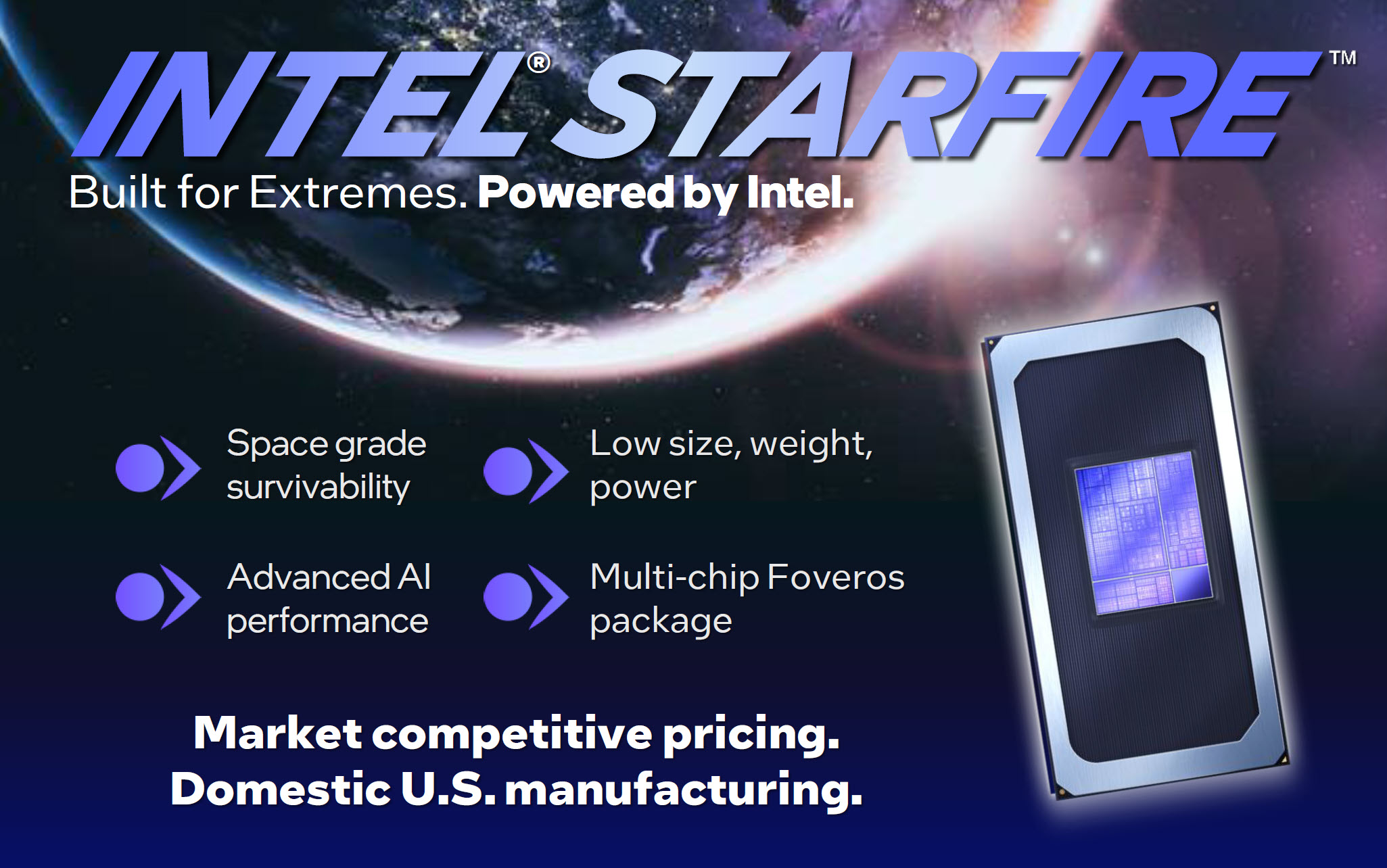
Intel has detailed Starfire, a new space grade system on chip designed for spacecraft and United States government applications that require dependable operation under radiation exposure, extreme temperatures, and strict power constraints. The platform combines Intel 18A processing technology, Intel 3 graphics, dedicated AI acceleration, and Foveros packaging inside a compact multi chip design manufactured in the United States.
According to the official Intel Starfire product brief, the processor is designed to deliver space grade survivability and advanced AI performance while meeting the size, weight, and power restrictions associated with orbital systems. Intel is preparing 2 configurations, identified as Low Power and Performance models, with initial samples scheduled for Q3 2026.
Both models use an 8 core CPU configuration consisting of 4 Performance cores and 4 Low Power Efficient cores. The Low Power version operates its Performance cores at 1.0 GHz and its Low Power Efficient cores at 850 MHz. The Performance version increases those frequencies to 3.1 GHz and 2.1 GHz respectively. The architecture is closely related to Intel Panther Lake, although Starfire has been adapted for demanding aerospace environments rather than consumer laptops.
Graphics processing is handled by 4 Xe3 cores with 64 execution units manufactured using Intel 3 technology. The integrated graphics operate between 800 MHz and 1.0 GHz on the Low Power model, while the Performance version reaches 2.0 GHz. Intel also integrates a 3 tile neural processing unit manufactured on Intel 18A, helping the complete platform deliver up to 45 TOPS within a 10W power envelope or up to 75 TOPS at 35W.
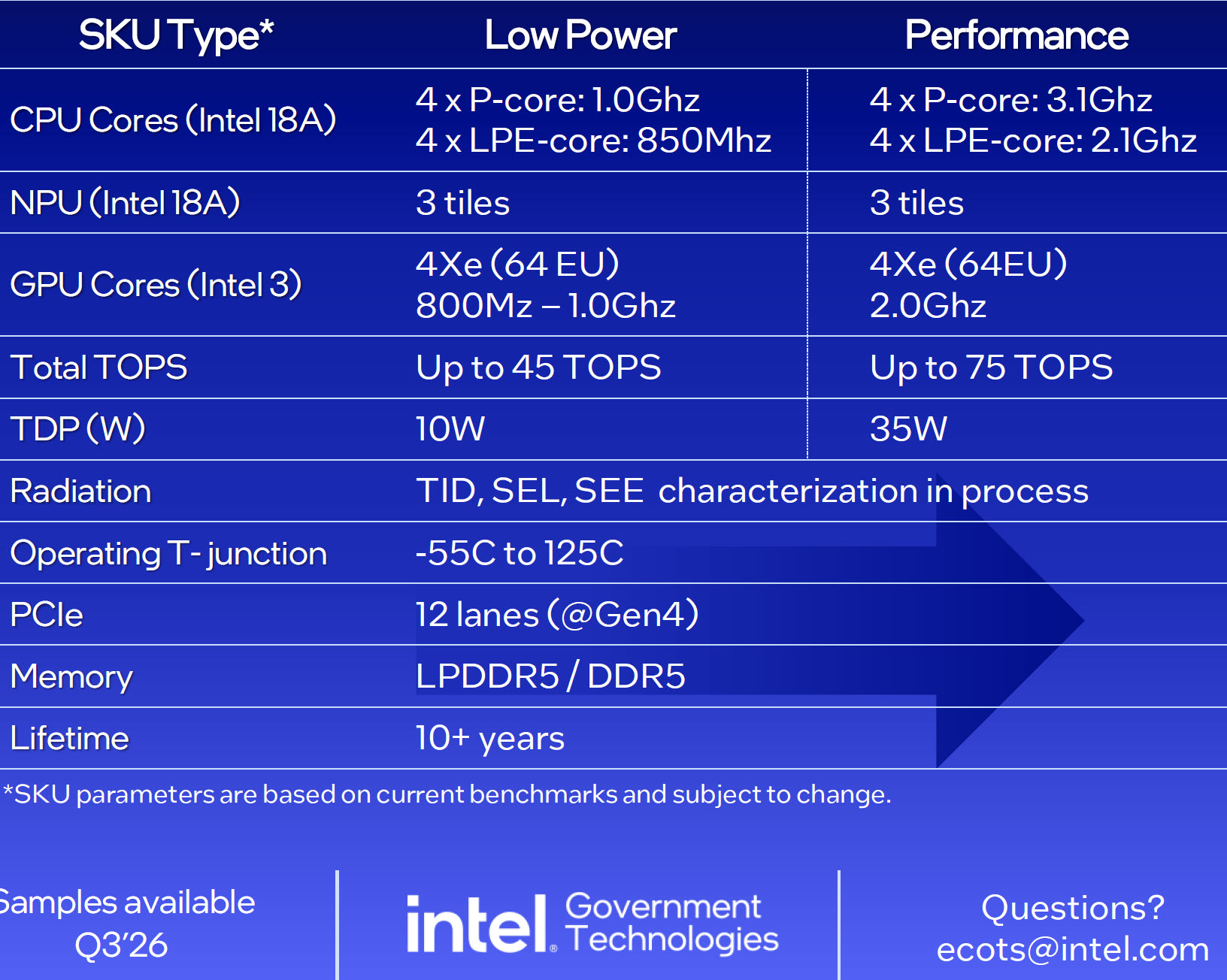
Starfire supports DDR5 and LPDDR5 memory alongside 12 PCIe 4.0 lanes. Intel lists an operating junction temperature range from minus 55 degrees Celsius to 125 degrees Celsius, allowing the processor to function across the extreme thermal conditions encountered during launch, orbit, and long duration missions. The company is also targeting a product lifetime exceeding 10 years, which is important for aerospace platforms that cannot be regularly serviced or upgraded after deployment.
Radiation testing covers Total Ionizing Dose, Single Event Latch Up, and other Single Event Effects. However, Intel currently lists this characterization as work in progress, meaning Starfire should not yet be described as fully radiation qualified. Final specifications may also change before commercial availability. The original product information was highlighted by X86 is dead and back.
Intel Starfire TID & SEE perfect for Star...https://t.co/2p1LtjsN5z pic.twitter.com/AV4KmIADT1
— X86 is dead&back (@x86deadandback) July 13, 2026
The use of Intel 18A is particularly significant because smaller and more advanced manufacturing processes can be more vulnerable to radiation related data corruption than older semiconductor nodes traditionally used for spacecraft. Intel must therefore combine its RibbonFET transistors and PowerVia backside power delivery with additional architectural protection and system level hardening. The broader development of this manufacturing platform as Intel 18A P entered risk production, highlighting the company’s effort to expand 18A across AI, data center, government, and high performance computing markets.
Starfire represents more than another specialized Intel processor. It demonstrates how modern AI computing is moving beyond data centers and personal computers into spacecraft capable of processing sensor information, navigation data, and imagery directly in orbit. Up to 75 TOPS could allow future satellites to analyze information locally instead of transmitting every raw data stream back to Earth.
The most important factor will be qualification rather than theoretical performance. Space systems prioritize predictable operation, radiation tolerance, thermal stability, and long term availability above benchmark results. Intel has presented a compelling technical foundation, but Starfire will need to complete radiation testing and prove that an advanced 18A platform can deliver the reliability expected from considerably older and more established aerospace processors.
Could Intel Starfire accelerate AI processing in space, or will aerospace operators continue favoring older semiconductor technologies with longer reliability records?
